BIA-ALCL vs breast-implant capsule SCC: different cancers, different evidence records
BIA-ALCL is a lymphoma usually found in fluid or capsule around an implant; reported breast-implant capsule SCC is an epithelial cancer in capsule tissue. Neither is ordinary breast cancer or diagnosed by routine silent-rupture imaging. A symptom-triggered workup needs implant, imaging, fluid, and pathology records.
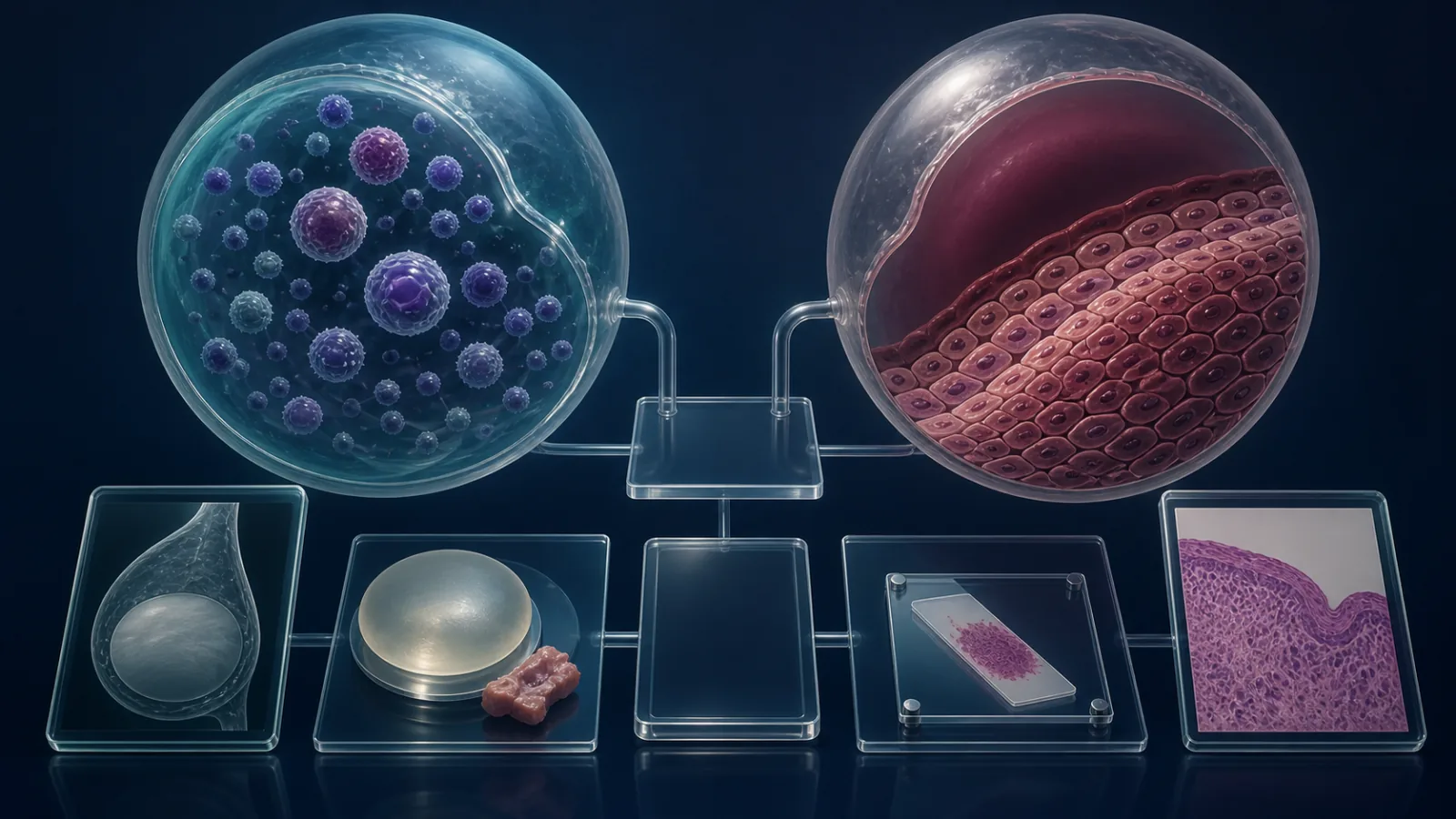
BIA-ALCL and squamous cell carcinoma reported in the capsule around breast implants are different cancers. BIA-ALCL is a T-cell lymphoma usually identified in peri-implant fluid or capsule; capsule SCC is an epithelial malignancy described in capsule tissue. They are not ordinary breast cancer, do not share a proven incidence or risk-factor profile, and are not ruled out by routine imaging used for silent silicone-implant rupture. New swelling, a mass, pain, hardening, skin change, or another implant change calls for a symptom-specific clinical and pathology pathway.123
The goal is not to make every implant change sound like cancer. It is to keep distinct conditions from being collapsed into “implant illness” or a generic ultrasound.
Keep four questions separate
| Question | Primary job | Do not substitute |
|---|---|---|
| BIA-ALCL | Evaluate a specific lymphoma associated predominantly with textured implant or tissue-expander history | A routine rupture image or ordinary breast-cancer screen |
| Capsule SCC and other reported tumors | Evaluate a distinct capsule-tissue malignancy with still-limited incidence and risk-factor data | BIA-ALCL testing alone |
| Implant rupture or deflation | Assess device-shell integrity and local implant findings | Cancer pathology |
| Breast cancer screening or diagnosis | Evaluate breast tissue under age-, risk-, symptom-, and imaging-specific pathways | Implant-surveillance imaging alone |
The implant MRI-versus-ultrasound article owns silent-rupture surveillance. A cancer question requires fluid or tissue diagnosis when clinically indicated.
BIA-ALCL has a specific cell and specimen pathway
FDA describes BIA-ALCL as a type of non-Hodgkin lymphoma, not breast cancer.1 Common presentations include persistent swelling, a mass, or pain near the implant, often with fluid collection or capsule findings. The agency advises clinicians evaluating suspected cases to collect fresh seroma fluid and representative capsule tissue for appropriate pathology, including CD30 and ALK characterization.1
That means:
- the fluid should not be discarded without the planned laboratory pathway;
- the laboratory needs the implant history and clinical concern;
- cytology, cell block, immunohistochemistry, flow cytometry, histology, and culture answer different questions; and
- a negative test is interpretable only if the right specimen and method were used.
Do not infer diagnosis from a late seroma photograph or a CD30 result without the complete pathology interpretation.
Capsule SCC is not “the same thing but rarer”
FDA’s 2023 communication describes reports of SCC arising in the capsule around implants and says incidence and risk factors remain unknown.2 Reported cases have included pain, swelling, lumps, and skin discoloration, but symptoms are not specific. Diagnosis in reports was generally established through pathology of capsule tissue.
FDA also notes limits in medical-device-report data, including potential duplicates, underreporting, and the absence of a denominator, so raw report counts cannot produce an incidence rate.2 The AEMS-and-MAUDE guide explains that denominator problem.
Do not apply BIA-ALCL’s texture association or testing algorithm to SCC unless an authoritative source specifically supports the step.
Implant surface and history can be missing from memory
For BIA-ALCL, FDA states the risk is higher with textured-surface implants than smooth-surface implants.1 A current smooth implant does not by itself reconstruct the entire device history; a person may have had prior expanders or implants.
Collect:
- every implant and tissue expander;
- manufacturer, model or style, fill, shell surface, size, serial or lot;
- implantation and removal dates;
- operative reports and placement planes;
- prior seroma, contracture, infection, rupture, or revision;
- device cards and manufacturer tracking;
- imaging; and
- pathology from prior capsule or fluid.
If the record is missing, request it from the surgeon, facility, and manufacturer rather than guessing from shape or year.
Routine removal is not FDA’s asymptomatic recommendation
FDA does not recommend removing implants solely because an asymptomatic person is concerned about SCC, other lymphomas, or BIA-ALCL.12 That bounded statement is not a promise that no risk exists and is not an instruction for a symptomatic individual.
When an operation is considered, diagnosis can change its extent. The capsulectomy-terms guide explains why implant-only, partial, total, total intact, and en bloc operations are not synonyms.
Build the diagnostic chain before scheduling explant
An imaging center, surgeon, pathologist, and oncologist may each hold different parts. Assign one clinician to reconcile them.
Report type is not incidence
FDA uses medical-device reports, published literature, postapproval studies, registries, and other sources for postmarket surveillance.4 A report can identify a signal without proving causation or frequency. Literature cases may overlap with reports.
When reading an online count, record:
- condition definition;
- confirmation criteria;
- report and literature deduplication;
- implant exposure denominator;
- surface and device-history completeness;
- follow-up date; and
- FDA’s latest conclusion.
Avoid comparing BIA-ALCL and SCC raw counts as if they came from identical case capture.
Preserve separate screening and surveillance schedules
Routine breast-cancer screening, diagnostic evaluation of a new breast symptom, implant rupture surveillance, and long-term monitoring after capsule surgery can all coexist. One clear scan does not reset every schedule.
Ask which clinician owns each job and how an implant can affect mammography technique or imaging interpretation. Keep results in one longitudinal record.
Route the exact question to the exact specimen
- Name the presenting change. Document side, swelling, mass, pain, hardening, skin change, timing, progression, and systemic context without diagnosing it.
- Recover every device record. List implants and expanders, surface, model, serial or lot, dates, planes, revisions, and prior fluid or capsule findings.
- Separate diagnostic jobs. Keep BIA-ALCL, capsule SCC or other tumors, rupture, infection, contracture, and breast-tissue cancer as distinct questions.
- Preplan fluid and tissue. Specify imaging, aspiration, specimen containers, cytology, immunohistochemistry, flow, culture, histology, and result owners.
- Let diagnosis determine surgery. Do not schedule a generic explant before the clinical and pathology information needed to choose operative scope is preserved.
- Maintain surveillance and reporting. Keep pathology, treatment, implant monitoring, breast screening, registry, and FDA reporting pathways distinct and current.
The decisive question is: “Which exact capsule, fluid, device, or breast-tissue diagnosis is being evaluated, and have the implant history and specimen plan been built to answer that question before surgery changes the evidence?”
Sources
- U.S. Food and Drug Administration. Questions and Answers about BIA-ALCL. BIA-ALCL identity, implant-surface association, common presentation, fluid and capsule testing, recommendations, and record questions. Accessed .
- U.S. Food and Drug Administration. Reports of Squamous Cell Carcinoma in the Capsule Around Breast Implants. FDA's bounded report summary, unknown incidence and risk factors, symptoms, pathology, imaging, recommendations, and MDR limitations. Accessed .
- U.S. Food and Drug Administration. Risks and Complications of Breast Implants. Current implant risks, BIA-ALCL, SCC and other capsule tumors, systemic-symptom evidence, rupture, and future operations. Accessed .
- U.S. Food and Drug Administration. Breast Implant Postmarket Safety Information. FDA postmarket surveillance, medical-device reports, studies, registries, and ongoing safety evaluation. Accessed .