Buccal fat removal vs facial slimming: identify the tissue before choosing permanence
Buccal fat removal permanently excises part of a deep cheek fat pad through an intraoral incision. It cannot substitute for reducing jaw-muscle width, adding projection, tightening skin, or treating submental fat. Identify the tissue and model future facial-volume change before permanent removal.
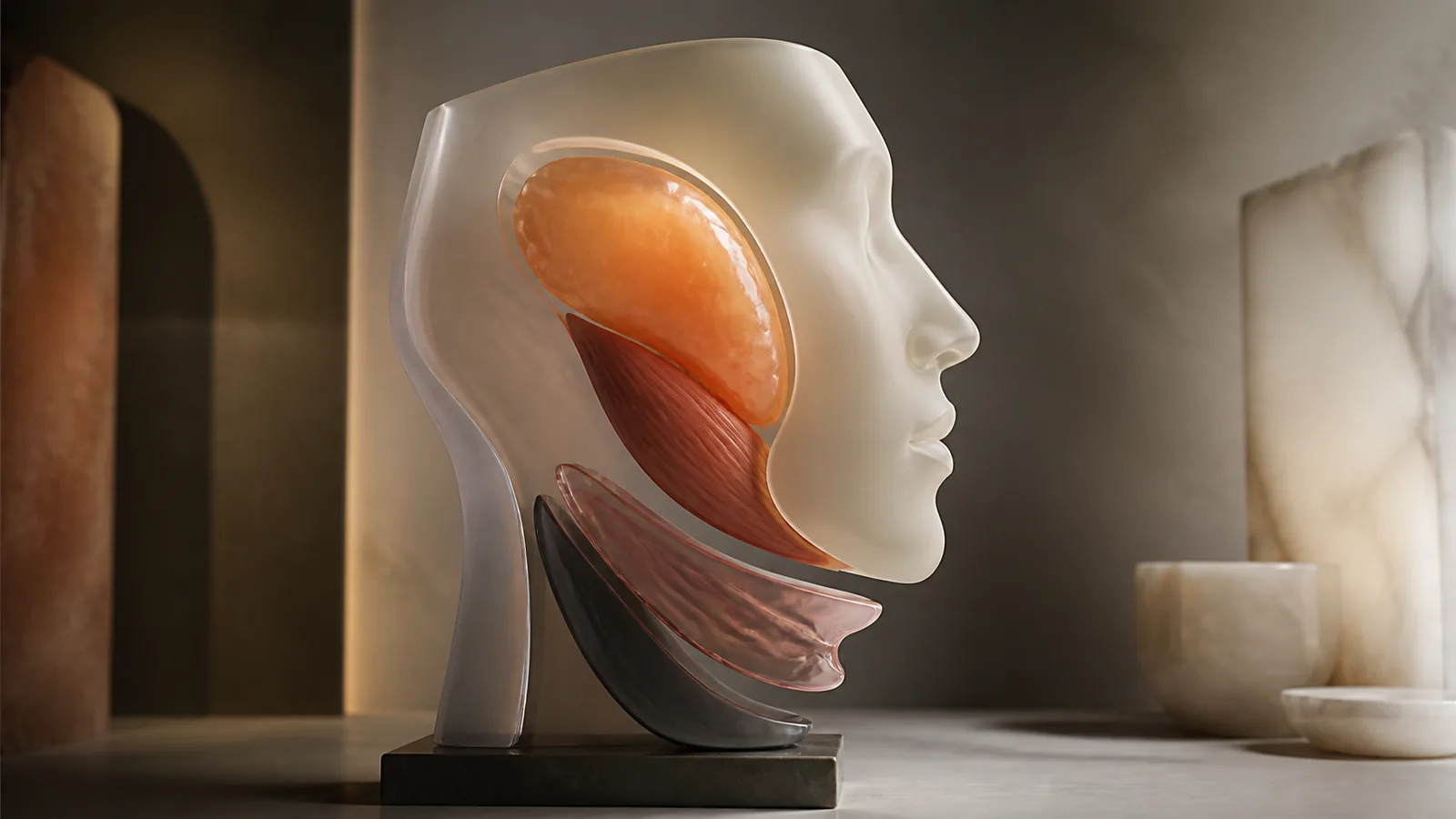
Buccal fat removal is a permanent surgical reduction of part of the deep buccal fat pad through an incision inside the mouth. It is not a general treatment for a “round face”: lower-face width may instead come from masseter muscle, bone, superficial fat, skin laxity, submental tissue, swelling, or proportions created elsewhere. Identify the tissue and model future facial-volume change before choosing irreversible removal.14
The social-media verb “snatch” hides anatomy. A useful consultation translates the desired change into a location, tissue plane, movement, and profile—then asks whether removing, adding, relaxing, tightening, or doing nothing best fits that target.
Buccal fat is one deep cheek compartment
The buccal fat pad is a specialized deep fat structure with extensions and relationships to the facial nerve, parotid duct, muscles, and vessels.4 Buccal lipectomy generally accesses it through the mouth and removes a selected portion. It is not the same as superficial cheek fat, a jowl, the under-chin compartment, or the masseter muscle.
| Concern described | Tissue question | Different route that may enter the discussion |
|---|---|---|
| Fullness below the cheekbone | Is deep buccal fat actually dominant, and is it symmetric? | Observation, conservative buccal excision, or adjustment of surrounding proportions |
| Wide lower jaw | Is width muscular, bony, parotid-related, or soft tissue? | Masseter assessment, structural planning, or no cosmetic intervention |
| Weak chin or jawline | Does limited projection make the midface look wider? | Chin implant or filler, structural surgery, or submental plan |
| Jowls or lax skin | Is descent or skin quality the concern rather than fat volume? | Lifting, tightening, resurfacing, or volume support depending on anatomy |
| Fullness under the chin | Is the target preplatysmal/submental fat, skin, muscle, or anatomy? | Submental injection, device, liposuction, or surgical contouring |
The same front-view outline can arise from different structures. Photographs alone cannot reliably separate all tissue planes; examination, movement, palpation, dental or skeletal context, and sometimes imaging change the plan.
Removal is permanent even though the face keeps changing
Excised buccal fat does not regenerate as the same intact pad. Meanwhile, facial fat compartments, skin, bone, muscle, teeth, and weight can change over decades. A contour that looks sharper soon after surgery may look overly hollow later—or may remain proportionate. Future appearance cannot be guaranteed.
ASPS’s August 2026 discussion of viral facial trends emphasizes that permanent fat removal must be evaluated against natural facial aging and individual anatomy rather than a transient aesthetic.2 That does not prove buccal fat removal inevitably “ages” every face. It supports testing the design across time.
Ask the surgeon to model at least three views:
- current face at stable weight;
- plausible volume change with aging or weight loss; and
- the result if no filler, fat grafting, lift, or revision is ever added.
A plan that depends on permanent maintenance filler should price and disclose that dependency before surgery.
Facial slimming options use different verbs
Masseter neuromodulator treatment reduces muscle activity and can reduce muscle bulk over time in selected people; it does not remove buccal fat or narrow bone. Dermal filler adds volume or projection and may create a more balanced outline without making the face physically smaller. Skin-tightening procedures aim for tissue contraction or remodeling within device- and anatomy-specific limits. Submental treatments target the under-chin region, not the deep cheek.
“Buccal fat alternative” is therefore often the wrong comparison. Use a verb:
- remove a defined fat compartment;
- relax a hypertrophic muscle;
- add chin, cheek, or jaw projection;
- reposition descended tissue surgically;
- tighten selected skin or soft tissue;
- reduce submental fat; or
- camouflage a proportion with styling or makeup.
The facial-balancing guide helps convert a broad marketing phrase into measurable profile and proportion changes.
Published evidence is limited and heterogeneous
A 2025 systematic review and meta-analysis synthesized reported complication prevalence after buccal fat removal while identifying important limitations in the available evidence.3 It cannot identify a universally ideal candidate, settle long-term aesthetic outcomes, or prove superiority over other contouring paths.
Demand study matching. Was fat removal isolated or combined with facelift, liposuction, implants, filler, or other surgery? Were outcomes standardized photographs, measured contour, patient report, or surgeon rating? How long was follow-up? Were late hollowing and revision captured?
Before-and-after images taken weeks after surgery may include swelling, weight change, makeup, lighting, focal length, and companion procedures. Request unretouched standardized images at several time points with every simultaneous procedure disclosed.
“How much is removed?” is a design question, not a contest
The pad’s size, accessibility, and contribution vary. Removing the entire visible portion or matching a social-media volume is not an evidence-based goal. Ask what portion and extension the surgeon intends to expose, how symmetry is assessed, and what endpoint stops removal.
A “small amount” needs an operative description. If tissue is removed, the record should state what was done on each side and whether unexpected anatomy changed the plan.
Risks belong beside the aesthetic goal
ASPS lists risks including asymmetry, bleeding, infection, injury to the facial nerve or salivary duct, numbness, prolonged swelling, contour irregularity, poor healing, persistent pain, and the possibility of revision.1 The intraoral route also makes oral care and infection instructions part of recovery.
Ask which symptoms are expected, which require same-day contact, and where urgent evaluation occurs. Identify who is available after hours and whether the operating surgeon personally assesses a suspected duct, nerve, bleeding, or infection problem.
If simultaneous procedures are planned, separate the risks and recovery of each. A lower-face liposuction or implant can change swelling, anesthesia, garment, diet, and complication ownership.
Reversal is addition, not restoration
If a face later looks hollow, options may include filler, autologous fat grafting, or another reconstructive plan. These add material or volume; they do not restore the original intact fat pad and its anatomy. Each adds cost, risk, maintenance or variability, and its own aesthetic limitations.
This is why conservative design matters. A temporary projection trial with filler can sometimes clarify proportions, but filler has its own FDA labeling and vascular risks and is not a guaranteed simulation of an implant or fat-removal result.
Price the initial surgery, anesthesia, facility, medicines, follow-up, time away from usual activity, management of complications, and plausible revision. Avoid a quote that treats future filler as an invisible add-on.
Use an anatomy-first decision sequence
- Name the exact contour. Mark the fullness or proportion in frontal, oblique, profile, smiling, and resting views.
- Identify the tissue. Separate deep buccal fat, superficial fat, muscle, bone, gland, skin, submental tissue, swelling, and optical proportion.
- Compare verbs. Ask whether removal, relaxation, addition, repositioning, tightening, submental reduction, or observation addresses that tissue.
- Model time. Review stable weight, future loss, aging-related volume change, and the appearance if no maintenance or revision occurs.
- Audit surgeon and setting. Verify license, relevant training, facility and anesthesia records, operative roles, after-hours care, and complete estimate.
- Protect revision options. Use a conservative endpoint and understand that later filler or grafting adds volume rather than restoring the original pad.
The decisive question is: “Which tissue is actually creating the contour I want to change, and why is permanent removal of buccal fat a better match than changing muscle, projection, skin, or another fat compartment?”
Sources
- American Society of Plastic Surgeons. Buccal fat removal safety. Professional patient-safety overview of surgical risks, asymmetry, injury, infection, contour issues, and informed consent. Accessed .
- American Society of Plastic Surgeons. Is viral beauty aging well? Plastic surgeons on the face trends filling your feed. August 2026 professional discussion of permanent fat removal, facial-volume change over time, and individualized rather than trend-led planning. Accessed .
- Journal of Cranio-Maxillo-Facial Surgery. Prevalence of complications of buccal fat removal: A systematic review and meta-analysis. 2025 synthesis of reported complication prevalence and limitations of the available heterogeneous evidence base. Accessed .
- Journal of Maxillofacial and Oral Surgery. Buccal Fat Pad: Anatomical Review and Evaluation of its Aesthetic Removal. 2026 anatomical review and evaluation of aesthetic removal, including the buccal fat pad's relationships to nearby structures. Accessed .