Compression boots for recovery vs medical pneumatic compression
Recovery boots, condition-specific medical pumps, and perioperative compression systems may all inflate around a limb, but they are not interchangeable. Compare the exact device, FDA record, intended use, sleeve, pressure sequence, screening, protocol, monitoring, outcome, and responsible clinician.
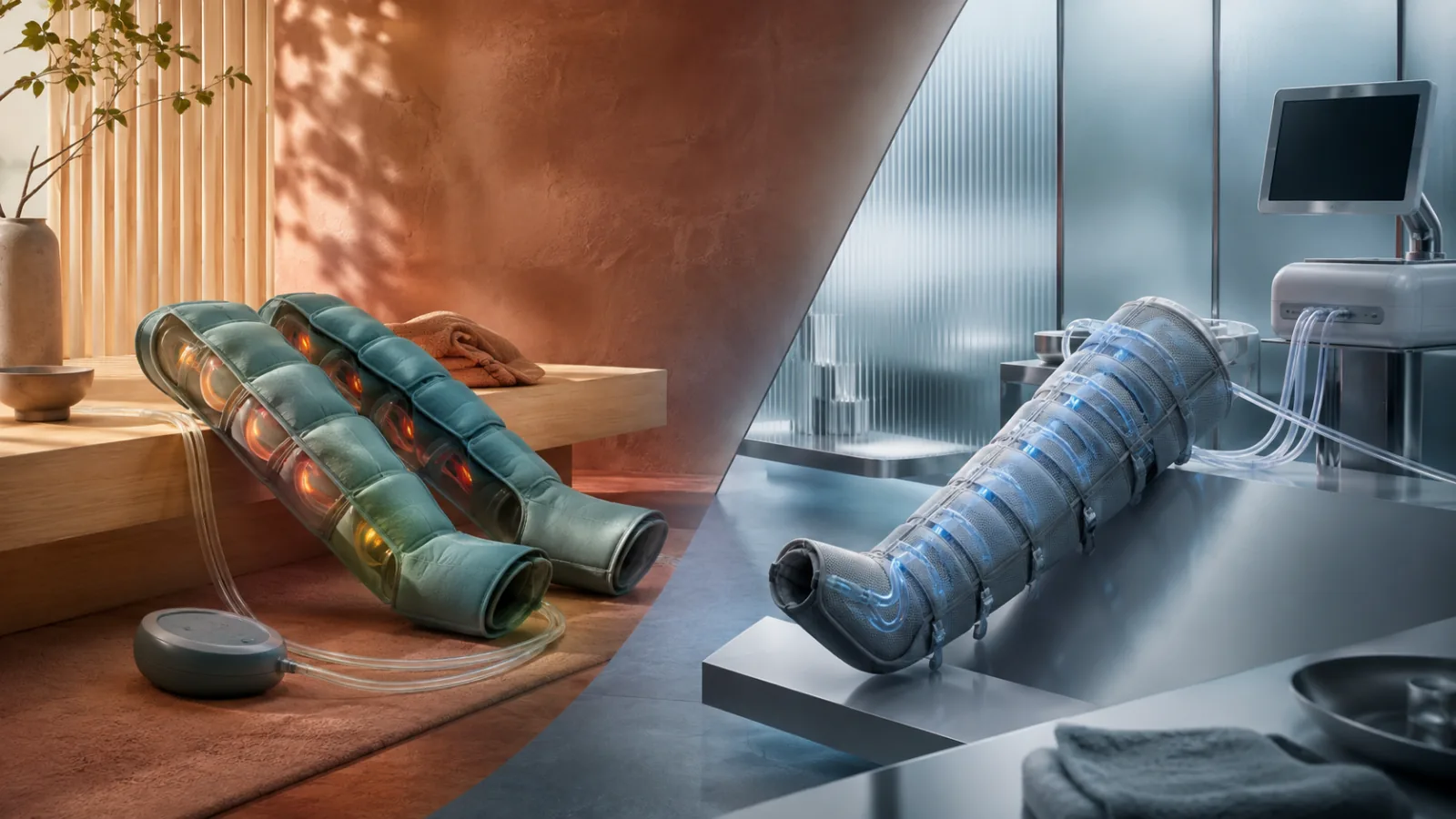
Inflatable compression boots can look similar while serving different jobs. A consumer recovery system may be cleared for temporary relief of minor muscle aches and temporary circulation increase; a prescribed pump for lymphedema or chronic venous insufficiency with venous stasis ulcers and a prescription device cleared for DVT prevention have different indications, protocols, screening, and owners. Never transfer a claim from one device or setting to another.124
The comparison begins with the label and the clinical question, not how strong the squeeze feels. This article does not prescribe compression or determine whether a device is safe for an individual.
Put the exact device into one of three lanes
| Lane | Primary job | Record that controls the claim |
|---|---|---|
| Consumer or athletic recovery | Temporary recovery, soreness, or circulation claims within the exact device's intended use | FDA clearance summary or other status, labeling, sleeve, pressure and program |
| Condition-specific home therapy | Management of a diagnosed condition such as lymphedema or chronic venous insufficiency with venous stasis ulcers under a care plan | Prescription, diagnosis, device order, medical-device labeling, training, monitoring, and follow-up |
| Perioperative prophylaxis | One component of a facility's procedure-specific clot-prevention plan | Facility protocol, device and sleeve, timing, monitoring, mobility and medication plan |
The same brand family can have different models, sleeves, controllers, programs, and cleared uses. Photograph the label plate and record manufacturer, model, serial or other identifier, sleeve type, body region, controller, and software version when relevant.
FDA clearance must match the wording
An FDA 510(k) summary for one Normatec leg system describes product-specific indications including temporary relief of minor muscle aches and pains and temporary increase in circulation to the treated area.1 It also includes contraindication and warning information. That record is not a category-wide authorization for detoxification, lymphatic treatment, faster healing, prevention of blood clots, or treatment of a vascular disease.
A different FDA 510(k) record covers the prescription Cirona 6300 system and includes DVT-prevention indications.4 That device-specific record shows why a perioperative prevention claim must be matched to the exact cleared system, prescription, and facility or clinician protocol; it cannot be borrowed by a consumer recovery boot.
Ask a seller to provide the device’s own FDA record and point to the exact intended-use language supporting the advertised claim. “FDA cleared technology” without manufacturer, model, submission number, and indication is incomplete.
If a spa uses a device as part of post-procedure recovery, ask whether the procedural clinician ordered or approved it, which region is treated, when it begins, what pressure sequence is used, what findings stop it, and who evaluates swelling or pain. Do not assume a recovery lounge can inherit a hospital protocol.
Medical coverage is not a performance badge
CMS’s national coverage determination addresses pneumatic compression devices for lymphedema and, under defined criteria, chronic venous insufficiency with venous stasis ulcers; it does not treat athletic recovery as the same benefit and does not guarantee payment for every patient, device, or plan.2 Coverage criteria are not a general ranking of device quality.
For prescribed use, obtain the diagnosis, order, device code and model, sleeve configuration, trial or prerequisite records, training, follow-up, supplier terms, rental or purchase structure, and the clinician who monitors response. Ask the health plan and supplier—not the wellness seller—to confirm current benefits and documentation.
Pressure and sequence are part of the dose-like protocol
“Compression level” alone is not enough. Devices may vary in chamber number, overlap, distal-to-proximal sequencing, gradient, inflation and deflation timing, program length, garment fit, and whether pressure is measured or estimated. A higher number does not prove a better or more therapeutic session.
Ask who selects the program and how fit is checked. Record skin condition, sensation, known vascular or cardiac conditions, recent surgery, pain, swelling, wounds, infection, implanted devices when relevant, and every device-specific contraindication or warning reviewed by the responsible clinician.
Recovery evidence needs an endpoint
Exercise-recovery studies use varied devices, populations, protocols, timing, comparators, and outcomes. A current systematic review found heterogeneous evidence rather than a single universal effect.3 Ask whether the advertised benefit is perceived soreness, limb circumference, blood-flow measurement, performance restoration, a biomarker, or injury prevention—and whether the study tested this device and complete protocol.
A short-term change in a surrogate or subjective score is not proof of faster tissue healing, better surgical results, or lower clot risk. Keep comfort and preference separate from medical outcomes.
Price use, ownership, and escalation
For a spa session, record duration, sleeve, program, cleaning, staff supervision, screening, and what happens if the session is stopped. For purchase or rental, include garment replacement, controller warranty, app or subscription, return policy, servicing, and clinical follow-up. For post-surgical use, ask whether it is included in the surgical quote and who coordinates it with garments, mobility, and any medication plan.
- Name the lane. State whether the job is temporary recovery, management of a diagnosed condition, or perioperative prevention.
- Match the exact device. Record model, sleeve, FDA record, intended use, warnings, controller, and protocol.
- Verify screening and ownership. Identify who reviews contraindications, chooses settings, monitors response, and handles new pain, swelling, skin change, or other symptoms.
- Interrogate the outcome. Match every claim to the tested population, comparator, endpoint, duration, and device.
- Calculate total commitment. Include sessions, rental or purchase, garments, replacement, subscription, follow-up, warranty, and return terms.
The decisive question is: “What exact device and intended use support this session, which lane is it operating in, who selected the pressure and sequence, and who owns a new symptom or an unmet medical goal?”
Sources
- U.S. Food and Drug Administration. Normatec 3 Legs 510(k) Summary, K233536. Used as a product-specific example of intended-use wording and contraindication information for a consumer-facing recovery system. Accessed .
- Centers for Medicare & Medicaid Services. Pneumatic Compression Devices. Used to distinguish medical pneumatic-compression coverage for defined conditions from general recovery use; not used as treatment advice or a coverage promise. Accessed .
- PubMed. Effects of lower-limb intermittent pneumatic compression on sports recovery: A systematic review and meta-analysis. Used for the limits and heterogeneity of recovery evidence and outcomes. Accessed .
- U.S. Food and Drug Administration. Cirona 6300 Disposable Deep Vein Thrombosis Prevention System 510(k) Summary, K151189. Used as a product-specific example of a prescription pneumatic-compression device cleared with DVT-prevention indications; not generalized to consumer recovery boots or every perioperative protocol. Accessed .