Cuffless blood-pressure wearable vs arm cuff: an estimate is not automatically a clinical measurement
A cuffless blood-pressure estimate should not replace a validated upper-arm monitor for diagnosis or medication decisions unless the exact feature has an FDA authorization and labeling supporting that use. Check calibration, drift, validation, intended use, and the consequence of a wrong reading.
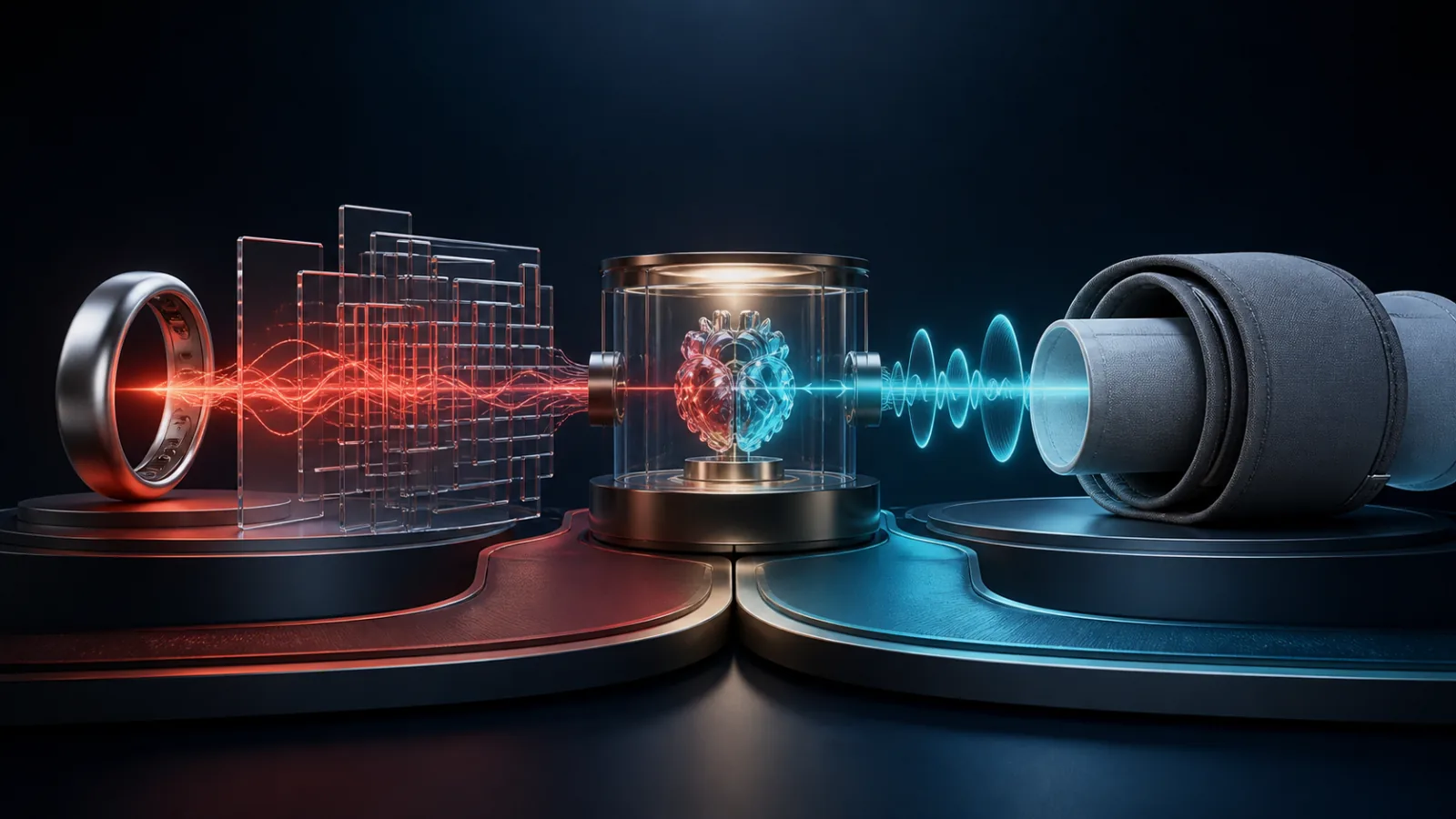
A cuffless watch, ring, patch, phone, or optical sensor should not be treated as a substitute for a validated upper-arm blood-pressure monitor merely because it displays systolic and diastolic numbers. Verify whether the exact hardware-and-software feature has FDA authorization for its claimed use, how it is calibrated, whether accuracy persists across time and real-world conditions, and what decisions its labeling permits. Do not use an unauthorized estimate to diagnose hypertension or change medication.123
This is a product-specific answer, not a declaration that cuffless measurement can never be useful. The technology may support research, repeated trend collection, or an authorized role. The display format alone does not establish measurement quality.
A number can come from very different physical methods
An upper-arm oscillometric monitor inflates a cuff, senses pressure oscillations as it deflates or adjusts pressure, and derives systolic and diastolic values. A cuffless system may use optical pulse signals, tonometry, pulse-transit or arrival timing, ECG, motion, demographic inputs, or a combination processed by an algorithm. Some require periodic calibration against a cuff; others claim not to.
| System | Primary evidence question | Common failure mode to investigate |
|---|---|---|
| Validated upper-arm cuff | Was the exact model validated in an appropriate protocol, and does the cuff fit the user's arm? | Wrong cuff size, position, preparation, movement, or unvalidated model |
| Calibration-dependent cuffless device | How often and under what conditions must it be recalibrated, and what happens as physiology or sensor fit changes? | Calibration drift or circular comparison to one imperfect reference reading |
| Calibration-free cuffless device | What independent reference testing supports accuracy across people, activities, positions, pressures, and time? | Hidden population model or reduced accuracy outside the development cohort |
| Wellness trend or alert | Does it claim a general signal, hypertension screening, or actual systolic/diastolic measurement? | A wellness disclaimer beside medical-looking numbers and treatment suggestions |
The FDA classifies noninvasive blood-pressure measurement systems as medical devices, while exact pathways and controls depend on product and intended use.4 A seller cannot turn a measurement claim into ordinary wellness by putting it on a watch face.
FDA status belongs to the exact feature
FDA warned consumers in 2025 not to use unauthorized devices or features that claim to measure blood pressure, including features in smartwatches and smart rings, because inaccurate readings can lead to delayed care or inappropriate treatment decisions.1 Look up:
- legal manufacturer;
- product and model;
- hardware generation;
- app and algorithm version;
- feature name;
- FDA decision number;
- intended use and population;
- prescription or over-the-counter status;
- required compatible phone or accessory; and
- labeling limitations and calibration instructions.
An FDA establishment registration, product listing, patent, study registration, or “FDA-compliant” claim is not marketing authorization. Authorization for a pulse, ECG, rhythm, or hypertension-notification feature is not automatically authorization to display blood-pressure measurements.
Use the FDA-status guide to distinguish approval, clearance, De Novo authorization, listing, and registration. If a feature is described only as general wellness, apply the wellness-product boundary rather than translating that phrase into FDA review.
Validation has to challenge the algorithm
FDA’s January 2026 cuffless-device document is draft guidance, not a final binding rule or a product authorization. It is still useful because it identifies the performance questions the agency considers important: reference method, subject diversity, blood-pressure range, body position, activity, environmental conditions, calibration, repeatability, and longitudinal performance.2
For any study, ask:
- Was the comparator an appropriate reference measurement taken close enough in time?
- Were low, normal, and high pressures represented?
- Did participants vary in age, skin pigmentation, wrist or finger anatomy, body size, rhythm, and relevant health conditions?
- Were motion, exercise, sleep, posture, temperature, and everyday wear tested?
- Were results reported as bias and individual limits of agreement rather than correlation alone?
- Were calibration and validation performed on independent data and participants?
- How did error change weeks or months later?
- How often did the device fail to produce a reading?
A high correlation can coexist with errors that matter for an individual. A large number of readings does not correct systematic bias; it can create a very precise picture of the wrong level.
Calibration is an ongoing dependency
When a cuffless device is calibrated to a cuff reading, the reference reading imports its own technique, cuff-fit, and timing errors. The algorithm may then perform best near the calibration pressure and under similar conditions. Ask what changes require recalibration: time interval, new user, weight change, sensor move, illness, medication change, firmware update, or reset.
Keep the calibration record:
- validated cuff make, model, and size;
- arm, body position, rest period, and time;
- repeated reference readings;
- wearable placement and signal-quality indicator;
- software version;
- date and calibration interval; and
- failure or out-of-range message.
“No cuff ever” removes the inconvenience but raises a different question: how the model anchors an individual’s absolute pressure and maintains that anchor.
A good arm cuff also requires good technique
An upper-arm device is not automatically accurate because it inflates. The American Heart Association recommends an automatic, validated upper-arm monitor with the correct cuff size and describes preparation and positioning: avoid relevant short-term triggers, rest quietly, support the back and arm, keep feet flat, place the cuff on bare skin, and take repeated readings as directed.5
Bring a home monitor to a clinical visit so staff can confirm fit, technique, and agreement with the office process. Record raw readings and timing rather than only an app’s weekly score. A single home or office reading does not by itself describe the full pattern.
Trends, notifications, and measurements have different jobs
| Output | Potential job | Do not silently convert it into |
|---|---|---|
| Change-from-baseline trend | Prompt to repeat with a validated method or review conditions | An absolute systolic/diastolic diagnosis |
| Hypertension-risk notification | Encourage appropriate confirmatory evaluation under exact labeling | Continuous blood-pressure measurement |
| Spot systolic/diastolic display | Measurement only within the product's demonstrated and authorized use | Permission to change medication independently |
| Nighttime pattern | Research or clinical context if validated for sleep and position | A substitute for an indicated ambulatory blood-pressure study |
The American Heart Association’s scientific statement emphasizes that cuffless devices introduce validation and calibration issues and that clinical adoption needs evidence fit for the intended use.3 Novel sampling frequency is valuable only when the measurement meaning survives.
Use two lanes for a safe comparison
- Define the output. Separate an absolute blood-pressure measurement, baseline trend, and risk notification; record the exact claim.
- Verify the product-specific status. Match manufacturer, model, feature, version, intended use, population, and limitations to the FDA record.
- Audit validation. Review reference method, pressure range, participant diversity, activities, longitudinal drift, individual agreement, and failed readings.
- Document calibration. Keep the reference cuff, technique, repeated readings, date, software, and conditions that trigger recalibration.
- Standardize arm-cuff confirmation. Use a validated correctly fitted upper-arm monitor with consistent preparation, posture, timing, and repeated measurements.
- Assign decisions before collecting data. State which output prompts confirmation, clinician contact, or no action; do not independently change medication from a wearable estimate.
The decisive question is: “What exact use is this cuffless feature authorized and validated for, and where is the written rule that sends an unexpected estimate to a correctly performed arm-cuff measurement and qualified review?”
Sources
- U.S. Food and Drug Administration. Do Not Use Unauthorized Devices for Measuring Blood Pressure: FDA Safety Communication. FDA warning on unauthorized wearable features that claim to measure or estimate blood pressure and the risk of incorrect readings. Accessed .
- U.S. Food and Drug Administration. Cuffless Non-Invasive Blood Pressure Measuring Devices—Clinical Performance Testing and Evaluation. January 2026 draft recommendations on calibration, reference methods, study populations, positions, activities, longitudinal performance, and reporting. Accessed .
- American Heart Association. Cuffless Devices for the Measurement of Blood Pressure. Scientific statement summary on device types, calibration, validation limitations, clinical role, and research needs. Accessed .
- U.S. Food and Drug Administration. Product Classification: Non-invasive Blood Pressure Measurement System. FDA classification record used to distinguish the regulated device category from generic wellness marketing. Accessed .
- American Heart Association. Home Blood Pressure Monitoring. Current upper-arm monitor selection, cuff fit, preparation, positioning, repeat-reading, and clinical follow-up guidance. Accessed .