Fleur-de-lis vs standard tummy tuck: the vertical scar solves a different direction
A standard tummy tuck uses a horizontal lower-abdominal pattern and advances tissue vertically; a fleur-de-lis design adds a vertical midline excision for substantial side-to-side and upper-central excess. The added vector can improve contour but creates a permanent vertical scar and T-junction.
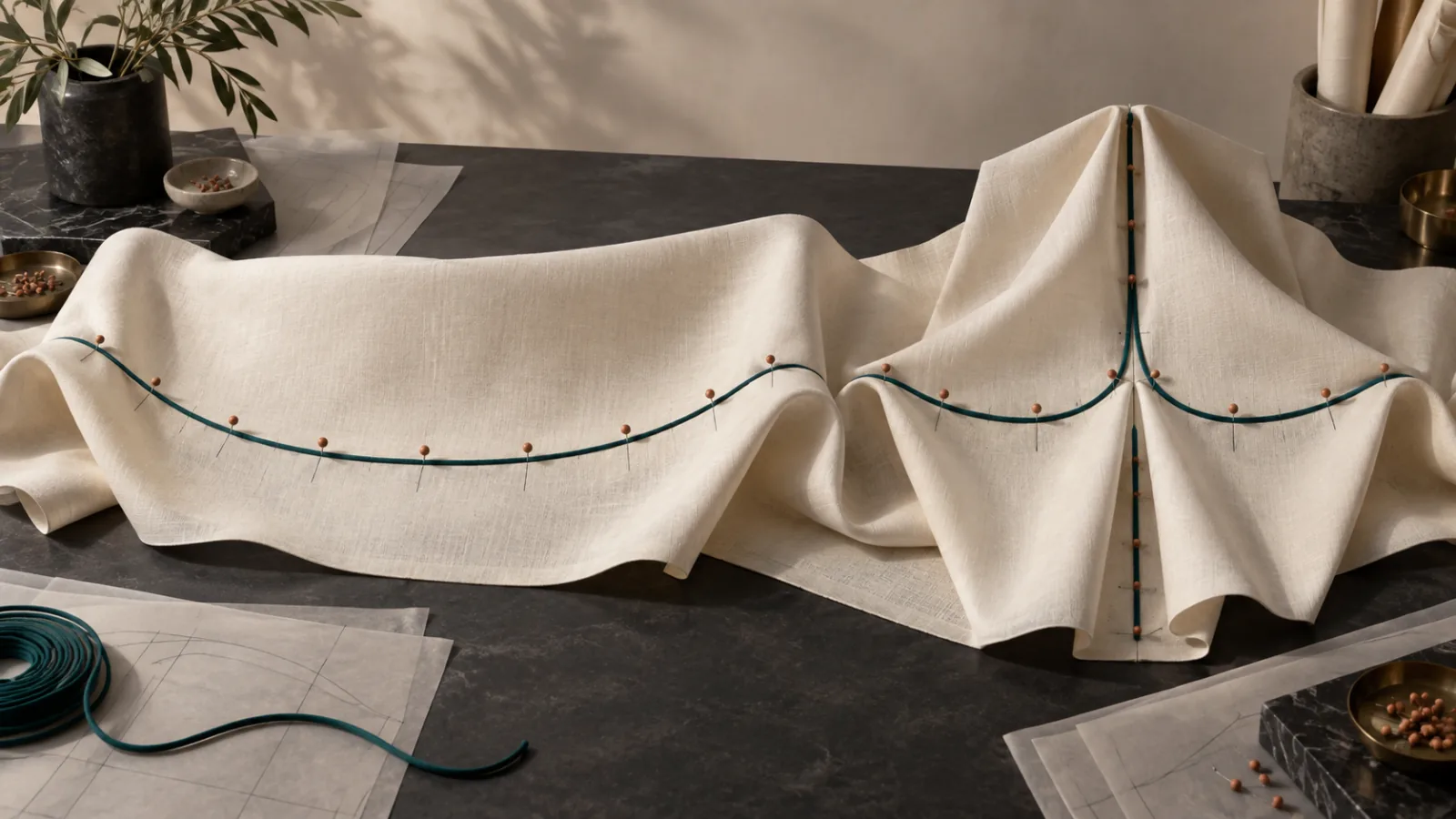
A standard transverse tummy tuck mainly removes excess through a low horizontal pattern and advances tissue vertically. A fleur-de-lis abdominoplasty adds a vertical midline excision so the surgeon can also reduce substantial side-to-side excess and upper central laxity. That extra contouring vector creates a permanent vertical abdominal scar and a T-junction; it is not simply a “more powerful” tummy tuck.123
The choice starts with the direction and distribution of redundant skin, not weight alone.4 Two people after similar weight loss can have different upper-abdominal, flank, circumferential, scar, wall, and navel anatomy.
Draw the excess in two directions
Pinch and pull demonstrations in consultation can show whether tissue moves predominantly up-and-down, side-to-side, or around the torso. The operative drawing should map what each incision captures.
| Planning dimension | Standard transverse pattern | Fleur-de-lis pattern |
|---|---|---|
| Main excision vector | Low horizontal excision with vertical advancement | Horizontal excision plus vertical midline wedge |
| Best-described target | Lower-abdominal apron and vertical laxity within anterior reach | Marked horizontal/central excess that remains after vertical advancement alone |
| Scar | Low transverse scar of variable length around the anterior trunk | Low transverse scar plus vertical midline scar meeting at a T-junction |
| Waist effect | Depends on anatomy, undermining, excision and any flank work | Added central narrowing may improve selected side-to-side redundancy |
| Not defined by the name | Navel, muscle repair, liposuction, flank extension and pannus-only removal | Those same components still require separate specification |
A fleur-de-lis is not automatically a circumferential lower-body lift. It does not by itself remove posterior waist or buttock skin. A standard tummy tuck is not automatically “mini,” and either operation may have different navel, wall, liposuction, or staging components.
The scar is part of the treatment mechanism
The vertical scar is not an accidental tradeoff. It is how side-to-side excess is removed. Ask the surgeon to draw its expected upper endpoint, relation to the navel, transverse scar, T-junction, prior scars, and swimsuit or clothing lines.
Discuss scar widening, color, elevation, asymmetry, delayed healing, T-junction breakdown, and potential revision without assuming one person’s photograph predicts another’s healing. Nicotine exposure, diabetes, nutrition, anemia, prior operations, radiation, skin folds, tension, perfusion, and aftercare can affect the wound plan.
Treomark’s surgical-scar guide explains why immature redness, hypertrophy, keloid tendency, widening, and contour tethering are different scar problems.
Muscle repair and navel work remain separate decisions
Neither incision label tells you whether rectus diastasis is present or whether plication is proposed. It does not diagnose a hernia. Ask for separate statements covering:
- skin and pannus excision;
- rectus plication or other wall work;
- hernia evaluation and responsible surgeon;
- original navel preservation, transposition, reconstruction, or removal;
- liposuction areas, volumes, sequencing, and why;
- flank or circumferential extension;
- drains, quilting or other dead-space strategy;
- pathology and specimen handling.
The diastasis-versus-tummy-tuck guide separates wall repair from the skin operation. The lower-body-lift comparison covers anterior versus circumferential reach.
Comparative evidence does not declare a universal winner
Studies of post-weight-loss patients report outcomes and complications for fleur-de-lis and transverse patterns, but selection is not random in most evidence: people receiving a vertical excision often have more extensive or differently distributed excess and different comorbidity or prior-surgery profiles.12
Do not interpret a crude wound-complication difference as proof that the incision alone caused it. Look for adjustment, definitions, follow-up, surgeon and center, concurrent procedures, weight stability, nicotine, diabetes, BMI, and patient-reported contour and scar outcomes.
Likewise, satisfaction in a selected cohort does not mean the larger scar is acceptable to everyone. The decision is preference-sensitive: contour improvement in a difficult central vector is exchanged for more scar and wound surface.
Staging may protect clarity
After major weight loss, abdomen, waist, breasts, arms, thighs, and back may all be discussed. Combining them changes operating time, positioning, blood loss, wound burden, mobility, clot risk, recovery help, and revision planning. A staged plan is not a failure; it can make each operation’s target and recovery legible.
Weight stability and nutrition are operative variables
After major weight loss, ongoing change can alter the amount and direction of excess skin, garment fit, wound tension and the value of a contour operation. Ask how the surgeon defines stability and what evidence supports the chosen timing; do not adopt a universal number of months from a marketing page.
The preoperative record may include anemia, protein or micronutrient concerns, diabetes control, medications, bariatric procedure and absorption history, nicotine exposure, sleep apnea, mobility and prior clot history. Testing should be selected for the person and operation rather than sold as a fixed panel. A normal screening value is not a nutritional warranty, and supplements should not be started or stopped without the responsible team.
The vertical and horizontal wound surfaces increase the importance of a realistic home plan. Identify who helps with transfers, drains or dressings, meals, walking, children or pets; where the patient sleeps; how stairs are handled; and who can return to the facility if a wound opens or swelling changes.
Recovery should match the scar map
The T-junction concentrates closure lines and deserves specific inspection and wound instructions. Ask where dressings and compression will cross it, how moisture and skin folds are managed, what photographs can be sent securely, and when in-person examination is required. “Keep it clean and dry” is not a complete plan for a long, mobile abdominal wound.
Mobility, breathing exercises, clot prevention, pain and nausea control, hydration and bowel function interact. The surgeon and anesthesia team should define the individualized plan; this article does not prescribe a garment, medicine or walking schedule.
When the patient travels, clarify how long they remain near the surgeon, who removes drains or sutures, where urgent imaging or emergency care occurs, and how the original team communicates with local clinicians. A low surgical quote can become a high total pathway when local wound care and travel are omitted.
Normalize the quote by operative scope
A fleur-de-lis quote may involve longer markings, additional excision, closure, scar care, and follow-up than an anterior transverse plan. Compare surgeon, assistants, facility, anesthesia, planned duration, overnight care, garments, dressings, medicines, labs, pathology, caregiver, travel, visits, wound care, and revision policy.
Do not compare package names. Attach the operative drawing and list of components to the estimate. If the surgeon expects a later scar or contour revision, ask whether it is a planned stage, possible contingency, or included service.
The decisive question
Ask: “Which direction of my skin excess remains after a transverse-only design, what would the vertical excision remove, and is that additional contour worth this exact scar and wound plan to me?” The best design is the smallest operation that reliably owns the actual tissue problem—not the smallest scar in a brochure or the most extensive excision by default.
Sources
- PubMed. Fleur-de-lis abdominoplasty: a safe alternative for the massive-weight-loss patient. Prospective-registry analysis comparing outcomes and risk factors in fleur-de-lis and transverse approaches. Accessed .
- PubMed. Comparative analysis of fleur-de-lis and traditional panniculectomy after bariatric surgery. Post-bariatric comparative cohort including patient-reported outcomes and complication context. Accessed .
- PubMed. Preoperative markings and incisions in body-contouring surgery. Current body-contouring planning review for skin-excess vectors, markings, incision design, and selection. Accessed .
- American Society of Plastic Surgeons. There's more than one type of tummy tuck. Specialty explanation of why tummy-tuck scope and incision design vary with anatomy and goals. Accessed .