GLP-1 microdosing, pen clicks, and syringe units: three ways a dose can become ambiguous
“Microdosing” is not a standardized FDA label term, pen clicks are not a universal dose unit, and syringe units measure volume rather than drug mass. Verify the product, concentration, prescribed milligrams, corresponding volume, device, and written directions without reverse-engineering conversions.
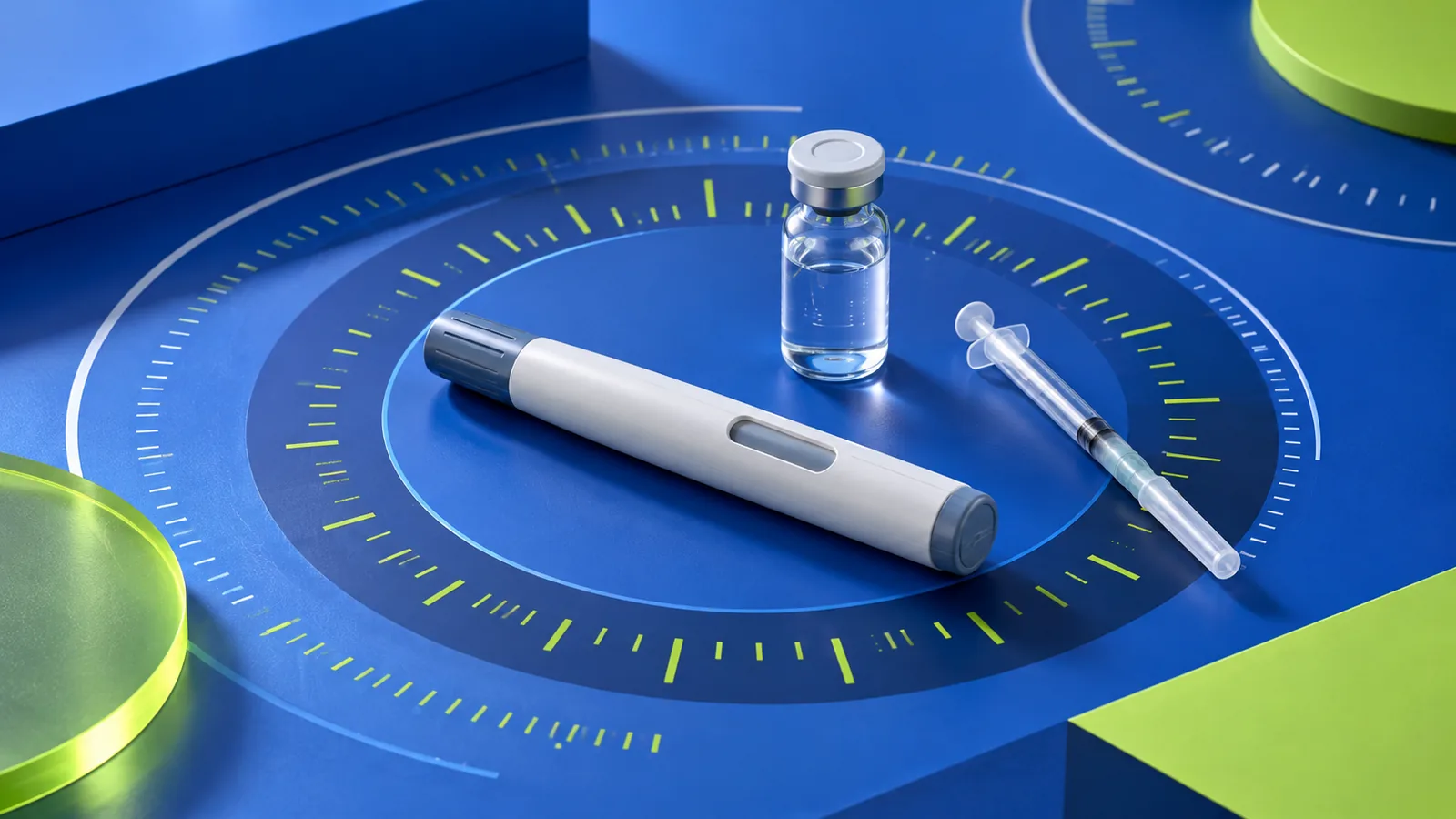
“Microdosing” does not identify a standardized FDA-approved GLP-1 regimen. Pen clicks are device mechanics, not a universal clinical unit, while insulin-syringe “units” describe volume and change meaning when concentration changes. The usable prescription record is product-specific: drug, finished dosage form, concentration, dose in milligrams, matching volume, correct device, frequency, titration instructions, and the prescriber or pharmacist who verifies every conversion.123
This distinction matters because the same number can describe different things. “Ten units,” “ten clicks,” and “ten milligrams” are not three ways to write one dose. They can represent unrelated quantities.
Put every number in its proper column
| Expression | What it describes | Why it cannot stand alone |
|---|---|---|
| Milligrams (mg) | Mass of active drug | It does not tell you the liquid volume without concentration |
| Milliliters (mL) | Liquid volume | It does not tell you the drug mass without concentration |
| Syringe units | Graduations on a particular syringe, commonly a volume scale | The drug mass changes with the vial concentration and syringe type |
| Pen clicks | Mechanical movement inside one pen design | Clicks are not transferable across pens, strengths, models, or instructions |
| Dose step | A named label or prescriber step | It still needs an exact product and written schedule |
FDA has described cases in which patients received five to twenty times the intended amount of compounded semaglutide. Reported contributors included unfamiliar vials, oversized syringes, variable concentrations, “unit” directions, and conversion mistakes by both patients and health professionals.1 The lesson is not to memorize a conversion from social media. It is to remove the need for improvisation.
“Microdosing” is a marketing description until it is translated
Clinics use “microdosing” to mean different things: a lower-than-label amount, slower titration, split frequency, maintenance strategy, side-effect response, or simply a low starting step. The word does not reveal whether the product is FDA approved, compounded, used on label, or prescribed off label.
Ask the prescriber to replace the term with a written statement:
- exact active ingredient and finished product;
- FDA-approved product or compounded preparation;
- intended treatment job;
- dose in milligrams;
- concentration in milligrams per milliliter when liquid is drawn from a vial;
- volume to draw in milliliters;
- syringe size and the exact line that corresponds to that volume;
- frequency and date of the next reassessment;
- what changes would trigger a pause, call, or new prescription.
Off-label prescribing of an approved drug and use of a compounded product are not the same regulatory event. The compounded-GLP-1 guide maps that boundary.
Do not build a dose by counting clicks
An approved pen is a finished drug-device combination with product-specific instructions. Its strength, dose counter, selector, priming or flow-check steps, remaining volume, and device warnings belong together. A click-count table copied from another pen can fail when the concentration, model, country presentation, or device generation differs.
The current OZEMPIC label identifies the approved product configurations and administration instructions.3 The correct source for a pen question is that exact product’s FDA-approved instructions plus the prescribing clinician or dispensing pharmacist—not an audio cue stripped from the label.
If a clinic proposes using an approved multidose pen in a way not described in its instructions, ask the clinician to state the off-label plan, clinical rationale, measurement method, and error controls in the record. “Everyone counts clicks” is not documentation.
Syringe units change meaning when concentration changes
An insulin syringe is calibrated to represent a volume. It does not detect what drug is in the vial. If one pharmacy dispenses one concentration and a refill comes from another concentration, the same syringe line may deliver a different mass.
Use a written two-way check:
- Prescription: intended dose in mg.
- Vial: concentration in mg/mL and total volume.
- Calculation: required mL for that dose.
- Device: syringe capacity and graduation scheme.
- Mark: exact line corresponding to the calculated mL.
- Verification: prescriber or pharmacist confirms the match for this vial and syringe.
FDA separately warns that compounded and conventional product labels may express strength differently, which can make total amount and amount per milliliter easy to confuse.4 Photographing the current vial and syringe for the clinical record can help, but a photo is not a substitute for professional verification.
Product identity comes before titration
Semaglutide, tirzepatide, and other products are not interchangeable because a clinic calls them all “GLP-1.” Approved products have different ingredients, indications, dosage forms, strengths, and instructions. Compounded products do not undergo FDA premarket review for safety, effectiveness, or quality, and FDA’s current page documents concerns about non-label dosing and titration as well as product composition.2
Preserve the pharmacy name and address, prescription label, lot or batch if supplied, beyond-use date, storage instructions, concentration, fill date, and prescriber. The telehealth verification guide helps connect a remote clinic to the actual prescriber and dispenser.
Avoid “dose-equivalence” shortcuts during a switch
A switch can involve a different molecule, indication, product, dosage form, concentration, device, or stage in a labeled schedule. A chart that assigns one “equivalent” dose can hide all of those differences. The prescriber should write a new plan that names the last dose and date, the new product, the starting step, the reason for the choice, and the monitoring plan.
Do not reuse a prior syringe or instruction sheet simply because the liquid looks the same. Do not transfer an old “units” number to a new vial. Do not combine leftover volumes unless the pharmacy and prescriber expressly direct it for the exact products.
Build a zero-ambiguity injection record
- Patient name and date
- Exact drug and finished product
- Approved or compounded status
- Pharmacy and prescriber
- Concentration in mg/mL
- Prescribed dose in mg
- Calculated volume in mL
- Supplied syringe and exact graduation
- Frequency and titration date
- Storage, beyond-use date, and contact for questions
Reconcile the dose before it is dispensed
Ask: “For this exact product and concentration, what is my prescribed dose in milligrams, what volume is that in milliliters, which line on this supplied device matches it, and who has independently verified the conversion?” If the answer is only clicks or units, the record is incomplete.
Sources
- U.S. Food and Drug Administration. Dosing errors associated with compounded injectable semaglutide products. FDA alert on unit, volume, concentration, syringe, and calculation errors. Accessed .
- U.S. Food and Drug Administration. FDA's concerns with unapproved GLP-1 drugs used for weight loss. Current FDA summary of compounded-product dosing, titration, salt-form, and adverse-event concerns. Accessed .
- U.S. Food and Drug Administration. OZEMPIC prescribing information. Current approved-product labeling for product configuration, strengths, dosing, warnings, and administration. Accessed .
- U.S. Food and Drug Administration. Strength-expression differences can lead to dosing errors. FDA guidance on total amount, concentration, volume, and label interpretation. Accessed .