Hospital vs ASC vs registered office surgery in Florida: verify the setting, not the label
Florida hospitals and ASCs are AHCA-licensed facilities. A physician office is generally outside the ASC definition unless it is or seeks to be Medicare ASC-certified; qualifying medical-doctor office surgery follows separate DOH registration and inspection rules. None is a safety score.
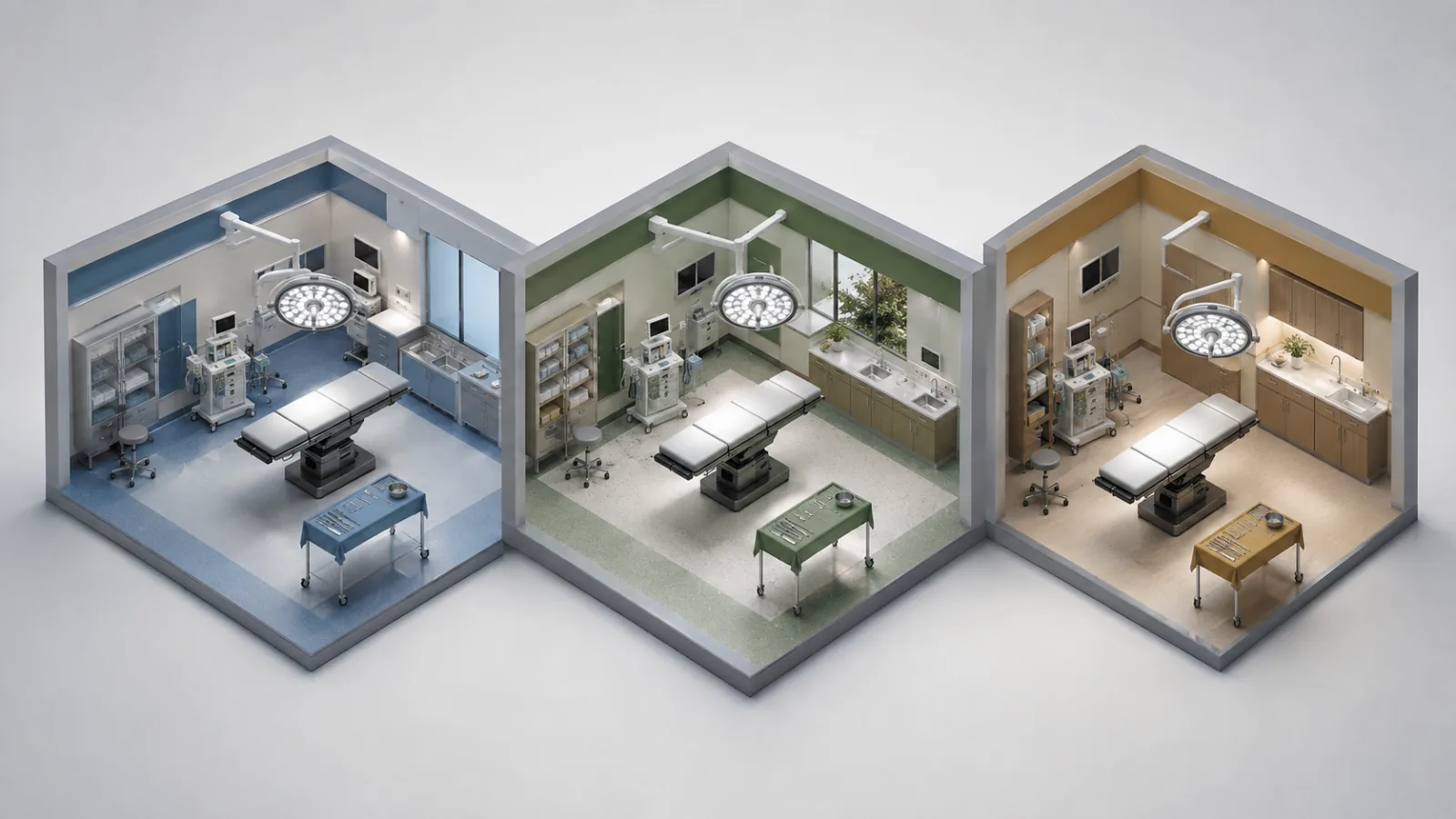
In Florida, a hospital, an ambulatory surgical center (ASC), and a registered physician office are distinct settings. Hospitals and ASCs are facilities licensed through the Agency for Health Care Administration. An office maintained for medical practice is generally outside the ASC definition, but an office certified or seeking certification as a Medicare ASC must be licensed as an ASC; qualifying medical-doctor office surgery follows separate Department of Health registration and inspection rules. None of these records is a safety score or guarantee.12345
Verify the street address and legal entity where the procedure will occur. A practice brand can use several sites with different records.
Classify the physical site before judging it
| Setting | Primary Florida record | Core distinction |
|---|---|---|
| Hospital | AHCA facility license and legal-action records | Broader licensed hospital services and capacity under chapter 395 |
| Ambulatory surgical center | AHCA ASC license for the exact address | Elective surgical care with admission and discharge within the statutory period |
| Physician office surgery | DOH Office Surgery Registration plus physician and designated-physician records when applicable | A physician office, not an AHCA-licensed hospital or ASC, operating under office-surgery law and profession-specific rules |
| Accredited site | Certificate and scope from the named accrediting organization | A separate private accreditation layer; not a substitute word for state licensure or registration |
| Hospital privileges | Current confirmation from the hospital or credentialing record | Authority for a named clinician and procedures at that institution, not licensure of another site |
Florida statutes define an ASC around elective surgery and discharge within 24 hours. An office maintained for medical practice is generally excluded from that definition, but an office certified or seeking certification as a Medicare ASC must be licensed as an ASC.1 Do not call every freestanding operating room a “surgery center,” and do not use the office label to bypass the Medicare-ASC exception.
Run the right lookup for the claimed setting
For a hospital or ASC, use FloridaHealthFinder to match legal name, license type, address, status, ownership details when shown, services, and legal actions.4 For a physician office, use MQA and select Office Surgery Registration, then inspect the registration address, status, designated physician, linked records, and actions.5 Also verify every surgeon and anesthesia professional by their individual license.
Save PDFs or dated screenshots from the official sources. Ask the practice to resolve any mismatch between:
- website and consent-form facility names;
- quote and scheduled address;
- AHCA or MQA legal name and the storefront brand;
- active versus expired, closed, pending, restricted, or disciplined records; and
- the named surgeon, designated physician, anesthesia team, and actual schedule.
“State inspected” is incomplete until the practice identifies which agency, authority, site, date, result, and corrective action.
Registration is not facility licensure
Section 458.328 establishes registration and practice requirements for office surgery by medical doctors, including a designated physician and inspection framework.2 The Board of Medicine rule supplies detailed standards for levels of office surgery, personnel, monitoring, equipment, anesthesia, recovery, and discharge.3 Verify a clinician’s profession and apply that profession’s current law and rules rather than assuming chapter 458 controls every office.
An office registration does not turn the office into an AHCA-licensed ASC. AHCA licensure does not verify each clinician’s current professional license or board certification. Accreditation does not erase either state layer.
The office registration guide explains how to keep those credentials separate.
Compare the actual procedure and anesthesia plan
The same marketing name can describe different extent, duration, positioning, fluid shifts, blood loss, implants, and recovery needs. Obtain the procedure list and expected anesthesia depth in writing.
Ask:
- Who is the surgeon and who administers anesthesia?
- What professional licenses, training, and current privileges apply?
- What anesthesia level is planned, who continuously monitors it, and who can rescue a deeper-than-intended level?
- What equipment, medicines, blood or transfusion pathway, laboratory, imaging, and specialist support are immediately available?
- Which patient or intraoperative findings require a different setting?
Do not assume a hospital is automatically appropriate for every operation or that an office is appropriate because a procedure is common. The responsible clinicians should match patient, procedure, anesthesia, and rescue capability.
The transfer plan should exist before an emergency
Florida office-surgery law and rules address transfer arrangements, privileges or agreements, emergency equipment, and reporting under their stated conditions.23 Ask for the receiving hospital, transfer mechanism, emergency-services activation, stabilization roles, records packet, and who communicates with the family or support person.
A hospital being “five minutes away” is not a transfer plan. Traffic time is also not the only interval: recognition, decision, activation, stabilization, transport, handoff, and definitive care all matter.
For an ASC or hospital, ask how escalation within or outside the facility works and whether the planned service, staffing, and time are available on the procedure date.
Recovery and discharge are setting-specific operations
Identify recovery staffing, monitoring, discharge criteria, pickup rules, overnight capability, and what happens if discharge is not appropriate. Under the statutory definition, an ASC expects discharge within its licensed time boundary.1 A physician office should not be marketed as providing unlicensed overnight clinical care.
Ask where the patient goes after discharge, who provides care, what credentials cover promised tasks, which symptoms trigger the surgeon versus emergency services, and whether distance or travel changes the plan. The facility record ends at discharge; continuity does not.
Normalize quotes across settings
A hospital quote, ASC quote, and office quote may package facility, surgeon, anesthesia, supplies, implants, pathology, medicines, laboratory work, recovery, and overnight care differently. Request the same line-item categories and complication assumptions from each.
Price the possibility of extended observation, transfer, hospital admission, additional anesthesia, pathology, imaging, garments, prescriptions, travel changes, and follow-up. Do not infer quality from price or choose a setting only because one complication cost is excluded.
Verify the final address again
- Name and classify the site. Record legal entity, street address, facility type, proposed operation, and scheduled date.
- Open the correct state record. Use AHCA for hospital or ASC and MQA for office registration and individual licenses; save the lookup date.
- Verify separate credentials. Check surgeon, anesthesia team, designated physician, privileges, accreditation, and inspection without merging them.
- Match capability to the plan. Document procedure extent, anesthesia, monitoring, rescue, blood and equipment needs, recovery, discharge, and exclusions.
- Test transfer and continuity. Name emergency activation, receiving hospital, handoff, after-hours clinical owner, lodging or home care, and total cost.
The decisive setting question is: “What exact Florida record governs this address, and does the verified team, anesthesia, rescue, transfer, and recovery capability match this specific operation?”
Sources
- Florida Statutes § 395.002. Definitions for hospitals, ambulatory surgical centers, and related facilities. Current definitions used for hospital and ASC scope, the 24-hour ASC boundary, the physician-office exclusion from the ASC definition, and the Medicare-ASC exception. Accessed .
- Florida Statutes § 458.328. Office surgeries. Current law used for medical-doctor office-surgery registration, designated physician, inspection, incident reporting, transfer agreement or privileges, and practice requirements. Accessed .
- Florida Administrative Code Rule 64B8-9.009. Standard of Care for Office Surgery. Current Board of Medicine rule used for office-surgery levels, personnel, monitoring, equipment, anesthesia, recovery, and discharge standards for medical doctors. Accessed .
- Florida Agency for Health Care Administration. FloridaHealthFinder Facility Locator. Official AHCA lookup used for hospital and ASC legal name, address, license status, characteristics, and actions; it is not the office-surgery registry. Accessed .
- Florida Department of Health. MQA Health Care Provider Search. Official lookup used for Office Surgery Registration records and individual physician licenses. Accessed .