Prefilled syringes at a med spa: preparation, repackaging, and sterile-drug records
Drawing a dose for immediate administration is not the same workflow as filling, labeling, storing, or distributing syringes in advance. When a med spa removes a sterile drug from its original container, the record should preserve who prepared it, when, under which controls, how long it was held, and the source lot.
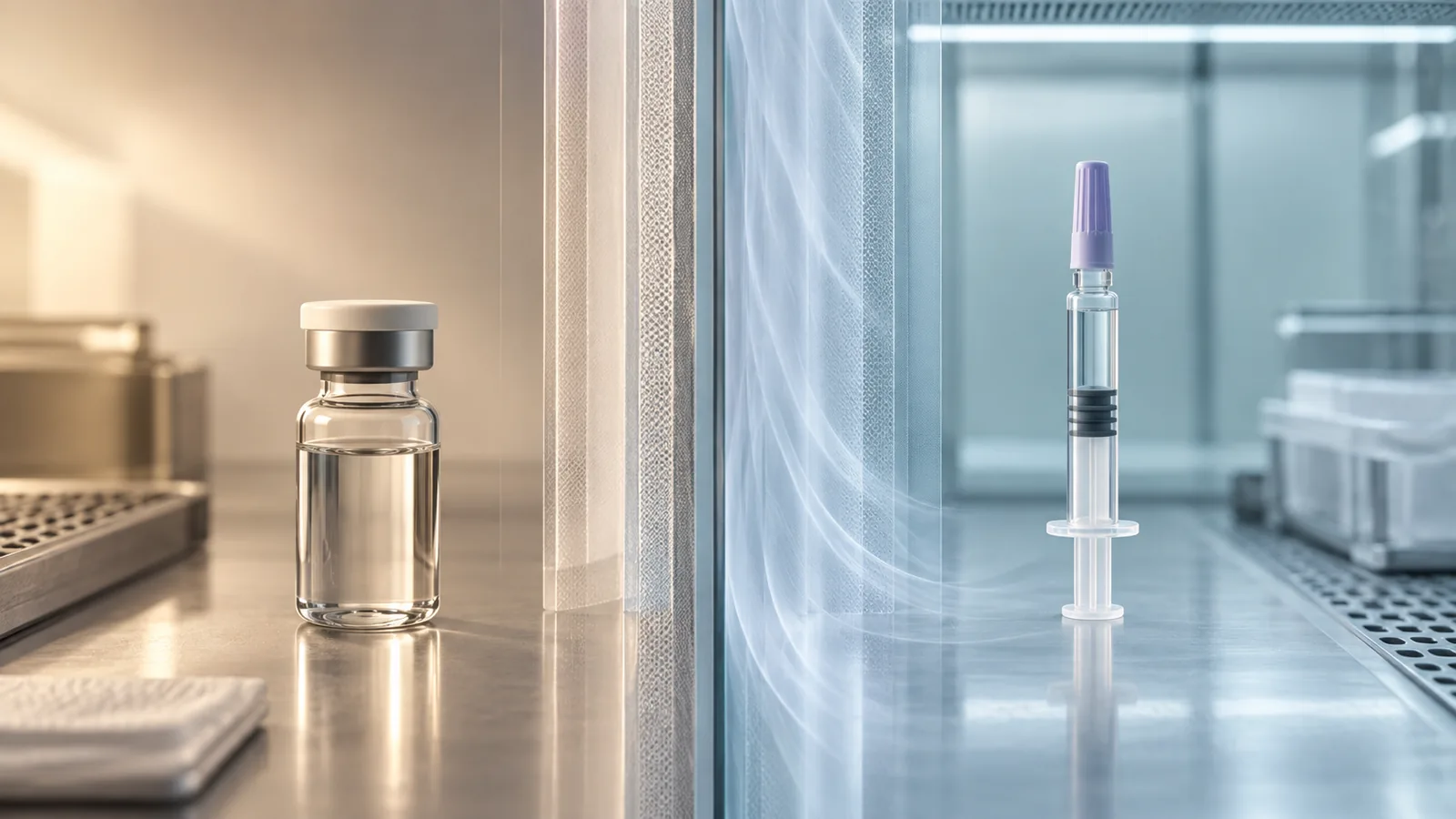
Preparing one sterile dose for prompt administration is not the same workflow as filling, labeling, storing, or distributing a supply of syringes in advance. A med spa that removes a drug from its original container should be able to state who did it, when, for which patient or batch, under what professional and regulatory authority, with what aseptic controls, beyond-use decision, label, storage, transport, and lot traceability.124
The words “prefilled syringe” describe a container state, not a complete safety or legal conclusion. It might be an FDA-approved manufacturer-filled product, a pharmacy-repackaged presentation, a patient-specific compounded preparation, or a syringe drawn in a clinic. Those pathways carry different evidence and records.
Translate the workflow before judging it
Begin with verbs. “We prefill” can hide several materially different actions.
| Workflow | Record to request | Unanswered issue |
|---|---|---|
| Manufacturer-filled syringe | Original label, approval record, lot, expiration and storage | Whether it is the correct product and remained in controlled custody |
| Pharmacy or outsourcing-facility repackaging | Facility identity, status, label, lot, beyond-use date and shipment records | Whether the operation fits the applicable pathway and product conditions |
| Patient-specific preparation | Order, preparer, source container, patient, date/time, concentration and administration time | Whether storage or delay changes the risk and governing standards |
| Clinic-made stock supply | Batch record, facility authority, environmental controls, testing, labels, distribution and recall plan | Whether the clinic has crossed into repackaging or manufacturing |
Do not assume that “under a hood” resolves the distinction. A hood is one piece of an environmental-control system; certification, placement, airflow, room classification, cleaning, monitoring, personnel practices, process validation, and quality oversight determine what it actually supports.
A 2026 letter shows why co-location is not a shortcut
FDA’s warning letter to PReye describes a registered drug repacker owned alongside a med spa. FDA said bulk liquid was filled into multiple containers under unsuitable aseptic conditions using a non-certified, non-qualified flow hood in an unclassified office space without a HEPA-filtered system, and cited missing quality systems and batch traceability.1 The company later recalled product for lack of sterility testing, according to the letter.
Those facts should not be generalized to every clinic that draws a syringe. The transferable lesson is that a separate company name, repacker registration, co-located suite, or desktop hood does not by itself establish compliant sterile production. Registration tells you an entity appears in a regulatory system; it is not FDA approval of the facility, process, or product.
Immediate preparation and advance stock create different questions
The longer a sterile product remains outside its original validated container, the more questions accumulate: container compatibility, adsorption, concentration, microbial entry, labeling, light, temperature, transport, and loss of the original closure’s integrity. Whether a specific hold time is acceptable depends on product labeling and the applicable practice or manufacturing standards; it cannot be inferred from the syringe looking clear.
Ask for a timestamped sequence:
- Original vial or container received and checked.
- Order linked to a named patient, if patient-specific.
- Preparation area released for use.
- Hand hygiene, garbing, disinfection, and aseptic transfer performed.
- Syringe labeled with product, concentration, preparer, patient or batch, time, and source lot.
- Storage conditions and maximum hold established from an identified authority.
- Administration, waste, return, or quarantine documented.
If syringes are routinely prepared before patients are known, moved between locations, sold to another practice, or held as stock, ask who classified that activity and why. The FDA repackaging guidance addresses specified pharmacy and outsourcing-facility circumstances; it is not a general med-spa permission slip.2
Sterility is a system, not a negative culture result
Sterility testing samples only part of a batch and cannot compensate for uncontrolled production. FDA’s aseptic-processing guidance treats facility design, air quality, personnel, cleaning, process simulation, container closure, environmental monitoring, and quality review as connected controls.3 CDC likewise emphasizes a clean medication-preparation area, aseptic technique, and strict single-dose-container practices in clinical settings.4
For a clinic-administered injection, observe whether medication preparation is separated from sinks, treatment debris, used sharps, food, phones, unpacked deliveries, and cleaning traffic. Ask how vial stoppers and work surfaces are disinfected, whether a needle and syringe are ever reused, and how single-dose remainders are handled. The sterile-vial guide covers those patient-to-patient controls in detail.
Drugs and licensed biological products do not share one shortcut
Botulinum toxin products are licensed biological products, while many other clinic injectables are approved drugs or devices. FDA has separate policy materials for mixing, diluting, or repackaging biological products outside the scope of an approved biologics license and for repackaging certain human drugs by pharmacies and outsourcing facilities.25 A practice should not assume that section 503A or 503B conditions applicable to drug compounding automatically create the same pathway for a biologic.
This becomes important when a clinic draws multiple toxin syringes from a reconstituted vial for later use. The record should identify the licensed product, approved storage after reconstitution, preparation time, patient assignment, concentration, syringe material, conditions of holding, and who classified the activity. “We are not compounding because we add only saline” does not answer whether advance stock preparation is repackaging or whether product labeling and professional standards support the hold.
If an outside entity supplies the prefilled syringe, request its legal name, address, role, registration or license, label, source-product identity, batch or lot, beyond-use date, storage, shipping condition, recall contact, and whether it appears in the relevant official database. The clinic still owns receiving and administration; the supplier owns only its part of the chain.
Beyond-use date and expiration are different clocks
The manufacturer expiration applies to the product in its validated unopened container under labeled storage. Once it is opened, reconstituted, diluted, or moved, another time limit may apply. A beyond-use date reflects the applicable preparation pathway and available stability and sterility information; it is not created by copying the original expiration onto a new syringe.
Ask who selected the date and where the support is documented. A refrigerator slows some processes but does not make an uncontrolled preparation sterile or indefinitely stable. Temperature logs, light protection, transport, freeze events, power loss, and container compatibility should be part of the decision.
Traceability must survive the container change
Moving a drug into a new syringe can disconnect it from the original name, strength, lot, expiration, supplier, and recall. A handwritten color dot or tray position is not durable traceability.
The label alone is not enough; it must point back to the original container and receiving record. If a problem appears, the clinic should be able to identify every affected syringe and patient without reconstructing the day from memory.
Ask who owns the altered product
Once a container is changed, accountability can fragment among prescriber, pharmacy, repacker, clinic owner, preparer, administrator, and medical director. Before treatment, identify:
- who made or repackaged the syringe and at what address;
- the license or registration relevant to that activity;
- who selected the beyond-use time and storage conditions;
- who releases a batch, investigates complaints, and initiates a recall;
- who the patient calls if the syringe label and consent do not match;
- how the record is obtained if the med spa or outside supplier closes.
An outside pharmacy does not erase the clinic’s duty to receive, store, identify, and administer the correct product. A clinic employee’s license does not automatically authorize manufacturing a stock supply.
The decisive question
Ask: “Was this syringe manufacturer-filled, pharmacy or outsourcing-facility repackaged, patient-specifically prepared, or made here—and what record ties it to the original product, lot, sterile process, hold time, and my administration?” The most reassuring answer is not that prefilling is common. It is a pathway whose identity, controls, and ownership remain visible after the vial has disappeared.
Sources
- U.S. Food and Drug Administration. Warning Letter: PReye LLC. FDA's 2026 findings concerning a registered drug repacker co-located with a med spa, office-based filling, aseptic controls, traceability, and recall. Accessed .
- U.S. Food and Drug Administration. Repackaging of certain human drug products by pharmacies and outsourcing facilities. FDA policy describing repackaging and conditions for enforcement discretion in specified pharmacy and outsourcing-facility settings. Accessed .
- U.S. Food and Drug Administration. Sterile drug products produced by aseptic processing—current good manufacturing practice. FDA guidance on facilities, environmental controls, personnel, validation, container closure, and contamination prevention for aseptic manufacturing. Accessed .
- Centers for Disease Control and Prevention. Preventing unsafe injection practices. Clinical injection-safety principles, including aseptic technique, single-dose containers, preparation areas, and cross-patient contamination prevention. Accessed .
- U.S. Food and Drug Administration. Mixing, diluting, or repackaging biological products outside an approved biologics license. FDA policy for specified biological-product preparation activities and why drug-compounding exemptions do not simply transfer to licensed biologics. Accessed .