Microneedling pen vs derma roller vs RF microneedling: classify the device first
A short, blunt home roller making surface claims is not the same regulatory or physical exposure as a motorized pen that penetrates living tissue. RF microneedling adds delivered energy and a separate device-specific risk profile.
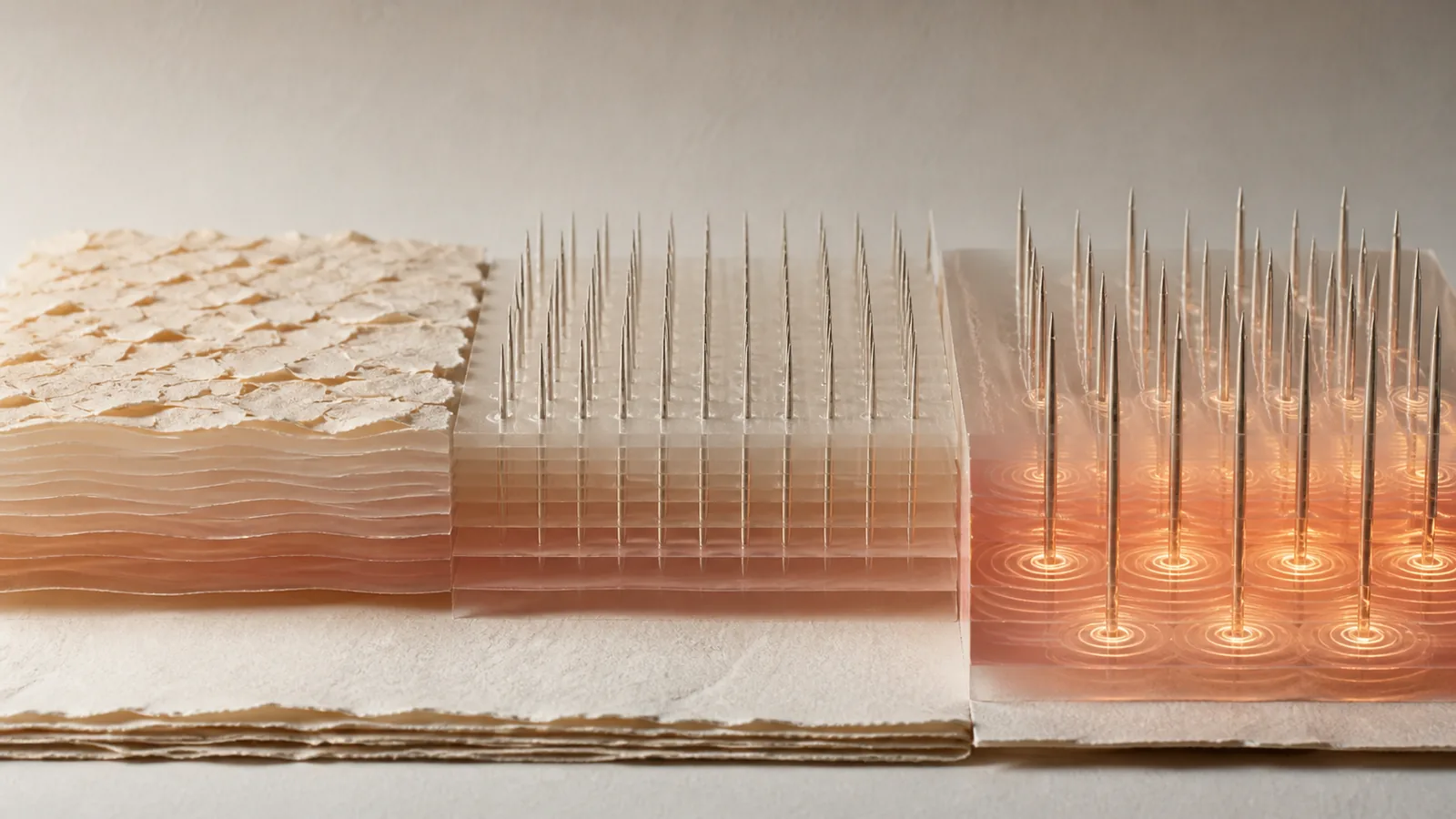
“Microneedling” does not identify one exposure. A short, blunt roller sold for surface exfoliation may fall outside FDA’s medical-device definition for microneedling, while a motorized pen that penetrates living tissue for a treatment claim can be an FDA-regulated medical device. RF microneedling adds electrodes and heat below the surface. Compare the exact model, intended use, penetration, cartridge, energy, treatment area, and any substance applied with it.12
The familiar comparison—roller versus pen—focuses on shape and misses the decisive variables. A roller can have long sharp needles; a pen can be used superficially. Product status follows intended use and technological characteristics, not the silhouette alone.3
Put the offering into one of three exposure classes
| Exposure class | Defining feature | Verification priority |
|---|---|---|
| Surface cosmetic product | Short or blunt projections and claims limited to exfoliation or surface appearance | Exact product instructions, hygiene, sharing, and claim boundaries |
| Mechanical microneedling medical device | Needles penetrate living tissue to change structure or function | FDA clearance for model and indication, depth controls, sterile cartridge, training, and aftercare |
| RF microneedling medical device | Microneedle electrodes deliver radiofrequency energy to create subsurface heating | Exact handpiece and clearance, insulation and depth pattern, energy settings logic, operator, and complication plan |
FDA says it has cleared specific microneedling devices for particular uses, including improving the appearance of facial acne scars, facial wrinkles, and abdominal scars in adults 22 or older.2 That is not a clearance of every pen, every depth, every treatment area, or every advertised outcome. Hair growth, pore “erasure,” stretch marks, drug delivery, and use with biologic products require separate evidence and status checks.
The resurfacing comparison helps choose among treatment families. This article starts one level later: after someone says “microneedling,” what physical and regulatory product are they actually proposing?
Penetration changes the record you need
Surface contact, crossing the outer dead-cell layer, and reaching living tissue are not interchangeable actions. Ask for the adjustable depth range, the planned depth by treatment zone, how contact and pressure affect penetration, and what prevents an operator from carrying a single headline depth across the face or body.
The goal is not to select a number yourself. It is to make the treatment map auditable. Anatomy, scar type, skin condition, device label, and clinician judgment all matter. A provider should be able to explain why the proposed zone and endpoint fit the exact clearance or why a use is off-label.
Motor speed, needle count, cartridge geometry, passes, pressure, overlap, and skin preparation can change the exposure even when two clinics quote the same maximum depth. A brand comparison that omits those fields is not a procedure comparison.
A cartridge is a patient-specific control
FDA advises asking whether a new needle cartridge is used for each patient and each session, including another session for the same patient.2 The disposable cartridge is not the whole instrument. Reusable handpieces and other components still need cleaning and disinfection according to the device instructions.
“Sterile needles” does not answer how the handpiece, cord, controls, work surface, topical anesthetic container, gloves, or post-procedure products are handled. The useful question is how the entire clean pathway is maintained.
Add-ons create another regulated proposition
Microneedling is often sold with PRP, PRF, exosomes, polynucleotides, vitamins, compounded mixtures, or cosmetics. FDA states that it has not cleared microneedling devices for use with another product.12 That does not mean every topical applied after a procedure has identical risk. It means a clinic cannot present the device clearance as FDA review of the combination.
Separate four fields:
- what the needling device is cleared to do;
- what substance is used and its own regulatory identity;
- whether the substance is applied to intact skin, immediately after needling, driven through channels, or injected; and
- what evidence supports that exact combination and endpoint.
The PRP-versus-PRF guide shows why preparation details matter for autologous blood products. An exosome vial or cosmetic ampoule does not become FDA reviewed because it is paired with a cleared pen.
RF is not merely a stronger setting on a pen
RF microneedling uses needle electrodes to deliver energy and create local heating. FDA’s October 2025 safety communication described reports of burns, scarring, fat loss, disfigurement, nerve damage, and interventions required to address injuries, while its evaluation continued.4 FDA characterizes RF microneedling as a medical procedure and says the devices should not be used at home.
The device may use insulated or non-insulated needles, different energy-delivery patterns, depths, pulse structures, and handpieces. Ask for the model and handpiece, not only a platform family name. The RF safety guide provides the detailed treatment-area and response-plan review; mechanical needling cannot borrow RF clearance, and RF cannot borrow the lower-risk story of a surface roller.
Home and clinic labels answer different questions
FDA says it has not authorized microneedling medical devices for over-the-counter sale.2 A consumer roller may be marketed lawfully for a limited cosmetic surface claim without being a cleared medical microneedling device. “Not a medical device” in that context does not mean FDA evaluated it as a treatment for scars, hair loss, or wrinkles.
Do not compare a home roller and a professional pen by needle count alone. Compare intended use, penetration, user population, anatomic exclusions, sanitation instructions, replacement schedule, adverse-event information, and the claim being made. If a home seller advertises structural treatment while pointing to an exfoliation product, the product and claim may no longer match.
Audit a proposal in seven fields
- Capture the exact model. Record manufacturer, model, handpiece, cartridge, and whether radiofrequency or another energy is delivered.
- Read the intended use. Match the cleared indication, age, anatomy, and endpoint to the proposed treatment.
- Map penetration and energy. Ask how depth, passes, pressure, overlap, and RF settings are selected by zone.
- Inspect single-use controls. Confirm a new compatible cartridge and the reprocessing instructions for reusable components.
- Separate every add-on. Name the substance, route, status, evidence, and whether the combination itself was reviewed.
- Verify the operator and response plan. Connect professional license and device-specific training to follow-up and escalation.
- Preserve the record. Keep model, cartridge or lot information, areas, settings summary, operator, products, and aftercare contact.
The booking question that exposes the whole plan is: “Is this product a surface cosmetic roller, a cleared mechanical microneedling device, or an RF microneedling system—and what exact device, cartridge, use, depth logic, and add-on record apply?”
Sources
- U.S. Food and Drug Administration. Microneedling devices. Device definition, legally marketed uses, contraindication and risk information, cartridge handling, and treatment-add-on status. Accessed .
- U.S. Food and Drug Administration. Microneedling devices: getting to the point on benefits, risks and safety. Consumer distinction between cosmetic rollers and medical devices, authorized uses, home-use status, training, and infection controls. Accessed .
- U.S. Food and Drug Administration. Regulatory considerations for microneedling products. FDA guidance on intended use, technological characteristics, penetration, and combination claims. Accessed .
- U.S. Food and Drug Administration. Potential risks with certain uses of radiofrequency microneedling. October 2025 RF-microneedling safety communication, serious reported complications, and provider/device verification recommendations. Accessed .