PEMF wellness mats vs FDA-cleared devices: waveform is not an indication
Pulsed electromagnetic field is a technology description, not one FDA status. A prescription bone-growth stimulator can be authorized for a defined indication; that does not validate a consumer PEMF mat's claims about pain, sleep, energy, inflammation, circulation, recovery, detoxification, or longevity.
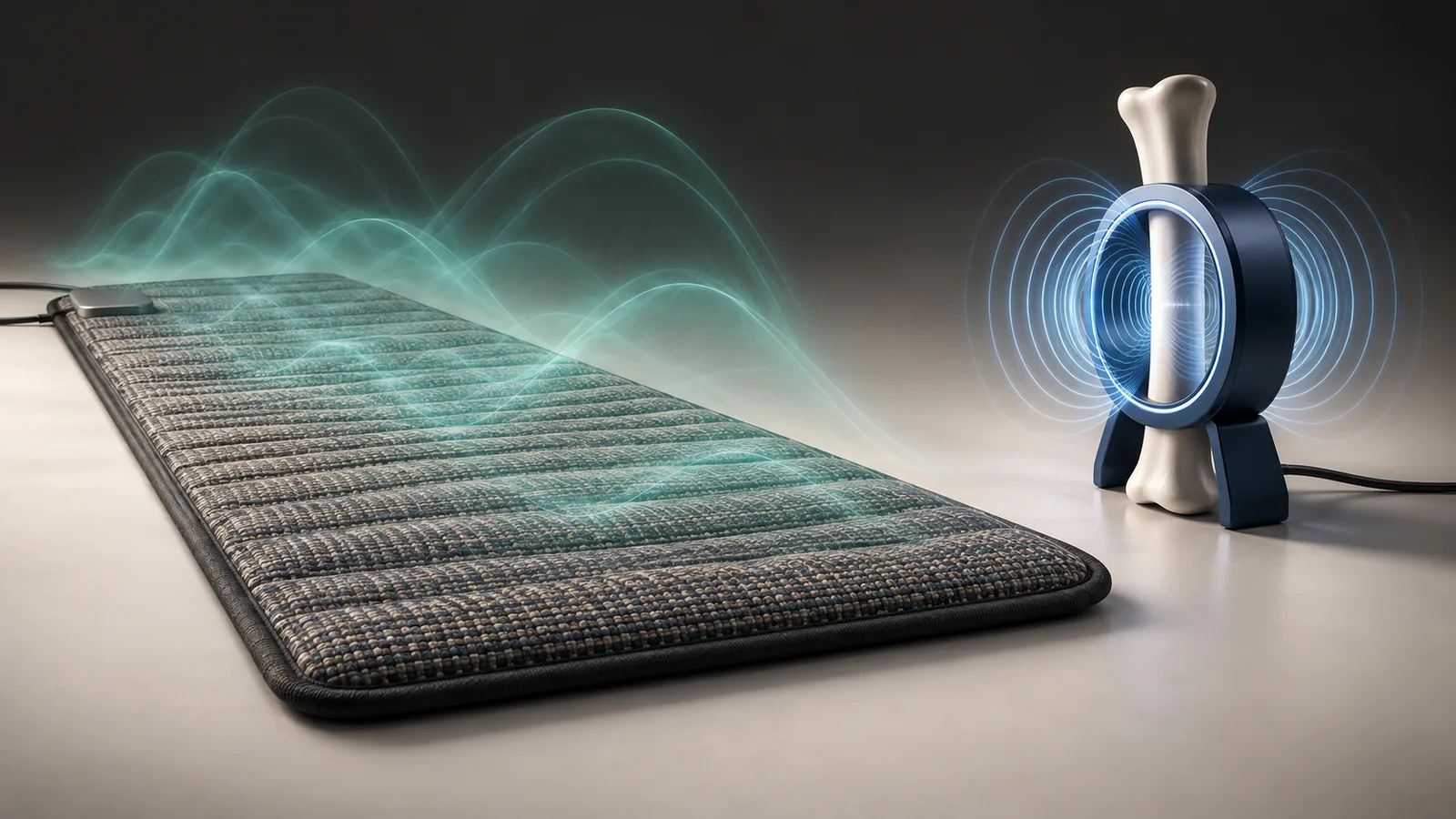
“PEMF” describes pulsed electromagnetic fields, not one product or FDA status. A prescription noninvasive bone-growth stimulator may be FDA cleared for its exact indication, hardware, waveform, patient population and labeling. That authorization does not transfer to a whole-body wellness mat or prove claims about pain, sleep, energy, inflammation, circulation, recovery, detoxification or longevity.123
The correct comparison begins with product identity and intended use. Two systems can both generate pulsed fields while differing radically in coil geometry, field strength, frequency, pulse shape, duty cycle, placement, session length, prescription status and evidence.
Technology family and clinical indication are separate
| Question | Prescription bone-growth stimulator | Consumer wellness mat |
|---|---|---|
| Regulatory claim | Exact cleared indication and prescription labeling | Often general-wellness positioning; any disease claim requires separate status and evidence |
| Exposure | Defined device, placement, regimen and performance specifications | Variable coils, programs, intensities and whole-body positioning |
| Evidence target | Bone-healing endpoint in a specified clinical population | Relaxation, sleep, recovery, pain or broad vitality claims may use unrelated endpoints |
| Clinical owner | Prescriber and follow-up pathway | Frequently self-directed purchase or spa session |
| Main inference error | Generalizing one cleared model to all PEMF | Borrowing medical-device language without a matching record |
FDA’s 2026 final rule reclassified noninvasive bone-growth stimulators into Class II with special controls.1 Older materials may call the device type Class III. Use the current classification record rather than copying a historical claim.2 Reclassification does not turn all PEMF products into cleared bone stimulators.
“FDA registered” is not the answer
A seller may cite establishment registration, device listing, a product code, a component supplier, FCC compliance, or a 510(k) belonging to another model. Verify:
- legal manufacturer and exact model;
- 510(k), De Novo or PMA number claimed;
- current product code and classification;
- prescription or OTC status;
- exact indication and patient population;
- waveform and accessories described in the decision record;
- current manual and labeling.
The FDA status guide explains why registration and listing do not establish marketing authorization or clinical benefit.
The 2026 reclassification changes the pathway, not the claim
FDA’s April 2026 final rule moved noninvasive bone-growth stimulators from Class III to Class II with special controls.1 That regulatory change means the defined device type now generally uses the 510(k) pathway rather than PMA, subject to the rule and controls. It does not retroactively clear an unreviewed mat or broaden a bone-healing indication to whole-body wellness.
Older advertisements may say “Class III FDA approved PEMF technology,” while newer ones say “Class II cleared.” Ask whether the statement describes the seller’s exact model or merely the history of a technology used by some prescription devices. The current LOF classification record is the fastest check.2
The word “medical” can also hide another product code. Electromagnetic devices cleared for pain, depression, incontinence or another indication may use different anatomy, energy and controls. Evidence should not move between them because the marketing page calls all of them PEMF.
Waveform details prevent evidence laundering
“Uses pulsed electromagnetic energy” is too broad to transfer a study. A defensible evidence match includes field strength at the tissue, frequency, pulse shape, duty cycle, coil design, treatment area, distance, session duration, number of sessions, comparator and population.
If a mat cycles among programs labeled sleep, detox, circulation or immune support, ask which exact exposure and clinical study supports each mode. A trial of a prescription coil placed over a fracture does not validate lying on a mat for general recovery.
FTC’s warning letter to a PEMF seller illustrates that disease-treatment and prevention claims require substantiation; a wellness label elsewhere on the site does not neutralize them.4 Treat testimonials as experiences, not controlled evidence.
Mechanism cannot substitute for outcome evidence
Electromagnetic fields can interact with tissue; that fact does not tell you whether a consumer protocol produces a meaningful effect. Mechanism claims about cellular voltage, ATP, inflammation, microcirculation, vagal tone or detoxification need a complete chain from delivered exposure to validated clinical outcome.
Ask whether the study measured:
- a patient-important symptom or function;
- a surrogate laboratory or imaging change;
- an immediate physiologic signal;
- a proprietary wellness score;
- duration after treatment;
- harms and discontinuations.
An immediate change in a sensor or thermal image is not proof of lasting recovery or disease modification.
Inspect the service dose and the business model
At a spa or recovery studio, ask staff to identify the manufacturer-set program rather than inventing a “dose” from intensity buttons. Record session duration, mat position, distance from coils, accessories and whether multiple energy devices are used at the same time. A stronger setting is not automatically a more effective one.
Check cleaning and inspection logs, damaged cables, controller errors and who removes a unit from service. If the device is sold for home use after an in-studio trial, confirm whether the consumer model delivers the same exposure as the studio model.
Membership design can pressure repeated use without reassessment. Ask what endpoint is evaluated, when the service stops for nonresponse, and whether unused sessions expire. A package should not turn transient warmth or relaxation into proof that an inflammatory or structural condition improved.
For a purchased mat, obtain the full electrical and electromagnetic specifications, warranty, repair process, return window, app dependence and data practices. “Lifetime warranty” should identify the legal company and excluded controller, shipping or wear items.
Safety belongs to the exact device
Review the current manual for its exact contraindications, warnings, treatment-area restrictions, and separation from implanted or wearable electronics. Do not borrow a precaution list from a different prescription device or consumer mat. This article cannot determine individual suitability.
At a spa, ask how the mat is cleaned, inspected and positioned; who checks contraindications; what the stop criteria are; whether intensity is changed by staff; and how an adverse event is documented. Tingling, warmth or a sensation of “energy” is not a dosing endpoint unless the device labeling says so.
Compare cost as a course, not a session
A mat purchase may include app access, warranty, replacement controller, returns and shipping. A spa package may include repeated sessions but no clinical reassessment. A prescription device may involve coverage criteria, rental or purchase, prescriber visits and adherence monitoring. These are different pathways.
Do not infer that the most expensive mat has the closest medical-device exposure. Price, number of programs, stronger magnets and “NASA-inspired” language are not clearance records.
The decisive question
Ask: “Which exact FDA decision and product-specific study support this exact model, waveform, placement and claim—and are you describing a prescription bone-healing device or a consumer wellness experience?” If the evidence changes devices midway through the answer, the claim match has failed.
Sources
- Federal Register. Reclassification of non-invasive bone growth stimulators. April 2026 final rule reclassifying noninvasive bone-growth stimulators from Class III to Class II with special controls. Accessed .
- U.S. Food and Drug Administration. Product classification LOF—noninvasive bone-growth stimulator. Current Class II prescription-device classification and 510(k) pathway record. Accessed .
- U.S. Food and Drug Administration. Bone-growth stimulators executive summary. Technical, indication, evidence, adverse-event, and regulatory history for noninvasive bone-growth stimulators. Accessed .
- Federal Trade Commission. Warning letter to PEMF Wellness Technology. FTC enforcement record illustrating that broad disease claims require competent and reliable scientific evidence. Accessed .