SARMs vs testosterone vs bodybuilding supplements: three regulatory categories, not one stack
SARMs marketed for muscle or performance are not FDA-approved drugs and cannot lawfully be sold as dietary supplements. Prescription testosterone products have specific approved indications. A bodybuilding supplement may contain supplement ingredients, an undeclared drug, or a mislabeled SARM.
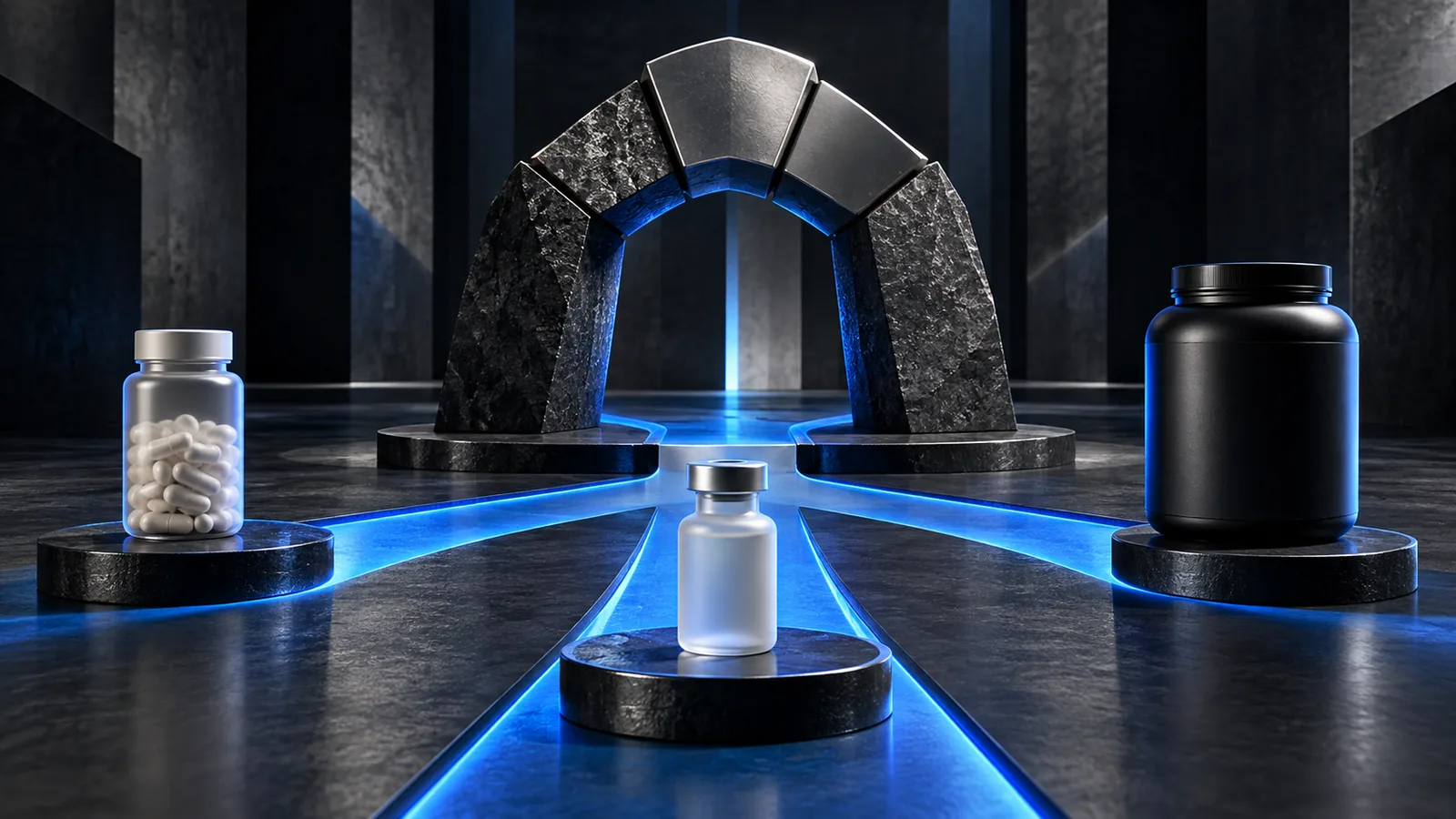
SARMs, prescription testosterone, and bodybuilding supplements are not interchangeable product categories. SARMs sold for human muscle or performance use are unapproved drugs and cannot lawfully be dietary-supplement ingredients. Testosterone products have product-specific FDA approvals and prescription labeling. A “bodybuilding supplement” label proves neither purity nor category; verify the actual ingredients, manufacturer, claims, testing, and seller before drawing conclusions.124
The word “stack” encourages consumers to group products by desired outcome. Regulation instead follows the active ingredient, intended use, finished dosage form, claims, and distribution pathway.
Three labels can hide three different legal identities
| Market label | Regulatory question | Record to request |
|---|---|---|
| SARM | Is the substance an approved drug for this human use? | Exact chemical name, FDA application if claimed, manufacturer, and laboratory identity testing |
| Testosterone | Which FDA-approved prescription product, indication, route, and patient population? | Prescription, current labeling, pharmacy, strength, lot, and monitoring plan |
| Dietary supplement | Does it contain lawful dietary ingredients and make lawful claims? | Supplement Facts, other ingredients, responsible firm, lot, and credible batch-specific testing |
FDA states that SARMs are not approved and cannot be lawfully marketed in the United States as dietary supplements.12 A bottle’s “research,” “not for human consumption,” or “dietary supplement” wording does not neutralize human-use directions and performance claims.
A prescription does not make categories equivalent
FDA-approved testosterone products are prescription drugs with exact ingredients, routes, strengths, indications, contraindications, warnings, and monitoring information. Their existence does not establish that a SARM is a substitute, a safer form, or an approved “next-generation testosterone.”4
Likewise, a wellness clinic’s medication order does not create FDA approval for an unapproved active ingredient. Ask for the drug’s nonproprietary name, NDC when applicable, application or label, dispensing pharmacy, prescriber, and indication. If the product is compounded, state that separately; compounded status is not FDA approval.
The testosterone-clinic guide covers the product-specific testosterone consultation without turning this page into treatment advice.
“Supplement” is not a laboratory result
Dietary supplements do not undergo FDA premarket approval like new drugs. NIH’s evidence review shows that performance ingredients have very different levels of support, studied populations, endpoints, and safety considerations.3 The category name therefore cannot answer whether a product contains what it lists—or whether it contains an undeclared pharmacologically active substance.
For a finished product, preserve:
- front label and Supplement Facts panel;
- complete ingredient list, including proprietary-blend amounts where disclosed;
- responsible firm’s legal name and contact;
- lot and expiration;
- seller and purchase record;
- batch-specific certificate of analysis, if offered;
- laboratory name, accreditation, methods, analytes, detection limits, and sample chain;
- recall or adverse-event contact.
A generic “third-party tested” badge can refer to identity, contaminants, banned substances, manufacturing, or something else. The supplement-quality guide explains how to identify the issuer and scope.
Claims can reveal the category problem
Promises to build muscle, burn fat, replace hormones, treat injury, accelerate recovery, or alter disease can implicate drug claims depending on the product and wording. Do not judge only the small-print disclaimer. Review the product page, influencer script, dosing directions, testimonials, and bundled laboratory program together.
FDA’s current warnings describe serious health risks associated with products represented to contain SARMs and other steroid-like substances.12 This article does not assign a personal probability or offer cycle, dose, or post-cycle instructions. It provides a product-verification framework.
Evidence for one molecule does not transfer to a bottle name
A published trial identifies a chemical, purity, dose form, amount, population, comparator, duration, endpoint, and adverse-event collection method. A retail product with the same nickname may differ in identity or composition. A seller should not use a paper about one investigational compound to substantiate an entire multi-ingredient stack.
When a study is cited, ask:
- Is it a human trial or laboratory/animal study?
- Was the ingredient pharmaceutical grade and identity-confirmed?
- Does the dose form match the retail product?
- Did the study measure the claimed outcome?
- How long were participants followed?
- Was the study designed to evaluate harms?
- Is the investigated use FDA approved?
ClinicalTrials.gov registration or publication is not approval to market the product.
Build a clinician handoff without self-prescribing
Bring photographs of every panel, lot, purchase source, stated amount, start and stop dates, and symptoms to a licensed clinician. Include prescription medicines because ingredient and interaction review depends on the entire exposure record. Do not rely on a seller to decide whether an unexpected symptom is “detox,” “suppression,” or normal adaptation.
Name the product before comparing the category
Ask: “What is the exact active ingredient and finished product, what lawful category is it sold under, what product-specific FDA or testing record supports that identity, and who is clinically responsible for the full exposure?” If the answer is only “SARM,” “testosterone support,” or “research grade,” it is not yet verifiable.
Sources
- U.S. Food and Drug Administration. Certain bodybuilding products put consumers at risk. Current FDA status and safety context for SARMs and steroid-like bodybuilding products. Accessed .
- U.S. Food and Drug Administration. FDA warns about use of SARMs among teens and young adults. FDA explanation that SARMs are unapproved drugs and not lawful dietary-supplement ingredients. Accessed .
- National Institutes of Health Office of Dietary Supplements. Dietary supplements for exercise and athletic performance. Federal evidence review for common performance-supplement ingredients and limitations. Accessed .
- U.S. Food and Drug Administration. Testosterone information. Current FDA information for approved prescription testosterone products and labeling. Accessed .