Sliding genioplasty vs chin implant: moving native bone or adding a permanent device
Sliding genioplasty cuts and repositions a person's chin bone with fixation; a chin implant adds a shaped permanent device over the skeleton. Compare skeletal geometry, movement needed, bite and airway context, soft tissue, device tolerance, scars, recovery, and revision options.
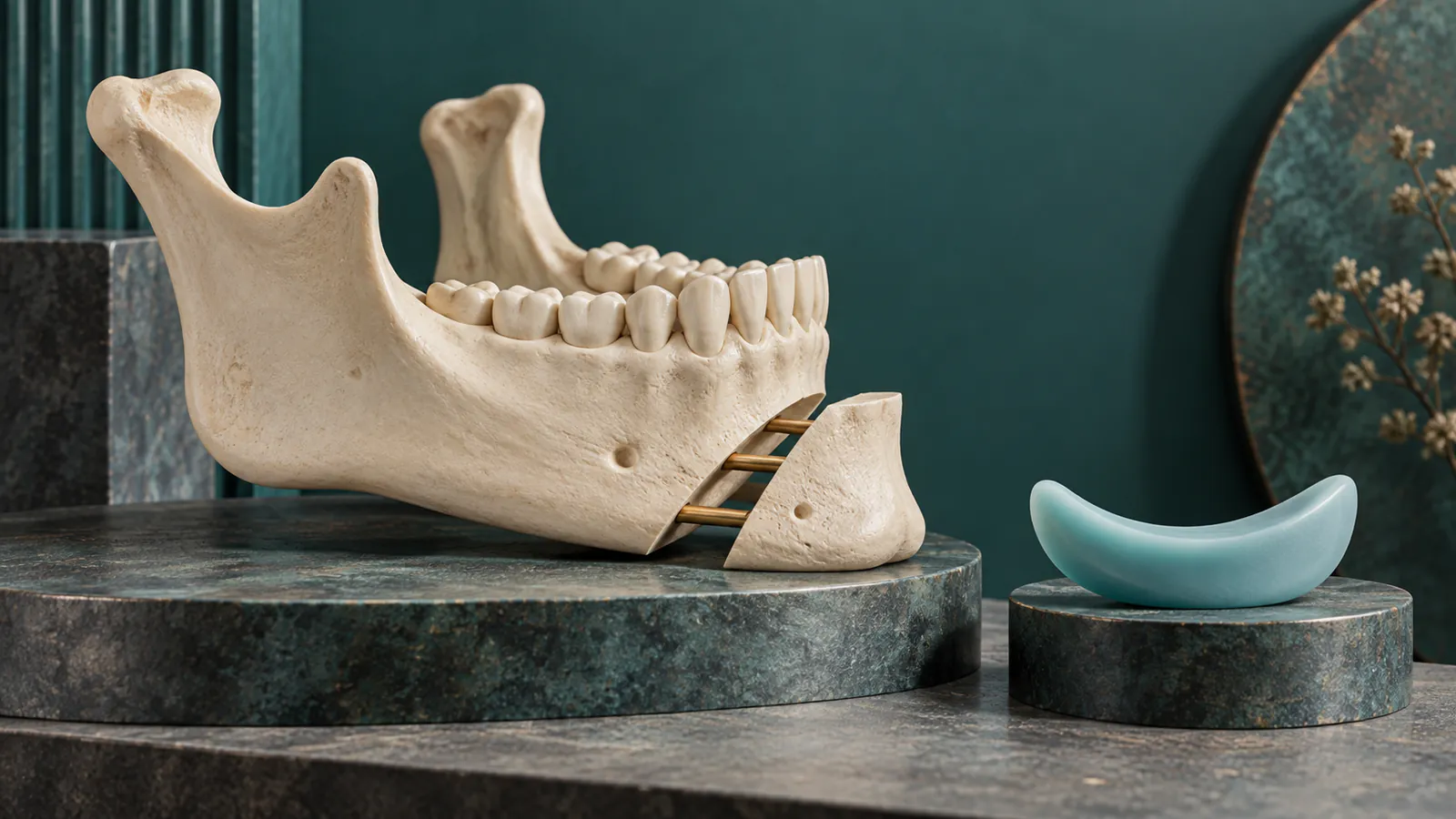
Sliding genioplasty repositions a segment of the patient’s bony chin and secures it with fixation; a chin implant adds a permanent device over the existing skeleton. Genioplasty can change horizontal and vertical position or asymmetry, while an implant is chosen for a defined augmentation shape. Neither changes the tooth-bearing jaw like orthognathic surgery. The decision requires skeletal, dental, airway, soft-tissue, device, and revision analysis.12
This comparison is different from chin implant versus filler. Both options here are operations, and one introduces a device while the other creates a bone cut and fixation construct.
Start with the movement, not the material
| Desired change | Sliding genioplasty | Chin implant |
|---|---|---|
| Forward projection | Advances the native chin segment | Adds projection with a selected implant shape |
| Vertical height | Can shorten or lengthen selected bony relationships in an operative plan | May change apparent height depending on design but does not reposition native bone |
| Asymmetry | Can move or rotate a segment within anatomical limits | Can use standard or patient-specific contour, but adds rather than moves bone |
| Width and side contour | Depends on osteotomy and segment plan | Implant wings and shape can add selected lateral contour |
| Foreign material | Uses fixation hardware but not a large contour implant | Leaves a permanent contour prosthesis unless removed |
Ask the surgeon to state the intended change in millimeters and directions on cephalometric analysis or another documented plan. “Weak chin” is not a complete diagnosis.
Neither procedure corrects every jaw problem
The chin is the front portion of the lower jaw, but chin surgery does not automatically correct dental occlusion, mandibular body position, temporomandibular symptoms, or sleep-disordered breathing. If bite, airway, or broader jaw relationships are relevant, ask whether an oral and maxillofacial or orthodontic assessment belongs before cosmetic planning.
A surgeon should explain whether the concern is isolated chin contour, skeletal jaw relationship, submental soft tissue, neck anatomy, or a combination. The facial-balancing guide helps keep each component separate.
A chin implant is a specific medical device
FDA classifies chin prostheses as medical devices, and clearance belongs to exact device records rather than “chin implants” as a universal product.2 Device models can differ in material, shape, size, fixation method, sterility, and intended use. Patient-specific implants add a design-and-imaging workflow; an FDA 510(k) record for one patient-specific system does not clear every custom implant.3
Request:
- manufacturer and exact model;
- material and size;
- standard or patient-specific status;
- 510(k) number when applicable;
- imaging and design approval process;
- sterile or nonsterile supply and preparation;
- incision, pocket, and fixation plan;
- implant card, lot or serial information, and operative report;
- removal or replacement plan.
“Medical-grade silicone” is a material description, not the full regulatory record.
Genioplasty creates a bone-healing and nerve plan
Sliding genioplasty involves an osteotomy below the tooth roots and repositioning near sensory nerves and soft-tissue attachments. The plan should identify direction and amount of movement, fixation, bone gaps or grafting if relevant, mentalis management, dental-root protection, and how sensory changes are discussed and followed.
The current systematic review found that both approaches can produce satisfactory outcomes but reported different complication profiles and substantial variation across a small comparative literature.1 Do not use pooled ranges as a personal prediction. Ask the surgeon for procedure-specific definitions and their own auditable follow-up denominator.
Scars are only one part of access
Both operations are often approached through the mouth, while some implants may use an external incision. An “invisible scar” claim should not eclipse oral-incision healing, muscle reattachment, device pocket, infection, fixation, numbness, and contour-transition questions.
Compare:
- internal versus external incision and why;
- oral hygiene and diet instructions;
- lower-lip and chin sensation documentation;
- mentalis closure and animation;
- swelling, activity, and follow-up schedule;
- imaging after surgery;
- signs that trigger urgent contact.
This page does not give postoperative instructions; use the operating surgeon’s plan.
Revision means different work
Implant revision can involve repositioning, removal, replacement, capsule or pocket work, soft-tissue change, and evaluation of underlying bone. Genioplasty revision can involve healed bone position, fixation hardware, scar, nerve symptoms, asymmetry, and a new osteotomy or graft plan. “Reversible implant” should not be heard as “no lasting tissue change.”
Ask whether removal alone is expected to restore the baseline contour, what imaging would be obtained, whether the same surgeon owns urgent device concerns, and what parts of revision are included in the original quote.
Read comparative evidence by anatomy
The 2025 systematic review included a limited set of heterogeneous single-center comparisons.1 Check baseline severity, movement needed, implant materials, follow-up, satisfaction instruments, sensory definitions, infection, displacement, reoperation, and who selected each operation. If more complex cases preferentially received genioplasty, a simple outcome comparison can reflect selection as much as technique.
Make the skeletal plan visible
Ask: “What three-dimensional change does my chin need, can adding a named implant achieve it without moving bone, or does the native chin need to be repositioned—and how do the nerve, device, healing, and revision plans differ?” That is the real choice.
Sources
- PubMed. Implant-based chin augmentation vs osseous genioplasty—systematic review. Current comparative review of indications, outcomes, complications, and evidence limits. Accessed .
- U.S. Food and Drug Administration. Chin-prosthesis product classification. FDA Class II, 510(k), and 21 CFR 878.3550 classification record for chin prostheses. Accessed .
- U.S. Food and Drug Administration. Patient-specific chin prosthesis 510(k) summary—K152463. Example of model-, material-, design-, and intended-use-specific device clearance. Accessed .