Transconjunctival vs transcutaneous lower blepharoplasty: compare the complete eyelid plan
A transconjunctival lower blepharoplasty reaches the fat compartments from inside the eyelid; a transcutaneous approach uses an external incision near the lash line and can directly address skin and muscle. Neither label defines the fat plan, lid support, skin treatment, scar, adjuncts, or risk by itself.
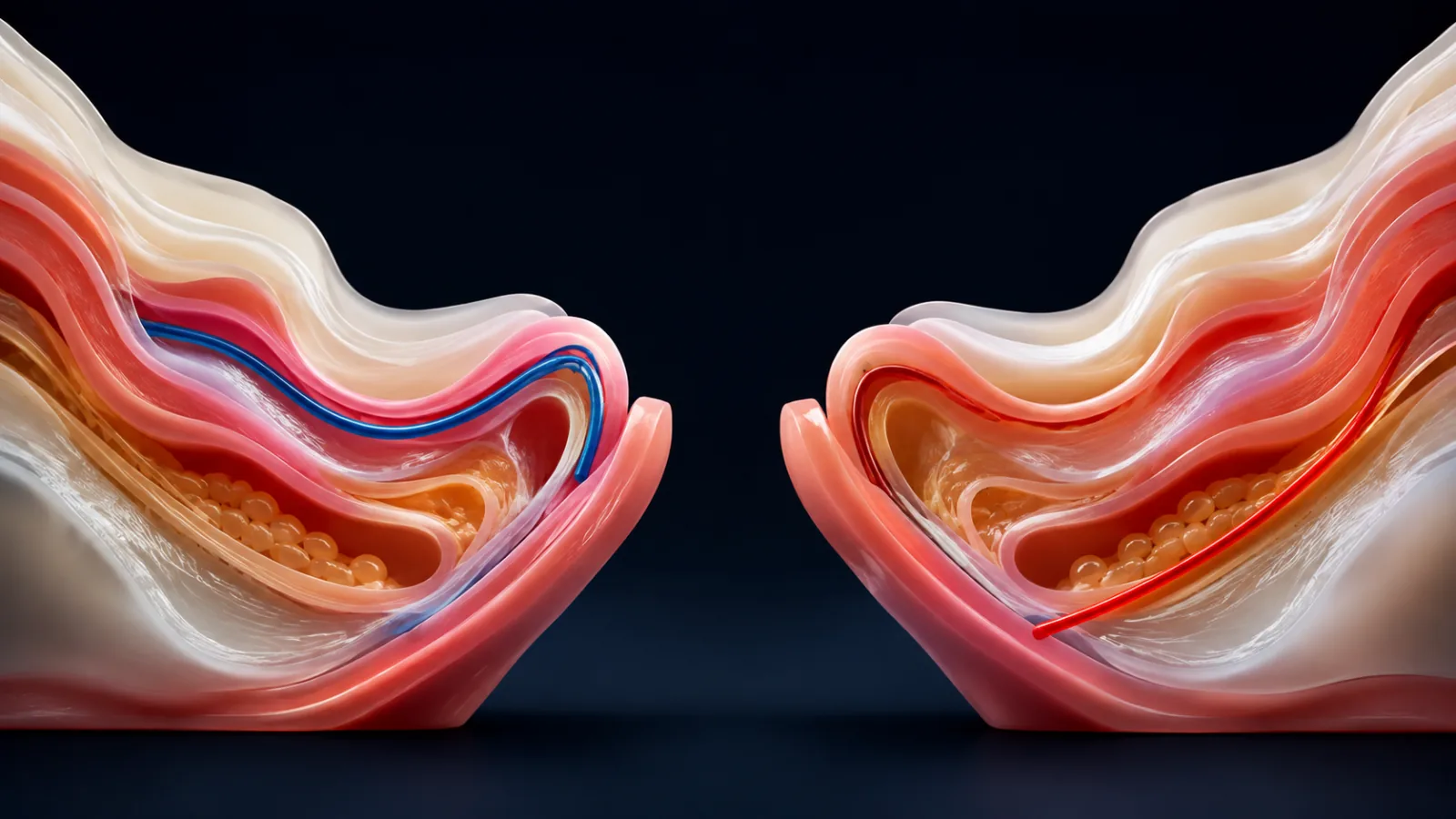
Transconjunctival lower blepharoplasty accesses lower-eyelid fat through the inner eyelid, while a transcutaneous approach uses an external incision near the lash line and can directly expose skin and muscle. Neither is one standardized operation or a universal winner: the decision depends on fat prominence and hollows, skin and muscle excess, lid tone and position, eye surface, prior procedures, needed support, fat removal versus repositioning, adjuncts, and the surgeon’s complete risk and recovery plan.123
“No external incision” is accurate for the access route; it does not mean no surgery, no scar, no lid-position risk, or no need for skin treatment.
Incision route is one row in the operation
| Component | Questions to ask | Why the route label is incomplete |
|---|---|---|
| Fat compartments | Which pads are prominent, removed, preserved, or repositioned—and where? | Both routes can be used for fat work |
| Tear-trough and lid-cheek junction | Is the plan fat transposition, grafting, filler, release, or no treatment? | An incision does not define volume redistribution |
| Skin | Is there true excess, fine texture change, muscle laxity, or expected redraping? | Transconjunctival access may be combined with a skin pinch or resurfacing |
| Lid support | What are snap-back, distraction, canthal position, scleral show, and prior support? | Canthopexy or canthoplasty is a separate maneuver |
| Eye surface | Dry-eye symptoms, contact lenses, prior corneal or eyelid disease, tearing? | Approach alone does not predict ocular-surface recovery |
| Adjuncts | Laser, peel, filler dissolution, brow or midface work, graft, resurfacing? | Adjuncts alter downtime and risk |
Request a diagram of each planned component. Two surgeons can both say “transconjunctival” while proposing meaningfully different operations.
Anatomy decides the job
The consultation should examine globe prominence, bony support, lower-lid position and tone, skin and orbicularis muscle, fat pads, tear trough, lid-cheek junction, canthi, cheek descent, symmetry, and eye-surface symptoms. Prior filler, energy treatment, blepharoplasty, orbital surgery, trauma, thyroid eye disease, facial palsy, and dry-eye care belong in the history.
Traditional reviews associate transconjunctival access with fat prominence when direct skin removal is not needed and transcutaneous access with situations requiring skin-muscle work.23 Modern plans can combine inner-eyelid access with a conservative skin pinch, resurfacing, fat transfer, or lid support. That is why anatomy and components matter more than a binary label.
Fat removal and fat repositioning are different operations
Removing a prominent pad can reduce fullness. Repositioning can move fat across the orbital rim toward a hollow. Preserving, trimming, transposing, grafting, or combining methods creates different contours and risks.
Ask the surgeon to specify:
- which fat compartment and side;
- excision, repositioning, preservation, or grafting;
- release and fixation points;
- how pre-existing hollowing and asymmetry affect the plan;
- what happens if intraoperative anatomy differs; and
- how over-resection, irregularity, or persistent fullness is reduced.
“Fat removal included” should not be treated as a unit of quality. The amount cannot be chosen from a photo or package tier.
Lid support should be explicit
Lower-eyelid retraction, ectropion, scleral show, asymmetry, rounding, chemosis, dry-eye symptoms, and difficulty closing the eye are among the concerns discussed around lower-eyelid surgery. Risk depends on anatomy, existing laxity, scar, dissection, skin removal, energy use, support maneuvers, healing, and other factors—not incision alone.2
Ask whether the plan includes no canthal work, canthopexy, canthoplasty, spacer graft, midface support, or another maneuver; why; and what scar, recovery, and risk it adds. A phrase like “tightening included” should be translated into anatomy and technique.
If a person has eye pain, vision change, inability to close the eye, severe swelling, bleeding, or another urgent postoperative concern, use the surgeon’s emergency instructions and urgent medical care. Do not compare online photos while waiting.
Evidence does not establish a universal best route
A 2025 systematic review found that both access routes were used for fat excision and repositioning but that outcome reporting and comparative evidence were too limited and heterogeneous to determine one best approach.1
A small 1995 prospective split-eyelid study compared routes in ten people and reported similar fat removal, with one unilateral transcutaneous scleral-show finding and no statistically significant overall difference.4 Its design is interesting because each person served as a comparison, but its sample, era, technique, and follow-up cannot supply modern universal complication rates.
For any quoted advantage, ask whether the evidence compares the same:
- patient anatomy and prior surgery;
- fat removal or transposition;
- skin-muscle dissection and skin removal;
- canthal support;
- laser, peel, or other adjunct;
- surgeon experience;
- outcome definition and assessor; and
- follow-up duration and completeness.
Scarless and noninvasive are inaccurate shortcuts
A transconjunctival incision is inside the eyelid, so there is no external incision from that access. It still involves tissue entry, healing, swelling, and an internal scar. A skin pinch adds an external incision. A transcutaneous incision is designed near the lash line but scar visibility varies with design, skin, tension, healing, pigment response, sun exposure, and complications.
Ask to see healed, standardized photographs across multiple time points and skin types. Photographs cannot show dryness, sensation, lid tone, vision, or dissatisfaction and should not replace a complication denominator.
Compare complete quotes
Itemize surgeon, facility, anesthesia, fat plan, skin and muscle work, canthal support, grafts, resurfacing, prescriptions, eye care, follow-up, pathology if applicable, and management of complications or revision. Confirm the operation setting and anesthesia personnel.
The under-eye options guide helps keep filler or PRF from being treated as equivalent substitutes for an operation when they address different anatomy.
Leave the consultation with an anatomy map
- Name the findings. Map fat pads, hollows, skin, muscle, lid tone and position, canthi, globe and bone support, eye surface, and asymmetry.
- List every maneuver. Specify access, fat removal or repositioning, release, skin work, muscle work, support, graft, and adjuncts.
- Match evidence to components. Check whether a comparison held fat plan, skin excision, canthal work, adjuncts, surgeon, and follow-up constant.
- Verify eye and emergency care. Record dry-eye and vision history, medications, eye clearance when indicated, after-hours contact, and urgent symptoms.
- Normalize recovery and cost. Compare the same operation, anesthesia, facility, eye care, follow-up, complication ownership, and revision terms.
The decisive question is: “Given my fat, skin, lid support, eye surface, and prior procedures, what complete operation is proposed beyond the words transconjunctival or transcutaneous?”
Sources
- Plastic and Reconstructive Surgery – Global Open. Transconjunctival or Transcutaneous Approach for Fat-preserving Lower Lid Blepharoplasty?. 2025 review of 24 cohort studies used for fat-preserving and repositioning approaches, limited comparative reporting, and the inability to name one best route. Accessed .
- Aesthetic Surgery Journal. An Overview of Surgical Approaches for Lower Eyelid Blepharoplasty. Current surgical review used for anatomy, preoperative examination, approach components, adjuncts, lid support, complications, and planning framework. Accessed .
- Indian Journal of Ophthalmology. Lower eyelid blepharoplasty: An overview. Review used for the traditional relationship between transconjunctival access and fat work without skin excess and transcutaneous access with direct skin work; individual plans can combine adjuncts. Accessed .
- Plastic and Reconstructive Surgery. Transconjunctival versus transcutaneous lower eyelid blepharoplasty: a prospective study. Small split-eyelid prospective comparison used only to illustrate limited direct evidence and why its six-month, ten-person findings are not universal complication rates. Accessed .