At-home IPL vs professional laser hair removal: compare the exact device
At-home IPL and professional laser hair removal are not simply weak and strong versions of one service. They can use different light sources, indications, skin and hair limits, controls, treatment schedules, and endpoints, so compare the exact model and label.
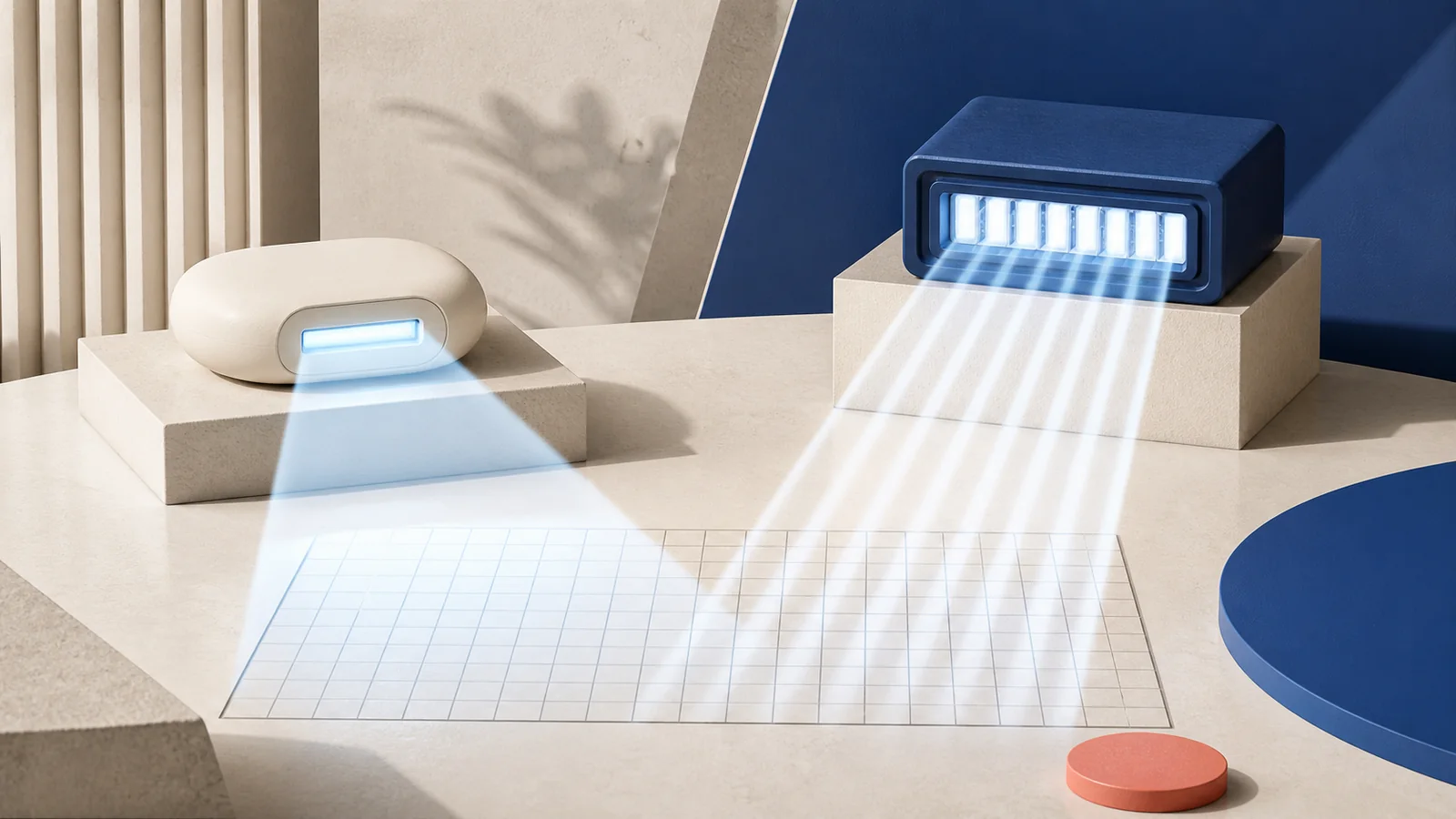
At-home IPL and professional laser hair removal should be compared model by model. A home IPL device may be FDA cleared for over-the-counter use by a defined user group and body areas; a professional platform may use laser or intense pulsed light with different wavelengths, controls, indications, operator requirements, and treatment logic. Neither category guarantees compatibility or a permanent zero-hair result.
“IPL” means intense pulsed light, a broad-spectrum light source rather than one laser wavelength. Some professional systems also use IPL, so “home IPL versus clinic laser” is not a universal technology split. Capture the exact manufacturer and model on both sides.
Device identity comes before power comparisons
| Field | At-home device | Professional service |
|---|---|---|
| Regulatory record | Exact OTC model and intended-use statement | Exact platform, handpiece, 510(k) or other record, and proposed indication |
| Energy source | Often IPL, but model-specific | Laser wavelength, IPL spectrum, or another named light technology |
| User controls | Preset or limited levels, contact and skin sensors, consumer instructions | Operator-selected settings, spot size, pulse structure, cooling, and device-specific controls |
| Eligibility limits | Label-defined hair colors, skin tones, areas, ages, and contraindications | Clinical assessment plus device labeling and operator protocol |
| Schedule | Frequent self-administered regimen and maintenance described in instructions | Appointment series tied to area, device, response, and growth cycle |
| Response route | Manufacturer instructions, warranty, and clinical care outside the device company | Named operator and clinic follow-up, plus manufacturer and FDA reporting when relevant |
An FDA-cleared home device is not cleared because all home IPL devices are equivalent. FDA summaries K240093 and K240583 illustrate model-specific indications, technical features, and instructions.12 Search the number printed in the instructions or ask the manufacturer for the record; then match the model rather than accepting an “FDA registered” badge.
Check the label’s hair and skin map
Light-based hair reduction depends on absorbing energy in hair pigment while limiting injury to surrounding skin. Very light, white, gray, or some red hair may not provide an effective target. Darker or recently tanned skin can require different technology and settings and may fall outside a home device’s label.
Do not use a generic internet color chart as the final screen. Read the current instructions for the exact model. Check treated body areas, hair colors, skin-tone limits, birthmarks or pigmented lesions, recent sun exposure, medications or conditions listed in contraindications, and whether the device is intended for facial use.
Professional treatment does not remove these questions. It adds a clinician or operator who must choose a device and plan. Ask how the provider assesses the skin on appointment day, documents changes, uses cooling, and responds to an unexpected skin reaction.
“Permanent reduction” has a defined but limited meaning
FDA device summaries may define permanent hair reduction as a long-term stable reduction in regrowing hairs measured at specified months after a regimen.1 It does not mean every follicle is destroyed, no maintenance will occur, or later hormonal or biological changes cannot produce visible hair.
Ask each seller to write the endpoint without superlatives:
- reduction in count, density, or regrowth;
- the area measured;
- the treatment regimen;
- the follow-up interval;
- the expected maintenance; and
- what counts as nonresponse.
AAD notes that home devices take longer and require periodic use to maintain results.4 Professional services also commonly involve a series and may involve maintenance. Compare the complete time horizon instead of one flash or one visit.
Home convenience transfers operating responsibility
A home device removes travel and scheduling but makes the user responsible for reading the instructions, preparing the skin, selecting only permitted settings, ensuring full contact, avoiding repeated overlap, tracking sessions, and stopping when the instructions say to stop.
Do not share a personal device unless the instructions allow it and sanitation steps are clear. Do not improvise on areas excluded from the label or disable sensors to make a device fire.
A professional plan needs more than a device badge
The clinic should name the operator, exact platform and handpiece, wavelength or light source, area boundaries, starting logic, cooling, test-area policy, session spacing, progress measure, and follow-up. In Florida, laser and light-based hair removal sits within the electrology framework; verify the operator and exact facility address.5
Professional access can offer more device choices and operator adjustment. It also introduces operator and setting variability. A high advertised energy number does not prove a better or safer plan; pulse duration, spot size, wavelength, cooling, overlap, skin condition, and technique interact.
Adherence and stopping rules belong in the comparison
A device can fit on paper and still be a poor practical match if the regimen cannot be completed. Home use shifts the calendar, recordkeeping, and consistency to the user. Professional treatment shifts appointment availability and most operating decisions to the clinic. Compare the likely interruptions before comparing a headline session count.
For a home device, read the instructions for the initial schedule, maintenance phase, preparation, permitted repeat passes, and what to do after a missed session. Then price any replaceable components and confirm whether the advertised device life is expressed as flashes, years, a warranty period, or another model-specific measure. None of those numbers proves clinical durability; they answer whether the device can support the labeled regimen.
For a clinic series, define what happens when recent tanning, a medication change, skin irritation, travel, or a missed appointment delays treatment. Ask whether an expired package loses visits, whether an area can be paused, and whether reassessment is included when progress stalls. Those are contract questions, not predictions about biology.
Both paths need an explicit stop-and-review rule. Persistent pain, blistering, prolonged color change, an unexpected increase in hair, repeated sensor errors, or failure to see the agreed progress at the review point should not trigger improvised extra passes or automatic package renewal. The home instructions and the clinic response plan should identify who can evaluate the issue, what records to bring, and how an event involving a device can be reported. FDA clearance establishes a model-specific marketing pathway; it does not replace those operating and follow-up decisions.13
This makes adherence a measurable field: planned sessions, completed sessions, reasons for interruption, response at each checkpoint, and the decision to continue, adjust, switch, or stop.
Compare both paths in six steps
- Name both devices. Capture manufacturer, model, energy source or wavelength, handpiece, and regulatory number.
- Match the intended use. Check hair colors, skin tones, body areas, user type, age, contraindications, and endpoint in the exact record and instructions.
- Map the complete regimen. Compare frequency, session time, appointment travel, consumables, package expiry, and maintenance over the same horizon.
- Assign responsibility. For home use, identify manufacturer support and a clinical response route. For professional care, verify the operator, facility, and follow-up contact.
- Measure consistently. Use the same area boundaries, lighting, photography, and review interval rather than judging day-to-day appearance.
- Price the endpoint. Include device cost or clinic series, replacements, missed visits, touch-ups, and maintenance without inventing a result guarantee.
Treomark’s electrolysis comparison adds the follicle-by-follicle alternative, while the Florida rules guide covers local provider verification. The defensible choice is the device and regimen whose label fits the hair, skin, area, user, and response plan—not the category with the strongest power claim.
Sources
- U.S. Food and Drug Administration. 510(k) summary K240093. Official example of an over-the-counter home-use IPL hair-removal device, its intended users, contraindications, controls, schedule, and permanent-reduction definition. Accessed .
- U.S. Food and Drug Administration. 510(k) summary K240583. Official example showing that home-use light-device indications and technical characteristics are model-specific. Accessed .
- U.S. Food and Drug Administration. Search the releasable 510(k) database. Official instructions for finding a device's applicant, model, product code, decision, and available summary. Accessed .
- American Academy of Dermatology. Hair removal: how to choose the right method. Dermatology guidance on home devices, professional laser treatment, hair-color limits, series, and maintenance. Accessed .
- Florida Department of Health, Board of Medicine. Electrologist. Florida record source for professional laser or light-based hair-removal operators and facilities. Accessed .