Dermaplaning vs microdermabrasion vs a superficial peel: three surface-treatment mechanisms
Dermaplaning uses a blade to remove surface scale and vellus hair; microdermabrasion uses controlled abrasion, often with suction; a superficial chemical peel uses a defined agent to create a controlled chemical injury. The evidence, depth, recovery, sanitation, and skin-fit questions are different.
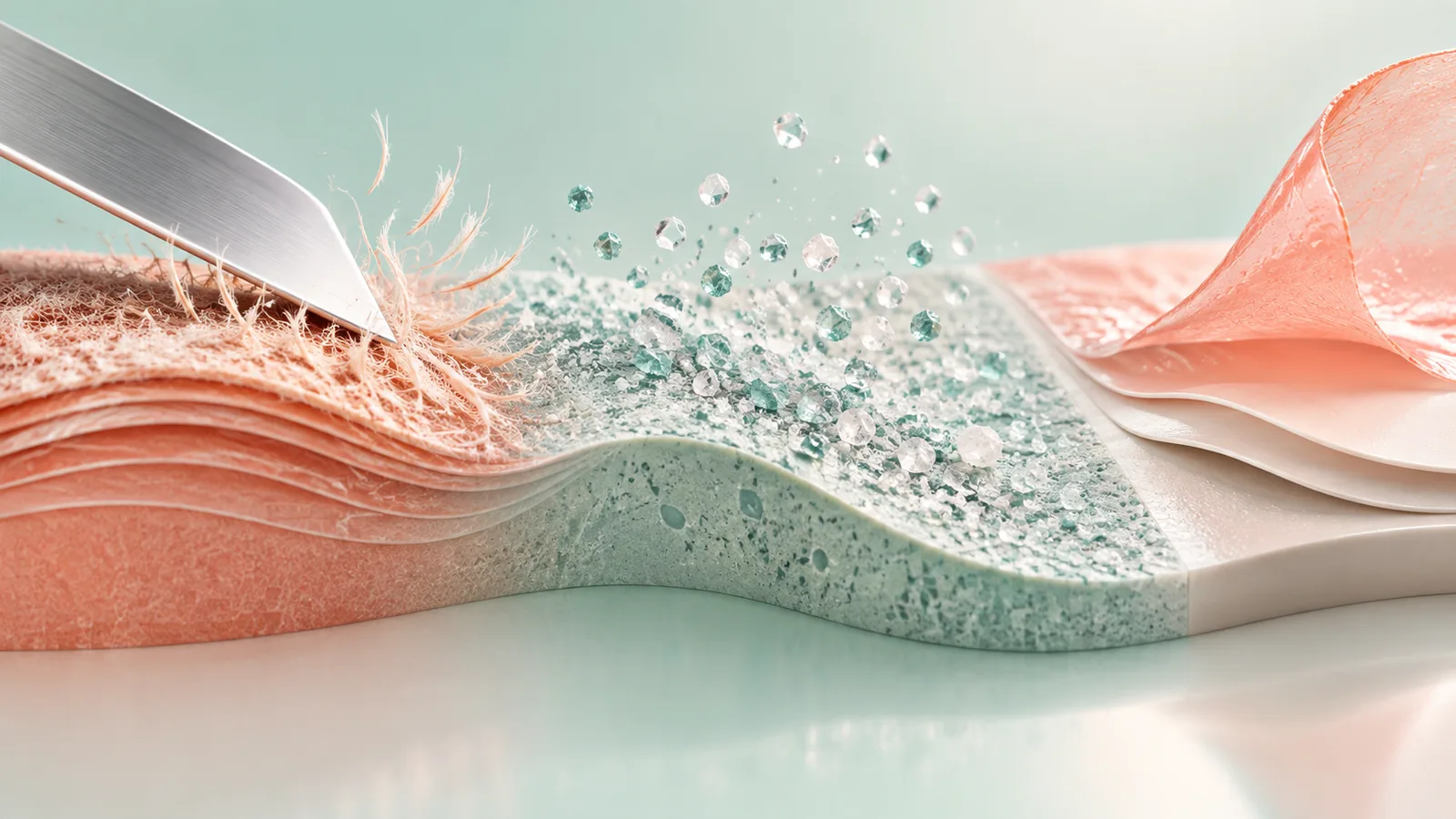
Dermaplaning, microdermabrasion, and a superficial chemical peel all act near the skin surface, but they are not equivalent exfoliation strengths. Dermaplaning uses a blade to remove surface scale and vellus hair; microdermabrasion uses mechanical abrasion, commonly with suction; a superficial peel uses a named chemical agent, formulation, concentration, contact time, and endpoint. The right comparison names the target, skin state, evidence, exact implementation, credential, sanitation, recovery, and response plan.124
The word dermaplaning is sometimes used loosely for consumer shaving, professional blade exfoliation, or even confused with surgical dermabrasion. Here it means professional blade-based removal of stratum-corneum scale and vellus hair—not deep scar planing or a home razor routine.
Compare mechanisms, not a generic exfoliation scale
| Path | Physical event | What the name does not specify |
|---|---|---|
| Dermaplaning | A blade passes across prepared skin to remove superficial scale and hair | Blade type, angle, passes, pressure, sterile or single-use controls, operator, and whether another product follows |
| Microdermabrasion | A device abrades the surface with a diamond tip or particles, often paired with suction | Tip/particle, vacuum, passes, endpoint, device hygiene, and treatment area |
| Superficial peel | A chemical formulation creates a controlled epidermal injury | Acid or agent, pH, concentration, vehicle, layers, contact time, neutralization, preparation, and true depth |
None of the labels alone defines intensity. Multiple blade passes, aggressive suction or abrasion, and a strong or repeatedly layered peel can change the tissue effect and recovery. Combination facials add still more variables.
Match the target before choosing the mechanism
Common goals include temporary smoothness, removal of visible vellus hair, superficial dullness, selected comedonal acne or pigment concerns, and preparation for makeup. Those goals should not be bundled with claims to rebuild collagen, treat deep acne scars, erase melasma, shrink pores permanently, or cure active acne.
Dermaplaning evidence is especially sparse and often anecdotal.1 It can produce an immediate smooth surface and remove hair, but the literature does not justify broad claims about long-term remodeling. Cutting vellus hair at the surface does not change the follicle into a thicker terminal-hair follicle; apparent blunt regrowth is not proof of biological thickening.
AAD describes microdermabrasion as superficial and often repeated, with temporary redness, swelling, tenderness, or pigment effects possible.2 The evidence review finds limited and outcome-specific support rather than one universal skin-rejuvenation effect.3 A vacuum device also adds maintenance, tip hygiene, particle control, and bruising questions.
A superficial peel is not one product. Glycolic, salicylic, lactic, mandelic, Jessner-type, trichloroacetic-acid and other formulations have different chemistry and use. Depth and risk depend on agent, concentration, pH, vehicle, preparation, layers, contact time, skin, anatomy, and operator.4 “Fruit acid” or “medical grade” does not provide those fields.
Evidence does not establish a universal winner
The cited split-face study comparing low-strength glycolic acid with microdermabrasion included only ten participants and found subtle preferences without a significant objective difference.5 It cannot rank every modern peel against every device, and it says nothing about dermaplaning as a third arm.
When a provider cites a study, check treatment target, population, skin types, exact device or formula, number and interval of sessions, comparator, outcome, follow-up, and adverse events. An improvement in immediate texture is not evidence for durable pigment or scar change.
Use a predeclared endpoint: standardized photographs, roughness scale, lesion count, pigment measure, days of downtime, irritation, or duration of smoothness. “Glow” can be a valid personal preference, but it is not a standardized clinical outcome and should not carry a medical claim.
Skin state can move the plan out of a facial lane
Active infection, open lesions, a new or changing pigmented lesion, significant dermatitis, sunburn, recent aggressive procedure, fragile skin, impaired healing, or unexplained rash can require postponement and a different evaluation. Medicines and topical products—including retinoids, exfoliating acids, acne treatments, anticoagulant context, and products affecting photosensitivity or healing—belong in the history.
Skin tone and prior post-inflammatory pigment change matter for every controlled-injury pathway. The response should not be “darker skin cannot be treated”; it should be a specific discussion of diagnosis, agent/device, technique, conservative endpoint, preparation, aftercare, and clinician experience.
Sanitation and add-ons change the exposure
For dermaplaning, verify a new single-use blade or documented sterile instrument pathway, clean setup, gloves, skin preparation, sharps disposal, and control of nicks. For microdermabrasion, verify patient-contact tip handling, particle or filter system, tubing and surface maintenance, eye protection when relevant, and cross-contamination controls. For peels, verify measured formulation, container label, application tools, timer, neutralizer when applicable, ventilation and eye protection.
Adding a serum, retinoid, peel, microneedling, light device, or infusion step is not merely a deluxe version. Each add-on changes penetration, irritation, evidence, scope, and aftercare. Ask why the sequence is needed and what healing gate separates treatments.
A practical selection framework
- 1. Define one primary target Separate vellus-hair removal and immediate smoothness from pigment, acne, texture, or scar claims.
- 2. Name the mechanism exactly Record the blade method, microdermabrasion device and suction, or peel formula and depth variables.
- 3. Audit evidence at endpoint level Match the study's population, protocol, outcome, and follow-up instead of importing a generic exfoliation claim.
- 4. Screen skin and product context Document active findings, pigment history, recent procedures, medicines, topicals, tanning, and healing factors.
- 5. Verify sanitation and response Check single-use or reprocessing controls, eye and sharps safety, aftercare, stop signs, and who evaluates a complication.
The useful distinction is not gentle, medium, and strong. It is blade removal, controlled abrasion, or chemical injury—each with a separate target, evidence base, operator workflow, and recovery record.
Sources
- Aesthetic Plastic Surgery. Dermaplaning, topical oxygen, and photodynamic therapy: a systematic review of the literature. Sparse and poorly documented dermaplaning evidence and terminology limits. Accessed .
- American Academy of Dermatology. Microdermabrasion: overview. Superficial mechanism, repeat-treatment expectations, temporary effects, risks, and preparation. Accessed .
- Plastic and Reconstructive Surgery. Microdermabrasion: an evidence-based review. Evidence limits and outcome-specific conclusions for microdermabrasion. Accessed .
- Journal of the American Academy of Dermatology. Chemical peels: review of current practice. Agent, concentration, depth, endpoints, complications, and patient-selection framework. Accessed .
- Dermatologic Surgery. Glycolic-acid peel versus microdermabrasion: a split-face study. Small comparative study illustrating why broad superiority claims are not justified. Accessed .