Florida's 2026 office-surgery-suite design law: what changed and what remains pending
Florida's 2026 law directs state code bodies to establish alternative building and fire-safety standards by January 1, 2027 for qualifying office-surgery suites serving up to six patients at once. It is not immediate six-patient permission, ASC licensure, accreditation, or replacement of clinical rules.
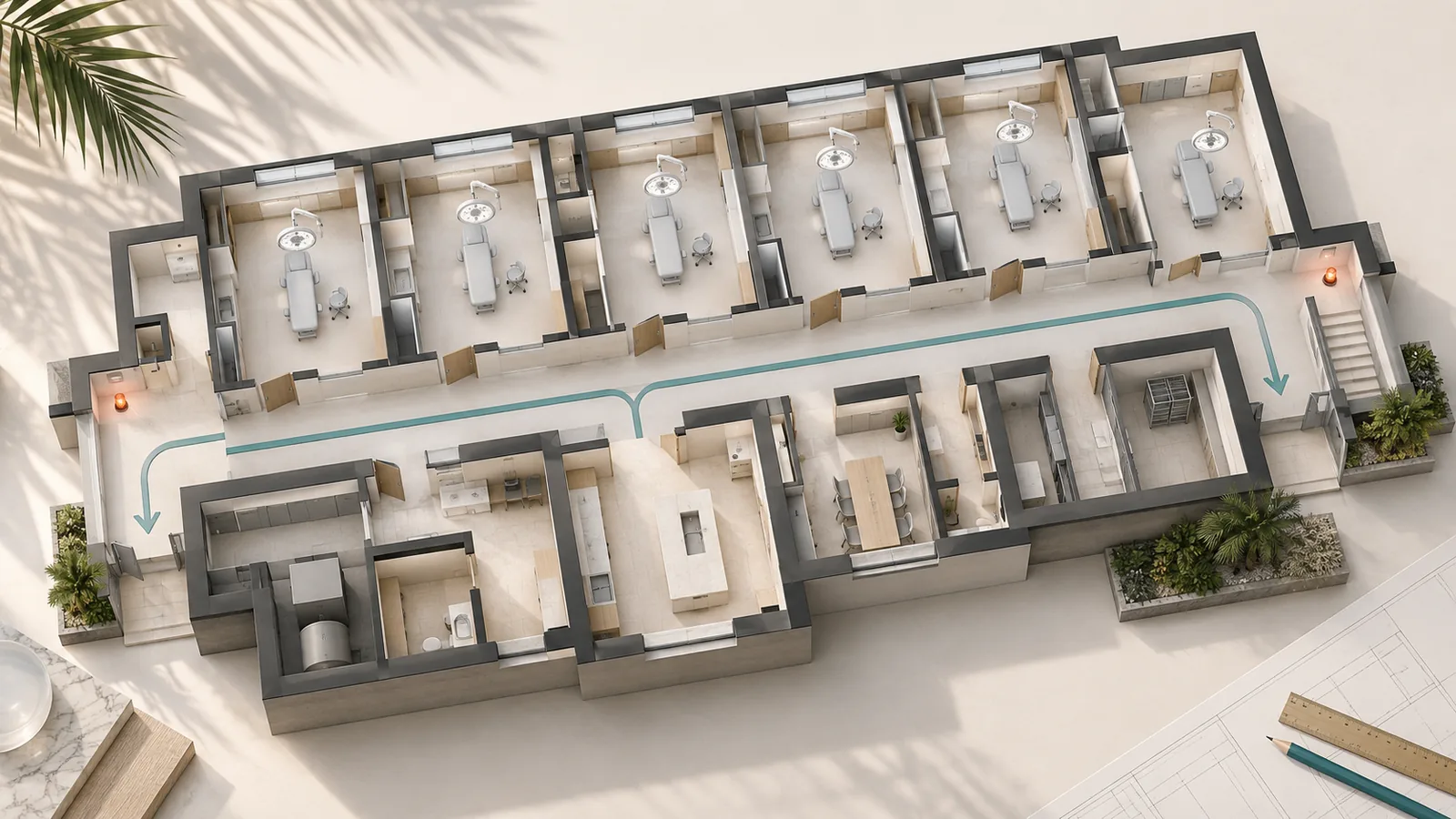
Florida’s 2026 section 553.884 directs the Florida Building Commission and State Fire Marshal to establish alternative building and fire-safety design standards by January 1, 2027 for qualifying office-surgery suites serving no more than six patients simultaneously. The law took effect July 1, 2026, but it is a code-development mandate—not automatic permission to operate six surgical patients, ASC licensure, accreditation, or a substitute for Board of Medicine office-surgery rules.123
The distinction matters because “the new Florida six-patient law” can sound like an immediate expansion of clinical authority. The statute addresses building and fire design. Patient concurrency, registration, staffing, anesthesia, procedure, recovery, inspection, emergency transfer, professional scope and other operational requirements remain separate questions.
Put the records in the correct layer
| Record | What it addresses | What it does not establish |
|---|---|---|
| Section 553.884 | Direction to create alternative building and fire design standards for defined office-surgery suites | That final technical standards were already adopted or a specific suite may use them |
| Florida Building Code and Fire Prevention Code | Adopted occupancy, construction, egress, fire protection and related technical requirements | Professional licensure or clinical procedure authority |
| Office-surgery registration | Physician and office compliance with applicable medical-board requirements | ASC licensure, hospital status or building-code approval |
| Accreditation | A private accreditor's standards and survey for its scope | Automatic state licensure or universal procedure approval |
| AHCA facility license | Licensure of a facility category such as an ambulatory surgical center | That a physician office is an ASC because surgery occurs there |
One address may have several records. A current business tax receipt or certificate of occupancy does not replace medical registration; a medical registration does not replace building and fire approval.
The six-patient figure has boundaries
The enacted statute describes office-surgery suites serving no more than six patients simultaneously under the alternative design standards to be established.1 The official legislative summary explains the pre-change code context and legislative objective.3 Do not convert that ceiling into a staffing ratio, procedure-volume recommendation, operating-room count, or personalized safety standard.
Until the implementing code is adopted and effective, verify the current code text, effective dates, permits and local interpretation for the exact suite. Even after adoption, a facility must demonstrate that it qualifies and complies. “Designed for six” does not mean six anesthetized patients may be managed by one physician or team.
Occupancy, simultaneous patients, and staffing are different numbers
Building occupancy calculations address how a space is classified and designed. The statutory “patients simultaneously” concept helps define the alternative suite standards. Clinical concurrency asks who is being evaluated, anesthetized, operated on, or recovered at the same time and which licensed professional is responsible. Staffing ratios and professional duties come from separate laws, rules, standards and the actual care plan.
Ask the practice to map a busy hour: patients in pre-op, procedure rooms and recovery; anesthesia professionals; surgeons; circulating and recovery staff; and who can respond if two patients deteriorate. A floor plan with six bays does not answer the map.
Likewise, a maximum design capacity is not a target. A suite may operate below it because of procedure type, anesthesia depth, staff, equipment, recovery needs or other rules. Advertising “new law allows six surgeries at once” would collapse several layers that must remain separate.
Adoption has a document trail
The path from statute to usable design standard can include commission workshops, proposed text, notices, public comment, final code adoption, an effective date, local plan review, permit, construction, inspection and occupancy approval. Each document answers a different status question.
Save the exact code edition and section cited by the architect or practice. Ask whether a local amendment, interpretation or existing-building provision applies and which authority approved it. A rendering, contractor statement or pending permit is not final approval.
Renovated spaces can raise questions about change of occupancy, fire barriers, sprinklers, alarms, egress, medical gas, electrical systems, accessibility and recovery areas. The final scope will depend on adopted technical language and the project. Consumers do not need to audit construction, but they can ask for current official approval rather than a promise that the space “was built to the new law.”
Emergency design and clinical response must connect
Life-safety design provides routes, separations, alarms and other physical protections. The practice still needs people, equipment and protocols to recognize an emergency, rescue the patient, summon emergency medical services, transfer records and continue care. A compliant corridor does not perform airway management; a skilled team cannot compensate for a blocked exit.
Ask where recovery occurs, how patients are observed, how emergency access reaches the suite, whether elevators or stairs affect transfer, and which hospital or emergency department is used. Compare those answers with the registration and anesthesia plan for the exact procedure.
A design law does not change the clinical rules by implication
Florida section 458.328 separately addresses physician office surgeries, including registration and practice requirements.4 Related Board of Medicine rules and Department of Health processes address inspections, anesthesia, personnel, equipment, transfer arrangements and other safeguards. Those provisions must be checked in their current versions.
The office-surgery registration guide explains registration, accreditation and inspection. The hospital-versus-ASC-versus-office guide separates facility types. Section 553.884 should be read alongside those systems, not as an override.
Ask a practice to identify:
- facility legal name and exact address;
- whether each procedure occurs in a hospital, licensed ASC or registered office;
- current office-surgery registration record;
- accreditation claimed and its current scope;
- building permit, certificate of occupancy and applicable code edition;
- fire inspection and emergency systems;
- number and location of operating, procedure, pre-op and recovery spaces;
- named clinicians and concurrent patient responsibilities;
- transfer plan, destination and transport process.
“Suite” is not a consumer quality grade
Marketing terms such as surgical suite, accredited suite, hospital-grade, operating theater and private OR can describe different physical and regulatory realities. Obtain the formal facility category and records. A beautiful room may lack a relevant authorization; a compliant facility can have modest décor.
Likewise, code compliance is a minimum legal and technical condition, not proof of the surgeon’s training, judgment, patient selection, result quality or complication rate. Verify the clinician and operation independently.
Watch implementation, not slogans
Section 553.884 sets a January 1, 2027 deadline for the responsible code bodies to establish alternative standards.1 Rulemaking and code adoption can produce proposals, workshop documents, technical amendments, effective dates and transitional provisions. A bill summary or commission slide is evidence of process, not the final enforceable code.
When a practice claims compliance with the new pathway, ask for:
- the final adopted code section;
- effective date;
- permit or plan-review record applying it to the address;
- final inspection or occupancy approval;
- any conditions or maximum occupancy;
- the separate current clinical registration and staffing plan.
If the technical standards remain pending, the honest answer should say so.
Compare settings by the proposed operation
A hospital, ASC and office can have different licensure, staffing, anesthesia, equipment, escalation, overnight, billing and transfer structures. No setting wins in the abstract. The appropriate comparison depends on the person’s health, operation, expected duration, anesthesia, combined procedures and required rescue capability.
Price should itemize facility, anesthesia, surgeon, assistants, implants or supplies, pathology, medicines, recovery, possible transfer and follow-up. A lower office facility fee should not be compared with an ASC quote until the procedure and included capabilities match.
The decisive question
Ask: “Which final, currently effective building and fire standards apply to this exact address today, what official record shows compliance, and how do the separate office-surgery registration and clinical staffing rules apply to my procedure?” The 2026 law creates a pathway for standards; it is not the completed proof for a particular suite.
Sources
- Florida Legislature. Florida Statutes § 553.884—Office surgery suites; safety design standards. Enacted direction, scope, definitions, code-development deadline, and agency responsibilities. Accessed .
- Florida Department of State. Chapter 2026-89, Laws of Florida. Enrolled law and July 1, 2026 effective date. Accessed .
- Florida Senate. 2026 bill summary—CS/HB 1175. Official legislative summary of prior design thresholds, intended alternative standards, and implementation. Accessed .
- Florida Legislature. Florida Statutes § 458.328—Office surgeries. Separate current physician office-surgery registration and practice requirements that the design statute does not replace. Accessed .