Infrared sauna versus traditional sauna: compare the exposure, evidence, and controls
Infrared and traditional saunas can both create heat stress, but they deliver it differently. A useful comparison measures the actual cabin conditions, thermal dose, study endpoint, device controls, and operating record—not the modality name alone.
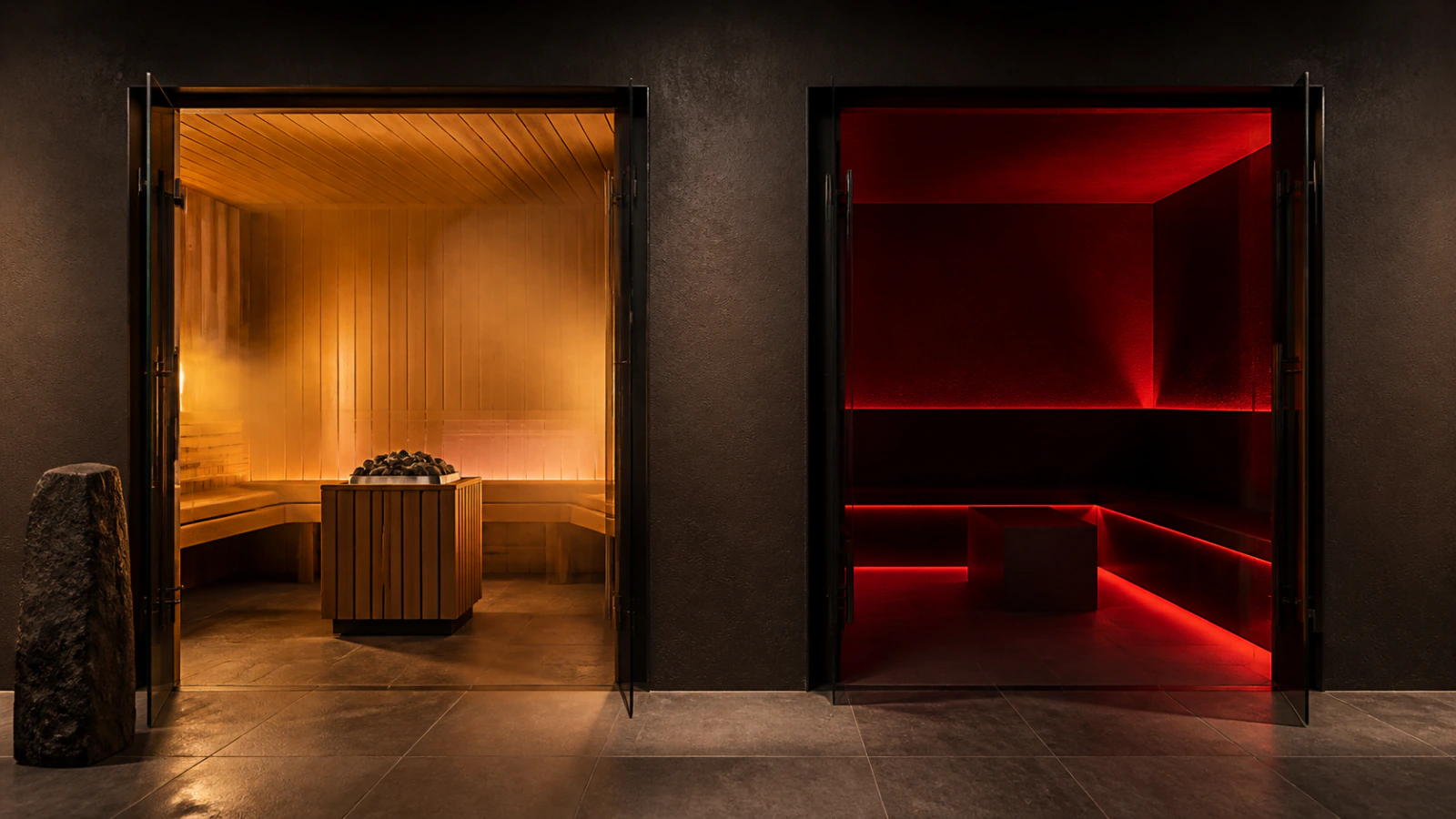
An infrared sauna and a traditional sauna are different heat-delivery systems, not two names for the same standardized dose. Traditional rooms mainly heat the air, surfaces, and bather through a hot stove or heater, convection, and radiation; water on heated stones can briefly raise humidity. Infrared cabins use radiant panels to transfer infrared energy while often operating at a lower air temperature. Either can raise skin temperature, heart rate, sweating, and sometimes core temperature—but only under the actual measured conditions.13
The comparison should therefore begin with the device, environment, session protocol, and endpoint. It should not begin with “deeper,” “gentler,” “more detoxifying,” or another adjective that has no defined unit.
Two mechanisms, many real exposures
| Comparison field | Infrared sauna | Traditional sauna |
|---|---|---|
| Primary heat delivery | Radiation from infrared-emitting panels or elements, plus warmed air and surfaces | Hot air and surfaces created by an electric or wood-fired heater, with convection and radiation |
| Common equipment | Cabin panels, dome, or blanket; each creates a different geometry and contact condition | Enclosed room, heater, stones when designed for them, ventilation, and benches at different heights |
| Environmental variables | Panel temperature and distance, air temperature, humidity, airflow, coverage, insulation, and controller behavior | Air temperature by bench height, humidity, airflow, heater output, room volume, water use, and controller behavior |
| Dose record | Time plus measured thermal environment, emitter arrangement, body coverage, interruptions, and physiological response | Time plus measured temperature and humidity at the occupied position, water events, interruptions, and physiological response |
| Evidence boundary | A result from one wavelength band, geometry, temperature, and protocol cannot represent every cabin or blanket | A result from one Finnish-style, dry, steam-assisted, or other room protocol cannot represent every traditional sauna |
Published descriptions often cite traditional Finnish-style rooms around 80–100°C with relatively low baseline humidity and infrared cabins at lower air temperatures. Those are contextual ranges, not required settings and not a dose conversion. A person at a high bench can experience different heat from someone near the floor. A blanket creates direct contact and constrained heat loss that a walk-in cabin does not. The controller display may also measure somewhere other than the occupied position.
Name the thermal dose before naming a benefit
A service record becomes testable when it captures:
- exact make, model, configuration, and maintenance status;
- heater or emitter type and location;
- preheat procedure;
- air temperature and humidity measured at the occupied position;
- panel distance or blanket contact and body coverage;
- session duration, interruptions, water-on-stone events, and cooling period;
- participant posture and relevant co-exposures; and
- endpoint timing and measurement method.
The 2026 far-infrared study at 65°C is a useful example because its title names a temperature and its methods define the exposure; it found that this particular protocol elevated core temperature.1 It does not prove that every product marketed as far infrared creates the same thermal strain, nor that the observed physiological change produces a particular long-term health outcome.
“Sweated more” is also incomplete. Sweat volume reflects heat load, environment, acclimatization, hydration, body characteristics, and measurement method. It does not identify a removed substance or establish a clinically meaningful “detox.” A detoxification claim needs a named substance, validated measurement, exposure source, amount eliminated, comparator, and patient-important outcome. General sweating cannot supply those missing elements.
Endpoint ladders prevent evidence inflation
Put every claim on the rung it actually studied:
- Engineering endpoint: cabin temperature, humidity, heater output, wavelength distribution, timer accuracy, or surface temperature.
- Immediate physiological endpoint: skin or core temperature, heart rate, blood pressure, sweat loss, plasma-volume change, or perceived heat.
- Short-term laboratory endpoint: a biomarker measured after one session or a brief series.
- Functional or symptom endpoint: a validated measure captured at a defined time with an appropriate comparator.
- Clinical event endpoint: a health outcome measured over enough time in a relevant population.
A change on rung two cannot be advertised as proof of rung five. The 2025 meta-analysis of passive-heating randomized trials combined several modalities and outcomes; that breadth is useful for studying passive heat, but it also limits any attempt to assign a pooled effect to one infrared cabin or one traditional-sauna protocol.2 The dry-sauna systematic review likewise found a literature with many small or nonrandomized studies and varied populations, exposures, and outcomes.3 Observational associations among frequent sauna users cannot by themselves separate sauna exposure from health status, lifestyle, culture, or access.
Infrared sauna is not red-light therapy
Both names refer to electromagnetic radiation, but the treatment records are different. A far-infrared sauna is designed primarily to produce heat over a relatively large body area. Red-light or near-infrared photobiomodulation is described by specific wavelengths, irradiance, fluence, treatment distance, pulsing if any, target tissue, and a device-specific indication or claim. A cabin may include colored ambient lights or separate light-emitting panels; that does not make its heat session equivalent to a studied photobiomodulation protocol.
Ask the provider to separate the line items:
- thermal session settings and environmental measurements;
- any independent light device, wavelength, irradiance, fluence, and treatment geometry; and
- evidence tied to each exact device and claimed endpoint.
“Infrared penetrates deeper” is not a complete outcome claim. Penetration depends on wavelength, tissue optical properties, power, geometry, and absorption, while the relevant question is what measured biological or clinical outcome followed under that protocol.
Controls belong in the comparison
Heat exposure can lead to dehydration, dizziness, overheating, or heat-related illness; risk depends on both the environment and the person exposed.4 Burns and electrical or fire hazards require exact model and recall checks.56 Product design adds another layer: temperature sensors, thermal cutoffs, timers, door or release mechanisms, wiring, grounding, installation clearance, ventilation, maximum occupancy, surface guards, and emergency procedures.
Recent recalls show why “infrared” or “traditional” is too broad for a safety conclusion. In October 2025, CPSC recalled certain Lifepro Bioremedy infrared sauna blankets after overheating reports and burn injuries.5 CPSC also recalled particular DIY sauna-heater kits for an electrical overheating and fire hazard.6 Neither recall condemns an entire modality. Each makes exact model, date code or serial range, installation, and corrective action part of the due-diligence record.
Compare quotes line by line
A price comparison is not meaningful until the exposure and inclusions match. Request written fields rather than a single session name.
| Quote field | What the written answer should identify |
|---|---|
| Unit | Manufacturer, model, cabin versus blanket, age, and current recall status |
| Protocol | Preheat, occupied temperature and humidity range, duration, supervision, cooling time, and whether settings are adjustable |
| Capacity | Private or shared use, occupancy limit, bench or body position, and cleaning turnaround |
| Controls | Timer, overtemperature limit, accessible exit or release, emergency call path, and staff response |
| Operations | Cleaning products and contact time, linen policy, inspection cadence, service history, and staff training |
| Package | Number of sessions, expiration, cancellation, transfer, taxes or fees, and refund terms |
| Claims | Exact endpoint, evidence source, device match, number and timing of sessions, and important limitations |
The same audit applies to a home unit quote, with added attention to space, electrical circuit, ventilation, flooring, assembly, warranty, return freight, replacement parts, and professional installation requirements. No advertised modality can substitute for the manufacturer’s actual installation and operating limits.
A clean comparison has three columns
- Define the machine. Record the exact cabin, blanket, heater, panel arrangement, controller, and occupied geometry.
- Measure the environment. Use actual temperature, humidity, time, position, contact, and interruption data rather than a modality stereotype.
- Label the endpoint rung. Keep engineering, immediate physiology, biomarkers, symptoms, and clinical events distinct.
- Check evidence transfer. Confirm that the study's device type, protocol, population, comparator, and time point match the claim being made.
- Audit operating controls. Verify model identity, instructions, recalls, installation, maintenance, cleaning, temperature limits, timer, exit, and emergency process.
- Normalize the quote. Compare the same exposure and inclusions, then preserve package and cancellation terms without inventing a typical price.
The fairest final sentence is concrete: “This unit produced this measured heat exposure for this duration, the cited study measured this endpoint under these conditions, and these controls govern the actual session.” Anything broader is a category claim waiting for its specifications.
Sources
- PubMed Central. Far-infrared sauna exposure at 65°C elevates core temperature. 2026 controlled exposure study used to distinguish a measured far-infrared protocol from generic infrared-sauna marketing. Accessed .
- PubMed. Non-acute effects of passive heating interventions on cardiometabolic risk and vascular health: systematic review and meta-analysis of randomized controlled trials. 2025 synthesis of randomized trials across passive-heating modalities, used to show endpoint and modality heterogeneity. Accessed .
- PubMed. Clinical Effects of Regular Dry Sauna Bathing: A Systematic Review. Systematic review of dry-sauna evidence, including study-design, size, protocol, and outcome limitations. Accessed .
- Centers for Disease Control and Prevention. About Heat and Your Health. Federal description of heat strain, heat-related illness, susceptibility factors, and the importance of actual environmental exposure. Accessed .
- U.S. Consumer Product Safety Commission. Lifepro Fitness Recalls Bioremedy Infrared Sauna Blankets Due to Risk of Burn Injuries. October 2025 recall documenting overheating reports, burns, and the importance of exact model and serial-number checks. Accessed .
- U.S. Consumer Product Safety Commission. DIY Cold Plunge Recalls Sauna Heater Kits Due to Risk of Serious Injury or Death from Fire Hazard. 2026 recall illustrating electrical installation and overheat hazards in sauna equipment. Accessed .