Red light therapy: clinic panels versus at-home masks
Clinic panels and at-home masks can use similar color names while delivering different wavelengths, irradiance, dose, distance, coverage, and schedules. Those numbers matter more than brightness.
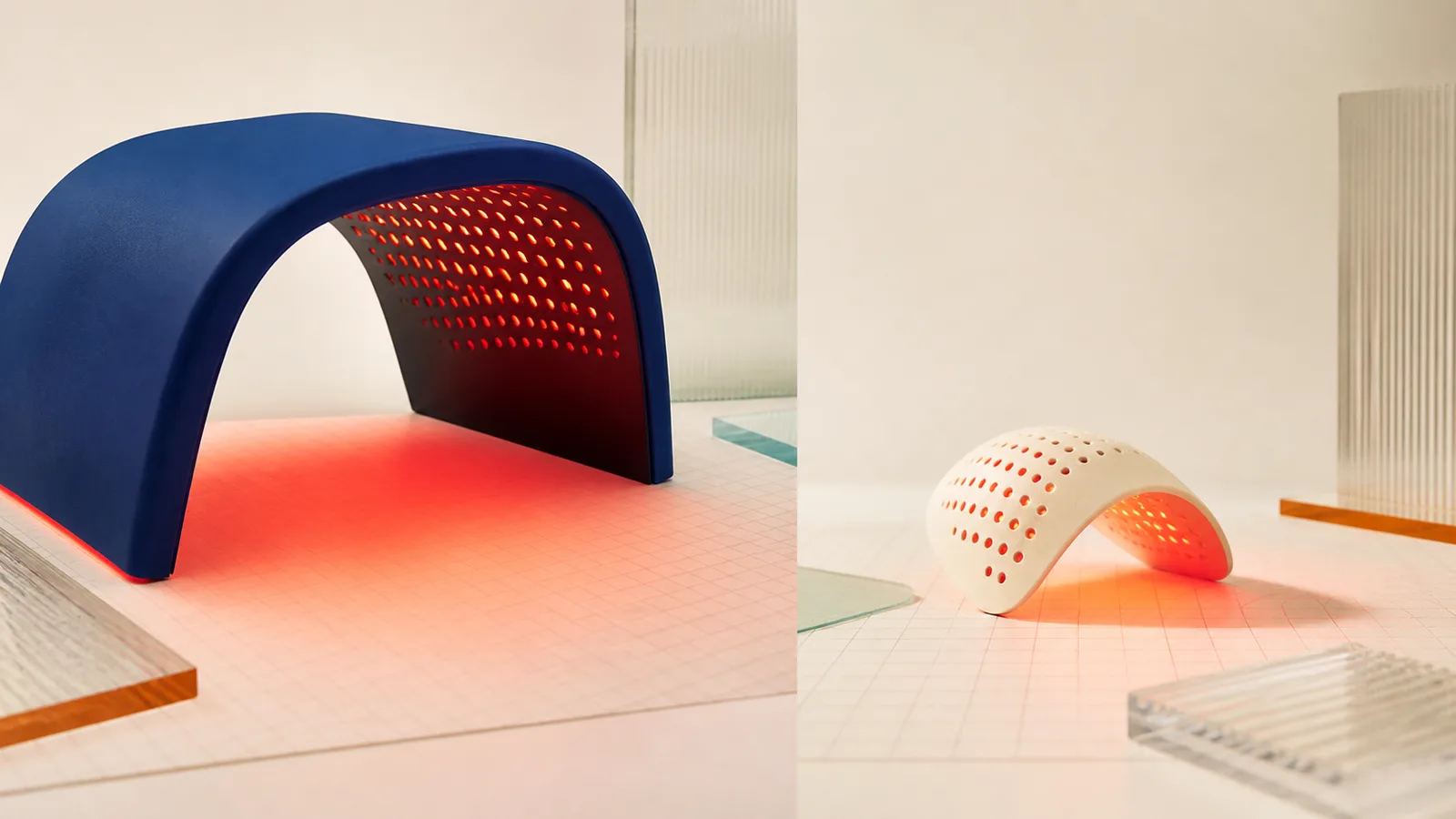
A clinic panel is not automatically stronger or better than an at-home red light mask, and a brighter-looking device is not automatically delivering a more useful dose. The meaningful comparison is wavelength, irradiance at the treatment surface, time, distance, coverage, schedule, and evidence for the exact goal.
Red and near-infrared light used at relatively low power is often called photobiomodulation or low-level light therapy. Results are parameter- and condition-specific; “red light works” is too broad to describe the evidence.
Translate the specifications
| Specification | What it means | Why it matters |
|---|---|---|
| Wavelength (nm) | The color or band of light; near-infrared is outside visible red. | Different wavelengths penetrate and interact with tissue differently. |
| Irradiance (mW/cm²) | Power arriving per unit area at a stated distance. | It helps determine how quickly energy is delivered. |
| Fluence or dose (J/cm²) | Energy delivered per unit area, roughly irradiance multiplied by time. | A session cannot be compared by minutes alone. |
| Distance | Gap between emitter and treatment surface. | Irradiance and uniformity can change substantially with distance. |
| Coverage and uniformity | How much of the target receives a similar exposure. | A peak number at the center may not describe edges or a curved mask. |
| Schedule | Sessions per week and total duration. | Home convenience may support repetition; clinic visits may use a different protocol. |
If a manufacturer gives only LED count, wattage drawn from the wall, or color names, you still do not know the dose at the skin. Ask for measured irradiance at the prescribed distance and how evenly it is distributed.
Clinic panel versus home mask
Clinic panels may cover a larger area, allow controlled distance, and be operated under a documented protocol. A flexible or rigid home mask places emitters closer to a curved surface and can make frequent sessions easier. Neither format guarantees correct parameters, accurate claims, good eye protection, or adherence.
A practical comparison includes the full course. Multiply session time by frequency and expected months of use, then include travel, setup, cleaning, and replacement. A technically capable device used inconsistently is a different intervention from the protocol in a study.
What the evidence can support
A 2025 umbrella review examined 15 meta-analyses covering 204 randomized trials and more than 9,000 participants. It found moderate-certainty evidence for some outcomes, including hair density in androgenetic alopecia, while most other evaluated outcomes had low or very low certainty because of heterogeneity or small-study effects.1 That is a more accurate picture than treating photobiomodulation as either universally proven or useless.
A meta-analysis specifically on androgenetic alopecia found higher hair density with photobiomodulation than control across included studies.4 This supports a condition-specific conversation; it does not establish that any red bulb, facial mask, or whole-body panel produces the studied result.
The home-device literature also includes positive findings but calls for more randomized research and careful attention to dosing.2 Product-specific parameters and adherence remain the bridge from a study to your routine.
FDA clearance and marketing language
Some light devices are FDA-cleared for a specified indication through the 510(k) pathway. Look up the exact model and manufacturer in the FDA database and read the decision summary.3 “FDA registered,” “medical grade,” and “uses FDA-cleared technology” are not the same as a clearance for that exact device and claim.
Beauty claims about appearance and medical claims about treating a condition also belong to different evidence conversations. Ask what precise outcome is being promised, how it is measured, and whether the product-specific record covers it.
Six comparison questions
- Define the goal. Skin appearance, acne, pain, recovery, and hair density should not share one evidence answer.
- Get the wavelengths. Record each stated peak or band rather than accepting red plus infrared.
- Calculate the delivered dose. Use measured irradiance at the actual distance and session time; ask about coverage uniformity.
- Match the exact device. Check the model in the FDA database when clearance is claimed and compare the authorized indication.
- Review use conditions. Discuss eye protection, photosensitizing medicines or conditions, heat, skin response, cleaning, and device integrity.
- Set a review point. Choose a realistic date and objective measure for continuing, adjusting, or stopping rather than buying an endless protocol.
A practical decision framework
Comfort and fit affect delivered exposure. A curved mask may sit close at the cheeks and farther from the chin; a panel may require a position you cannot hold consistently. Ask whether the stated irradiance was measured on a flat plane or across the actual treatment geometry. Heat, pressure points, glare, fan noise, session length, and setup time can determine whether a technically attractive protocol is usable for months.
For home devices, review warranty, return window, replacement parts, cleaning method, electrical certification, and whether output is expected to decline over time. For clinic packages, ask whether missed sessions can be rescheduled and whether the same device and distance are recorded. Neither consumer lux nor a phone-camera image measures therapeutic dose; use product documentation or an appropriate calibrated measurement instead.
Finally, more dose is not automatically better. Photobiomodulation protocols can be dose-dependent, and combining overlapping home and clinic schedules without a plan may move away from the studied exposure. Bring every device and schedule into the same conversation.
Choose by goal first, then compare product-specific parameters, relevant evidence, total schedule, safety instructions, and cost per completed course. A clinic panel offers supervision and controlled setup; a home mask offers convenience and repetition. Treomark’s red-light search can show locations publishing the service, but only the protocol tells you whether two red-looking experiences are comparable.
Sources
- PubMed. Effects of photobiomodulation on multiple health outcomes: an umbrella review of randomized clinical trials. Umbrella review of 15 meta-analyses covering 204 randomized trials and the certainty of evidence across outcomes. Accessed .
- PubMed. Therapeutic efficacy of home-use photobiomodulation devices: a systematic literature review. Systematic review of home-use devices, dosing, adherence, and limits in the evidence. Accessed .
- U.S. Food and Drug Administration. 510(k) Premarket Notification database. Database for checking whether a named light device has a clearance and for what indication. Accessed .
- PubMed. Meta-analysis of photobiomodulation for the treatment of androgenetic alopecia. Meta-analysis of photobiomodulation and hair-density outcomes in androgenetic alopecia. Accessed .