PRP and PRF cost: a tube, kit, session, and treatment plan are not equivalent units
A blood-collection tube is an input, not a standardized dose or outcome. Compare PRP or PRF quotes by indication, collection volume, tube or kit, anticoagulant, processing, final preparation and volume, delivery route, anatomy, session series, add-ons, operator, follow-up, and failed-draw policy.
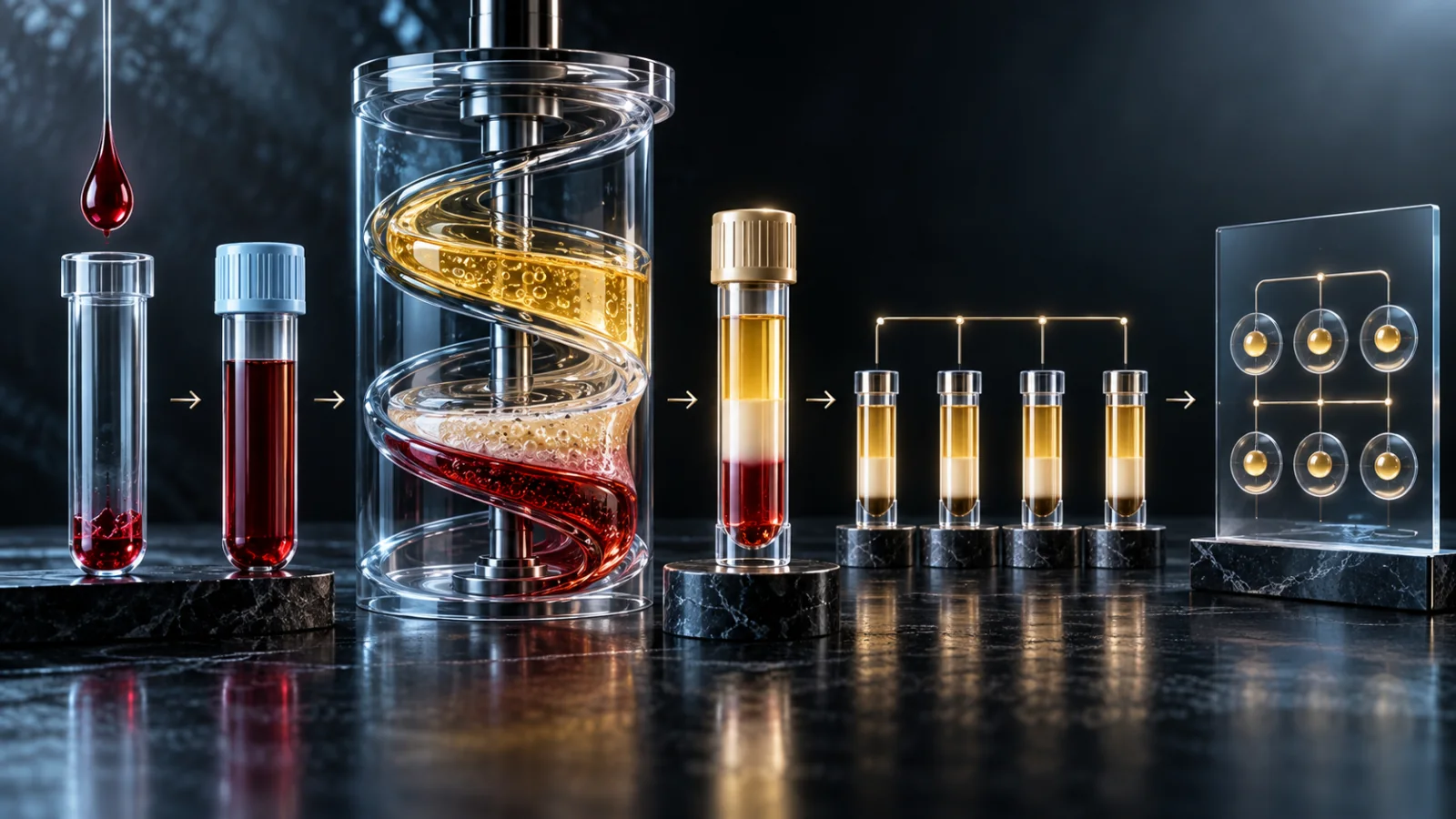
A PRP or PRF tube is a collection and preparation input, not a standardized treatment dose, session, or outcome. Tubes can differ in volume, additives, intended use, processing, platelet recovery, leukocyte and red-cell content, clot behavior, and final yield. A comparable quote must state the indication, collection volume, exact tube or kit, anticoagulant when used, centrifugation and processing, final preparation and volume, delivery route, anatomy, number and interval of sessions, add-ons, operator, follow-up, and what happens after a failed or incomplete draw.234
“Two tubes for the price of one” can describe more collected blood without proving a larger usable preparation, a standardized platelet dose, better evidence, or a better outcome. Likewise, PRF is not simply premium PRP. The preparation and clotting behavior change the material.
Convert marketing units into a process map
| Unit | What it actually describes | What remains unknown |
|---|---|---|
| Tube | A container and a nominal collection volume with or without additives | Platelet recovery, final volume, cellular profile, processing, clinical dose, or outcome |
| Kit | A collection/processing system with a defined regulatory and technical record | Approval of the treatment indication or equivalence to another kit |
| Spin or centrifugation step | A speed/time/geometry process that separates blood components | The final preparation unless radius, protocol, transfers, and yield are reported |
| Syringe or milliliter | Final material volume presented for delivery | Platelet or fibrin characteristics, concentration, activation, or evidence for the intended tissue |
| Session | One appointment that may include different draws, preparations, routes, and areas | Whether two clinics deliver the same material or complete course |
| Plan | A series plus follow-up, concurrent care, and a decision rule | Value unless endpoint, interval, add-ons, and exit terms are written |
The reviews document substantial variability in commercial systems, centrifugation, preparation, outcome measures, and timing.23 That heterogeneity is precisely why tube count cannot function as a universal dose or quality score.
Start with the intended use and route
PRP or PRF may be marketed for scalp hair loss, facial injections, microneedling application, scars, sexual-wellness injections, joints, surgery, or other uses. Evidence for one anatomy, preparation, and delivery method does not validate another. Define the exact condition or cosmetic target, how it was assessed, the delivery route and depth, and the outcome measure.
For hair, distinguish diagnosis and stabilization from the injection series. For facial use, distinguish direct injection from topical application after microneedling. FDA says authorized microneedling devices are not authorized for delivering blood products into the skin; a cleared microneedling cartridge does not approve a PRP combination.5 If a clinic cites a study, match the same preparation, population, delivery, concurrent treatment, endpoint, and follow-up.
“Autologous” means the material originated from the same person; it does not make every preparation method equivalent, sterile by default, or FDA approved for the claimed treatment. FDA’s CBER discussion identifies PRP as a blood product outside the HCT/P framework; in that forum FDA did not provide product-specific direction on individual tubes or kits.4
Reconstruct what happens between draw and delivery
Ask for the manufacturer and product number of tubes and kit; nominal blood volume; anticoagulant or separator; number of spins; centrifuge model, speed and time; transfers; activation; final volume; whether red cells or leukocytes are intentionally included; and how the preparation is labeled and kept associated with the right person.
Relative centrifugal force is not the same as revolutions per minute. Tube radius changes the force at a given RPM. A proprietary protocol can remain proprietary while still disclosing enough to identify the system and final material. “High concentration” needs a measured numerator, baseline, and method; a logo or tube color is not a laboratory result.
The workflow should include blood-draw safety, identity controls, aseptic preparation, single-use supplies, surface and centrifuge cleaning, sharps disposal, injection or microneedling infection control, and management of spills or interrupted processing. Any topical anesthetic, local anesthetic, additive, calcium product, exosome, filler, drug, or energy device is a separate component.
Normalize the quote at the treatment-plan level
ASPS explains that cosmetic-procedure cost varies with provider, geography, facility, anesthesia, and related components.1 No broad professional-fee figure would be a PRP tube price, South Florida market rate, or full-course total. Build the local quote from evaluation, diagnosis, laboratory work if clinically used, blood draw, kit/tubes, processing, delivery, anesthesia, treated areas, photographs, sessions, follow-up, concurrent care, maintenance, taxes, financing, travel, and complication evaluation.
Write the failed-draw and low-yield policy. Does the clinic charge for an unsuccessful collection, reattempt the same day, reschedule, substitute another tube, or change the plan? What happens if only part of the intended anatomy is treated or the preparation clots before delivery? These terms affect value more than a headline tube count.
A five-pass cost audit
- 1. Match the indication Define the tissue, finding, evidence, and outcome before comparing tube or session counts.
- 2. Identify the preparation Record collection volume, exact tubes/kit, additives, processing, final volume, and reported cellular or fibrin characteristics.
- 3. Identify delivery Name injection, cannula, microneedling, topical application, surgical use, anatomy, depth, operator, and infection controls.
- 4. Price the complete series Include diagnosis, draw, preparation, sessions, follow-up, concurrent care, maintenance, failed draws, and financing.
- 5. Preserve a transferable record Keep product identifiers, protocol, dates, treated sites, photographs, response, adverse events, and stop or revision decisions.
The defensible value unit is not a tube. It is a transparent, evidence-matched treatment plan whose preparation, delivery, workload, follow-up, and failure terms can be compared line by line.
Sources
- American Society of Plastic Surgeons. Understanding plastic surgery costs in the United States. Professional explanation of provider, geography, facility, anesthesia, and related factors that make one headline price incomplete. Accessed .
- Dermatologic Surgery. Platelet-rich plasma in dermatologic surgery: preparation and protocol review. Commercial-system, preparation, protocol, timing, and outcome heterogeneity. Accessed .
- Periodontology 2000. Platelet-rich plasma versus injectable platelet-rich fibrin: systematic review. Substantial preparation and tissue heterogeneity and need for standardized reporting. Accessed .
- U.S. Food and Drug Administration. Information for Practitioners — FDA's Regulatory Oversight of Regenerative Medicine Products. FDA discussion identifying PRP as a blood product outside the HCT/P framework and declining product-specific direction on individual tubes or kits. Accessed .
- U.S. Food and Drug Administration. Microneedling devices. Authorized microneedling-device uses and the explicit limit on delivering blood products into skin. Accessed .