Smartwatch blood oxygen vs a medical pulse oximeter
A smartwatch may estimate oxygen saturation from reflectance signals at the wrist, often for wellness use. A medical pulse oximeter has a specific intended use, sensor geometry, performance evidence, labeling, and clinical context. Neither measurement should be interpreted without signal quality and symptoms.
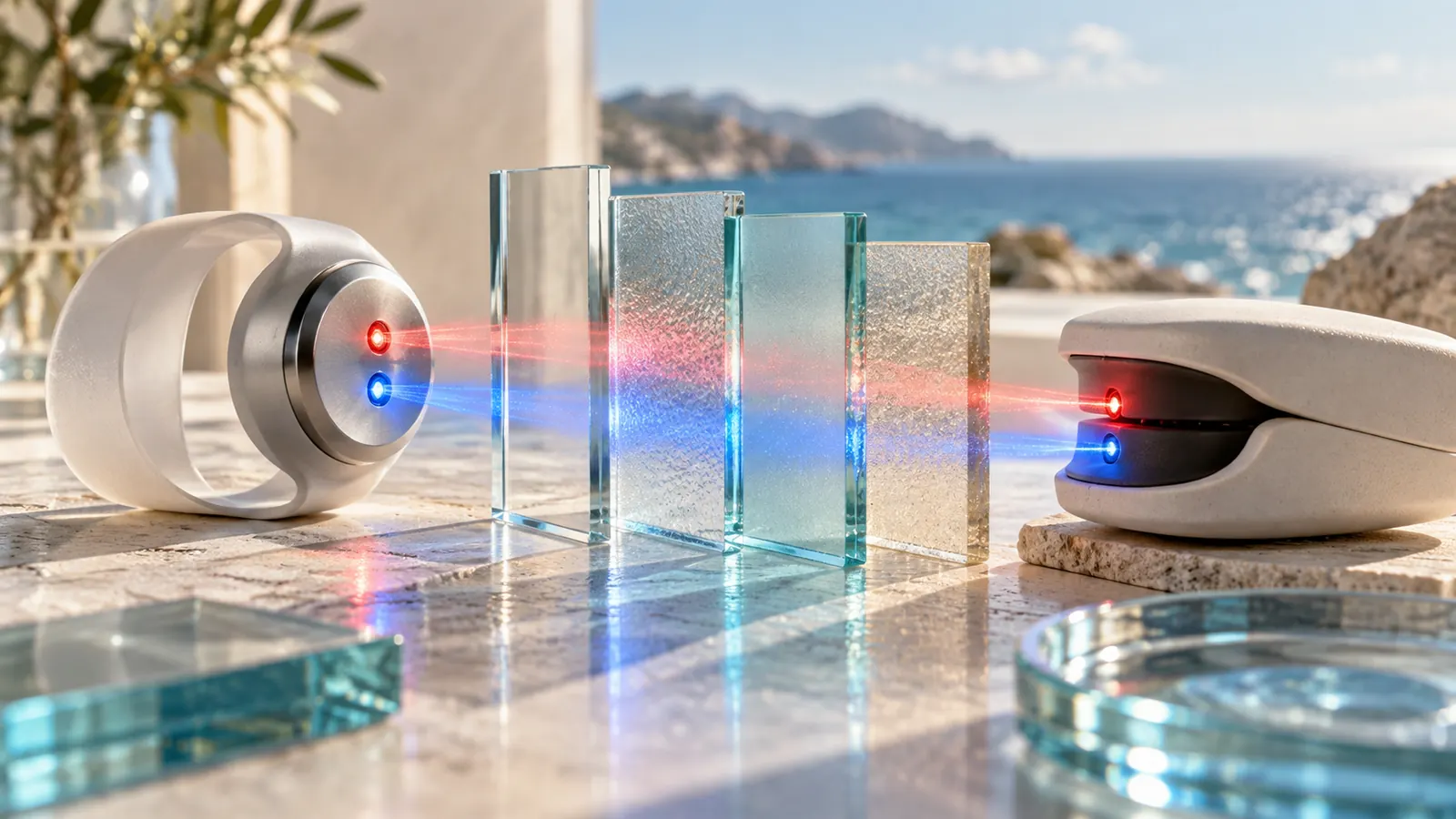
A smartwatch blood-oxygen value and a medical pulse-oximeter result are not automatically equivalent. Many watches use reflectance photoplethysmography at the wrist and may label the feature for wellness or spot checks; a medical oximeter has a product-specific intended use, sensor site, validation, performance limits and labeling. Both estimate arterial oxygen saturation indirectly, and motion, perfusion, skin properties, fit, temperature, nail factors, software, and illness context can affect readings.1245
The first verification step is not comparing two displayed percentages. It is identifying what each device is authorized and validated to do.
Reflectance and transmissive sensors see different optical paths
| Feature | Typical wrist wearable | Typical fingertip pulse oximeter |
|---|---|---|
| Geometry | Light emitted into and reflected back from wrist tissue | Light commonly transmitted through finger to a detector |
| Use pattern | Passive/overnight trends or prompted spot measurement | Observed spot check or continuous monitoring depending on product |
| Fit/contact | Band position, tightness, wrist anatomy and movement | Finger size, probe placement, nail and hand movement |
| Output | SpO2 estimate, trend, range or proprietary respiratory/wellness context | SpO2 and pulse rate, with alarms or waveform/perfusion features on some devices |
| Regulatory status | May be general wellness or a product-specific medical function | May be prescription, FDA-cleared OTC, or an unreviewed consumer product |
Fingertip shape does not itself prove FDA review. Search the exact model and intended use.
Oxygen saturation is estimated, not directly sampled
Pulse oximetry uses differences in light absorption between oxygenated and deoxygenated hemoglobin during pulsatile blood flow. The displayed SpO2 is an algorithmic estimate of arterial saturation, not an arterial blood-gas measurement.
FDA lists factors that can affect accuracy, including poor circulation, skin pigmentation, skin thickness, skin temperature, tobacco use and fingernail polish.12 Motion, ambient light, sensor placement, low perfusion and device-specific algorithms also matter. A stable-looking number can still be biased.
Ask whether the device displays signal quality, waveform or perfusion information and what its instructions say to do when the signal is poor. Repeating a low-quality measurement does not necessarily make it valid.
Skin tone evidence must be product specific
Evidence has shown systematic pulse-oximeter performance concerns across skin pigmentation, particularly at lower saturations. FDA’s January 2025 draft recommendations propose broader and better-characterized pigmentation representation, standardized assessment, and clearer labeling.3
Do not turn that into “all devices are inaccurate on darker skin” or “this brand solved bias.” Ask for the exact validation population, pigmentation measurement, saturation range, error metric, sensor model and software version. A study of one transmissive fingertip device cannot validate a wrist wearable.
Visual race categories are not a precise measure of skin pigmentation. High-quality validation should describe how pigmentation was measured and how results vary across relevant ranges.
Wrist convenience changes the data environment
Overnight watch readings may include long periods of motion, loose contact, pressure changes, cold hands, sleeping positions and intermittent sampling. The algorithm may suppress low-confidence measurements, creating gaps that are easy to overlook.
A nightly average can hide brief lows, while a minimum can reflect artifact. Ask:
- sampling frequency and whether it is continuous;
- how missing or rejected data are displayed;
- whether the app reports average, range, minimum or time below a level;
- software/firmware version;
- validation during sleep, exercise or altitude rather than only seated rest; and
- whether raw or high-resolution data can be exported.
Current wearable studies remain device- and protocol-specific.45 A good correlation at normal saturation does not prove reliable detection at clinically important low levels.
FDA status belongs to the exact feature
One watch can have an FDA-cleared ECG or rhythm-notification function while its blood-oxygen feature remains general wellness. Authorization does not transfer across sensors or software features.
Likewise, an OTC fingertip product may have a bounded intended use for spot-checking adults while a prescription hospital device supports monitoring under different conditions. Verify model, submission number, sensor, population, setting, saturation range, contraindications and labeling.
The general-wellness guide explains why registration, listing, clearance and approval cannot be substituted for one another.
A comparison reading requires a controlled protocol
If a clinician asks for side-by-side measurements, record time, posture, rest period, hand temperature, sensor site, watch fit, finger/nail condition, symptoms, altitude, activity and signal quality. Wait for each device to stabilize according to its instructions.
Even then, two consumer devices may differ within their allowed error. Do not average them into a third “true” value or select the preferred result. A clinical question may require a different device, repeated supervised measurement, arterial blood-gas measurement, or other clinician-selected testing, imaging, or evaluation.
Symptoms and trends belong together
FDA advises considering symptoms alongside a pulse-oximeter reading.2 Severe shortness of breath, chest pain, confusion, bluish discoloration, fainting or other urgent symptoms should not be dismissed because a watch shows a reassuring number. Conversely, one unexpected low value without symptoms can be artifact and still deserves a coherent repeat or follow-up plan rather than panic.
For a recurring trend, export dates, values, gaps, device/software, altitude, illness, sleep, exercise and relevant medicine changes. That record is more useful than a screenshot of one ring chart.
Wellness programs should not borrow hospital authority
A sleep, altitude, recovery or longevity program may display oxygen trends. Ask who reviews them, which thresholds are device-specific, what confirmatory pathway exists, and how urgent messages are handled. “Clinical-grade sensor” is a marketing phrase unless the exact product record and intended use support it.
- Identify the product Record exact model, sensor, software, intended use, FDA status, population and measurement mode.
- Check signal conditions Note site, fit, motion, perfusion, temperature, nails, skin/pigmentation evidence, altitude and signal quality.
- Name the summary Distinguish spot value, average, minimum, range, time below threshold and missing-data rules.
- Compare under one protocol Align timing, rest, posture and quality without assuming agreement identifies the true value.
- Define follow-up Keep symptoms, trends, confirmatory tools, result owner and urgent route attached to the measurement.
Treat the number as a sensor output, not a verdict
Ask: “What exact optical signal and algorithm produced this SpO2 estimate, for which intended use was it validated, how good was the signal, and what independent follow-up would change a decision?” A wrist number can be useful without becoming a medical pulse-oximeter result.
Sources
- Food and Drug Administration. Pulse oximeters. Federal device overview, limitations, prescription versus OTC products, factors affecting readings and product-specific intended use. Accessed .
- Food and Drug Administration. Pulse Oximeter Basics. Consumer guidance on estimating oxygen saturation, symptoms, reading limitations and the need to interpret measurements in context. Accessed .
- Food and Drug Administration. FDA Proposes Updated Recommendations to Help Improve Performance of Pulse Oximeters Across Skin Tones. January 2025 draft recommendations on broader and better-characterized pigmentation representation, clinical validation, labeling, and real-world performance limitations. Accessed .
- PubMed. Performance of Wearable Pulse Oximetry During Controlled Hypoxia Induction: Instrument Validation Study. 2026 product-specific comparison of one smartwatch and one medical fingertip oximeter against arterial saturation during controlled hypoxia, with small-sample limits. Accessed .
- PubMed. The accuracy of Apple Watch measurements: a living systematic review and meta-analysis. Current device-family review showing blood-oxygen accuracy varies by measurement conditions and physiology; low pooled mean bias coexisted with wide limits of agreement. Accessed .