Smartwatch ECG alert vs clinical ECG
A smartwatch can generate a background rhythm alert or a user-recorded single-channel tracing; neither equals a clinician-interpreted 12-lead ECG or diagnostic monitoring. A normal watch result cannot rule out a heart attack or every arrhythmia, and an alert is not a diagnosis by itself.
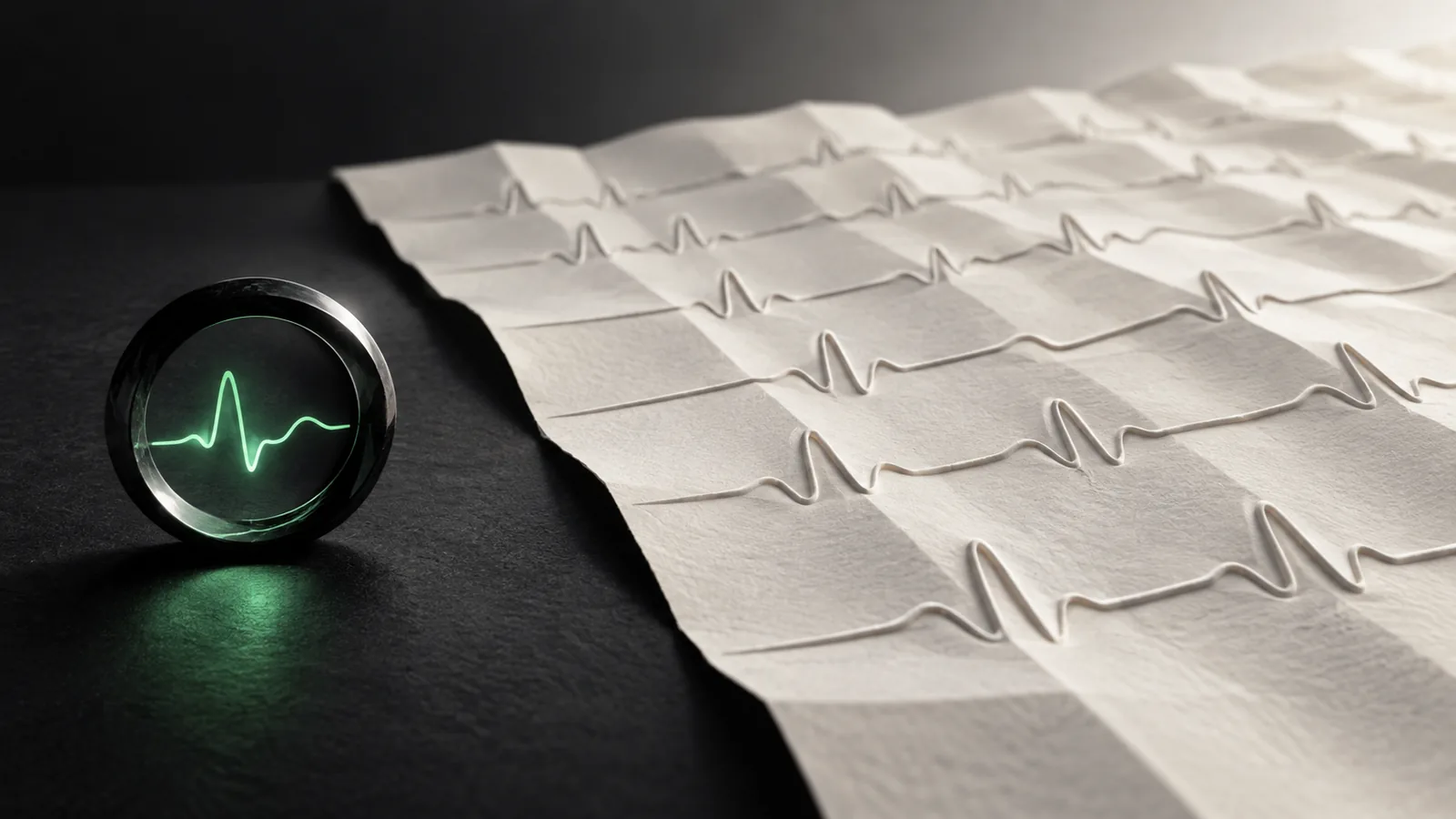
A smartwatch rhythm alert, a watch-recorded single-lead ECG, and a clinical ECG are different records. A watch can flag or display limited rhythm information for follow-up, but it does not by itself diagnose atrial fibrillation, rule out a heart attack, exclude other arrhythmias, or replace a clinician-interpreted 12-lead ECG or longer monitor when those are needed.125
The safest way to read a watch result is to identify what sensor produced it, whether the user actively recorded a tracing, what the cleared software is designed to classify, and what symptoms and clinical context sit outside the algorithm.
An alert and an ECG tracing are not the same artifact
Many watches use optical photoplethysmography (PPG) in the background to estimate pulse timing and look for irregularity. A watch ECG feature typically requires the wearer to touch an electrode and remain still while the device records a short, single-channel electrical tracing.6
| Record | What it captures | What it does not settle |
|---|---|---|
| Background irregular-rhythm notification | Pulse-pattern samples collected under the product's operating conditions | A diagnosis, continuous surveillance, or the rhythm at every unmeasured moment |
| User-recorded smartwatch ECG | Short Lead-I-like single-channel tracing and software classification | Twelve-lead electrical views, every rhythm diagnosis, ischemia evaluation, or symptom cause |
| Clinical 12-lead ECG | Simultaneous electrical views from standardized electrodes | Intermittent events that are absent during the recording |
| Patch, Holter, or event monitor | Longer rhythm capture under a prescribed protocol | Every structural, vascular, or noncardiac cause of symptoms |
| Clinician interpretation | Device output plus history, symptoms, examination, prior probability, and other testing | A guarantee about future events |
The FDA records for a cleared watch ECG feature describe an informational Lead-I-like tracing and limited classifications. They state that the app is not intended to replace traditional diagnosis or treatment and cannot detect heart attacks or all arrhythmias.12 Similar-looking features from another model or software version need their own record.
Clearance is software-version specific
Wearable features can change with hardware, operating system, algorithm version, geography, age setting, and user configuration. Capture the watch model, software version, feature name, regulatory record, date/time, and whether the result came from PPG or an electrical tracing.
Do not treat “FDA cleared smartwatch” as a blanket statement about every metric on the device. Clearance of an ECG app does not clear sleep staging, blood-pressure estimates, stress scores, readiness, calorie expenditure, or a third-party analysis service.
The label also defines who and what were evaluated. One FDA record, for example, limits the feature to adults above a stated age and distinguishes atrial-fibrillation and sinus-rhythm classifications.1 A result outside those operating conditions may be uninterpretable rather than reassuring or alarming.
Accuracy numbers need the test population
The 2025 meta-analysis found high pooled accuracy for atrial-fibrillation detection under studied conditions, with differences between automated algorithms and expert review and a share of difficult-to-read tracings.3 Those numbers are not the chance that any particular alert is a true diagnosis.
Positive predictive value changes with how common the condition is in the tested population. Motion, contact, skin conditions, tremor, ectopic beats, paced rhythms, heart rate, and signal quality can affect classification. Studies conducted on people already undergoing rhythm evaluation do not necessarily predict performance in asymptomatic general users.
Ask four separate questions:
- Can the device produce a readable tracing?
- Can the algorithm classify that tracing for its cleared categories?
- Can a clinician interpret the waveform in context?
- Does screening and acting on the result improve health outcomes in the population using it?
The USPSTF currently finds insufficient evidence to determine the balance of benefits and harms of atrial-fibrillation screening in asymptomatic adults 50 and older, including wearable approaches.4 That is an evidence gap about a screening strategy, not a declaration that watch tracings are useless.
A normal result has a narrow meaning
A watch may record only when worn, when contact is adequate, or when the user initiates a tracing. Intermittent events can occur outside that window. The software may also classify only a limited heart-rate range and set of rhythms.
“Sinus rhythm” on a short watch tracing means the algorithm found a pattern meeting its criteria during that recording. It does not rule out a prior or future arrhythmia, coronary blockage, heart attack, structural heart disease, blood clot, or noncardiac cause of symptoms.2
Symptoms such as chest pressure, severe shortness of breath, fainting, new neurologic symptoms, or a rapidly worsening condition require an appropriate urgent pathway regardless of what the watch displays. A consumer feature should not delay emergency evaluation.
An alert deserves preservation, not self-diagnosis
When a watch produces an unexpected alert, preserve the original record rather than only a screenshot of a summary. Export the PDF or waveform if available, and record:
- time, duration, position, activity, and symptoms;
- watch and software version;
- whether it was PPG notification or active ECG;
- signal-quality messages and repeated attempts;
- medications, caffeine, illness, exercise, and relevant context; and
- whether the event recurred.
A clinician may review the tracing and decide that a repeat clinical ECG, ambulatory monitor, other testing, or no further testing is appropriate. The American Heart Association describes diagnosis as a clinical process that may use a standard ECG and longer monitoring, not an app label alone.5
Wellness programs must separate screening from diagnosis
A spa, gym, longevity clinic, or coaching program may import wearable data. Ask who reviews it, what license and scope that person has, whether the feature is being used within its labeling, and how concerning findings are escalated. A dashboard that stores heart data does not become a diagnostic service because it uses an algorithm.
Privacy belongs in the same decision. Identify where raw waveforms and summaries are stored, which vendors receive them, whether data are used to train models or advertise, how long records are retained, and how deletion works.
Compare devices by decision utility
Battery life, comfort, and notification frequency matter only after the clinical job is defined. For symptom correlation, an easy user-initiated tracing might be useful. For rare events, monitoring duration may matter more. For a standard diagnostic snapshot, a 12-lead ECG provides a different set of views. For screening, evidence of benefit and downstream testing burden matter.
False positives can lead to anxiety and testing; false negatives can create reassurance. Unreadable recordings create a third category that should not be forced into positive or negative. A good program reports all three.
- Identify the signal Separate background PPG notification from an actively recorded single-lead electrical tracing.
- Match the exact clearance Record hardware, software, feature version, intended users, operating limits, and classifications.
- Preserve the original Keep waveform, date/time, signal quality, symptoms, activity, medications, and repeat events.
- Use the right comparator Distinguish a 12-lead snapshot, longer rhythm monitor, clinician diagnosis, and screening-outcome evidence.
- Map escalation and privacy Know who reviews the data, which findings change the pathway, where records go, and how they are retained or deleted.
Carry the signal limits with the result
Ask: “Did this feature produce a background pulse alert or an electrical tracing, and what diagnosis or decision still requires a clinical ECG, monitoring, and context?” A watch result is most useful when its limits travel with it.
Sources
- U.S. Food and Drug Administration. 510(k) summary K201525 for a smartwatch ECG app. Product-specific clearance describing a single-channel Lead-I-like tracing, informational classifications, age bounds, and non-diagnostic limitations. Accessed .
- U.S. Food and Drug Administration. De Novo decision DEN180044. Original regulatory record limiting evaluated classifications and stating that the software cannot detect heart attacks or every arrhythmia. Accessed .
- PubMed. Diagnostic accuracy of smartwatch ECG for atrial fibrillation: 2025 meta-analysis. Current meta-analysis of algorithm and expert interpretation, including unreadable tracings and study-level limitations. Accessed .
- U.S. Preventive Services Task Force. Atrial fibrillation: screening. Current evidence boundary: insufficient evidence to determine the benefit-harm balance of screening asymptomatic adults 50 and older, including wearable approaches. Accessed .
- American Heart Association. Atrial fibrillation diagnosis. Professional guidance that alerts and tracings need clinical interpretation and that diagnosis may use ECG or longer monitoring in context. Accessed .
- U.S. Food and Drug Administration. De Novo decision DEN180042 for an irregular rhythm notification feature. Product-specific record for a background photoplethysmography-based irregular-rhythm notification feature, its intended use, and limitations. Accessed .