Alexandrite vs diode vs Nd:YAG laser hair removal
Alexandrite, diode, and long-pulsed Nd:YAG are laser families, not fixed rankings. Wavelength affects melanin absorption and penetration, while treatment also depends on platform, pulse, fluence, spot, cooling, skin response, hair target, area, operator, and schedule. Compare the complete settings strategy.
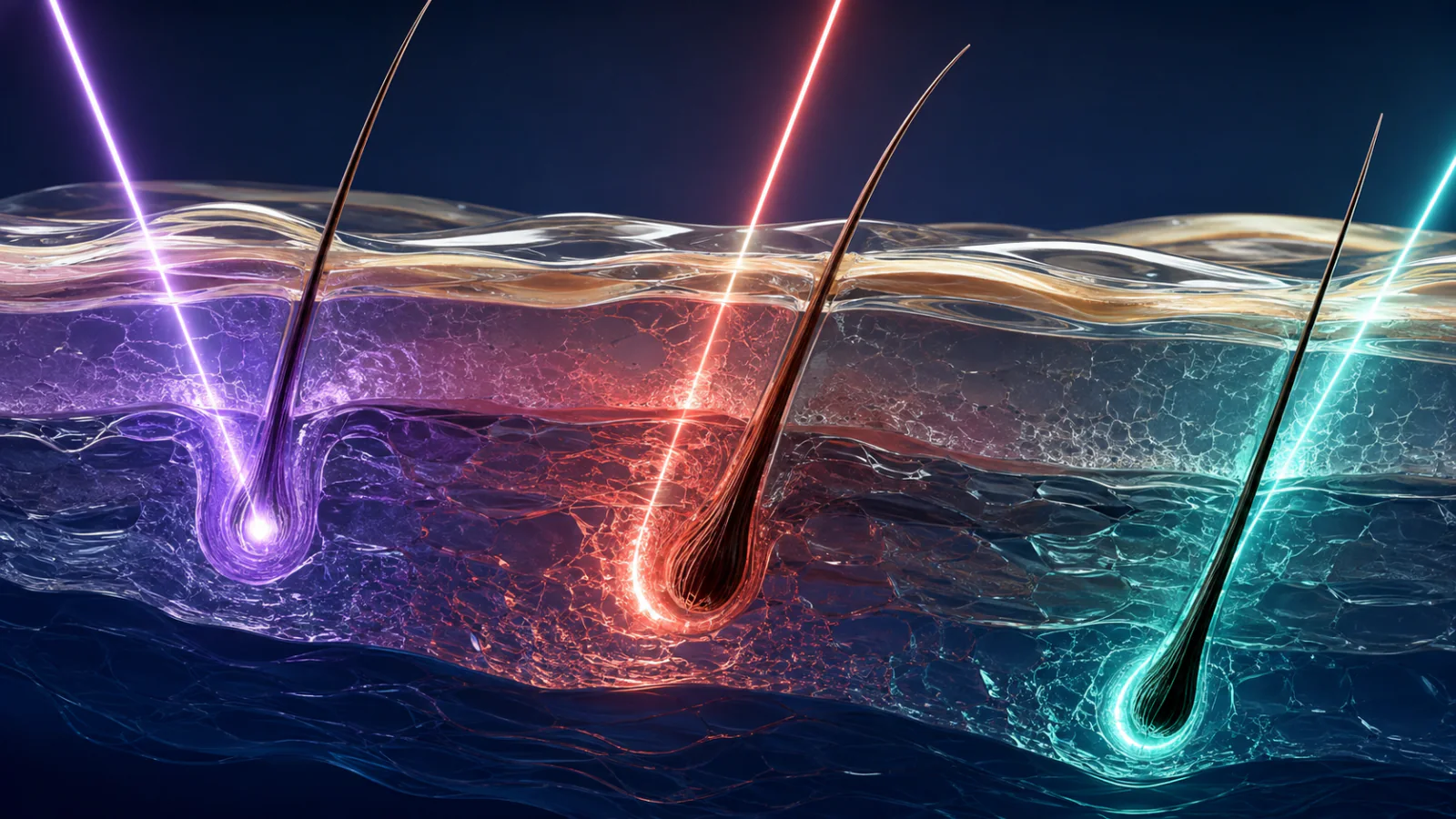
Alexandrite, diode, and long-pulsed Nd:YAG are laser families, not a fixed best-to-worst ranking. Their wavelengths affect melanin absorption and penetration, but performance and risk also depend on the exact platform, pulse duration, fluence, spot size, cooling, skin response, hair color and caliber, anatomy, operator, and schedule. Compare the documented treatment strategy and device record, not wavelength alone.123
The same wavelength can be delivered by systems with different pulse ranges, beam profiles, cooling and operator controls. Some platforms combine wavelengths. A consultation should therefore move from person and target to device and settings—not from a marketing name to a promise.
Use wavelength as one line in the plan
| Laser family | Planning implication | What the name alone cannot answer |
|---|---|---|
| Alexandrite, commonly 755 nm | High melanin absorption can make it efficient for suitable pigmented hair with careful epidermal protection | Suitability for every skin tone, device quality, pain, settings, or outcome |
| Diode, commonly around 800–810 nm | A broad product family with intermediate wavelength behavior and varied pulse/cooling designs | That all diode systems or handpieces perform alike |
| Long-pulsed Nd:YAG, commonly 1064 nm | Lower epidermal melanin absorption and deeper penetration can support planning in darker skin types | That it is risk-free, painless, or optimal for every hair and area |
| Multi-wavelength platform | May combine outputs in one system or handpiece | That every wavelength is delivered independently, at full capability, or cleared for every claim |
Melanin in the hair target competes with melanin in the epidermis for light. Wavelength, pulse timing, fluence, spot size, cooling and recent skin color all shape that balance.3 “Safe for all skin types” should become a specific plan for the person’s stable skin tone, recent sun or tanning exposure, pigment history, test spot, settings progression and response monitoring.
Hair biology sets another boundary
Laser reduction depends on enough target pigment and a follicle in a responsive growth phase. Dark coarse hair generally presents a different optical target from fine, light, gray, red or minimally pigmented hair. Face, neck, bikini, legs and back also differ in density, depth, hormonal sensitivity and cycle timing.
Map each zone separately:
- baseline hair color, caliber and density;
- skin type and current tanning or pigment change;
- prior waxing, plucking, electrolysis or laser history;
- medicines and topicals relevant to photosensitivity or healing;
- scars, tattoos, permanent makeup and pigmented lesions;
- expected interval and endpoint; and
- how incomplete response or unexpected stimulation is handled.
The electrolysis comparison explains why hair color and per-follicle treatment can change the modality choice.
Compare evidence without erasing protocols
Systematic and direct comparative studies report meaningful hair reduction across laser families, but studies vary in devices, fluence, pulse duration, cooling, skin types, body areas, session counts, follow-up, and outcome definitions.125 A group average from one machine cannot rank all future platforms or predict one person’s result.
Ask whether a quoted percentage means temporary count reduction after a session, reduction after a series, investigator-assessed change, participant satisfaction, or maintenance at a stated follow-up. “Permanent hair removal” and “permanent hair reduction” are not casual synonyms. Preserve the exact claim and its source.
Verify the device—not just the wavelength
A 510(k) record can identify manufacturer, model, product code, wavelengths, handpieces, specifications, intended use, predicate and decision date.4 Open the record for the device in the room. A generic classification, CE mark, FDA establishment listing, or another manufacturer’s clearance does not establish this model’s U.S. status.
Request:
- manufacturer and exact platform;
- handpiece and wavelength configuration;
- 510(k) or other U.S. regulatory record;
- instructions and intended-use language;
- spot sizes, pulse range, fluence range and cooling method;
- calibration, maintenance and eyewear;
- operator’s Florida license and facility record; and
- the settings log for each visit.
The Florida laser-hair-removal rules guide adds state-specific professional and facility checks.
Normalize a package before buying it
The package should define body-area boundaries, session count, interval rules, who may change settings, shaving and sun-exposure instructions, test-spot process, missed-visit policy, maintenance, photographs, adverse-response care, and what happens if the hair is not a suitable target. The laser package-cost guide helps compare these units without inventing a universal price.
- Map skin and hair. Record stable skin tone, recent exposure, pigment history, hair color, caliber, density, cycle, area, and prior treatment.
- Identify the exact system. Capture manufacturer, platform, handpiece, wavelengths, U.S. decision number, intended use, maintenance, and eyewear.
- Ask for the settings logic. Understand how pulse, fluence, spot, cooling, overlap, test spot, endpoint and prior response work together.
- Define the outcome. Choose consistent hair counts or photographs, session and follow-up dates, and a separate maintenance definition.
- Plan for nonresponse or an adverse pattern. Name contact, documentation, setting review, medical evaluation when appropriate, and whether another modality fits better.
The decisive question is: “Why does this exact device-and-settings plan fit this hair, skin, area, and treatment history better than the alternatives?”
Sources
- Journal of Cosmetic and Laser Therapy. Efficacy of lasers and light sources in long-term hair reduction: a systematic review. Used for comparative evidence, outcome variability, and limits of declaring a universal wavelength winner. Accessed .
- Dermatologic Surgery. Laser hair removal: comparison of long-pulsed Nd:YAG, long-pulsed alexandrite, and long-pulsed diode lasers. Used as a direct comparative study while retaining its population, protocol, and follow-up limits. Accessed .
- American Journal of Clinical Dermatology. Laser and Light Treatments for Hair Reduction in Fitzpatrick Skin Types IV-VI: A Comprehensive Review of the Literature. Used for melanin competition, skin-type considerations, and the role of wavelength and cooling. Accessed .
- U.S. Food and Drug Administration. 510(k) summary K234057. Used as a current product-specific example of why wavelength, handpiece, indications, specifications, and decision number travel together. Accessed .
- Lasers in Medical Science. Strategic selection of multi-parametric laser settings and clinical endpoints in dermatology: an engineering-to-clinical review. Used for current engineering-to-clinical context on parameter selection and endpoints without treating a review as a personal protocol. Accessed .