At-home STI test vs mail-in collection vs clinic NAAT: follow the specimen and the follow-up
A fully at-home STI test produces the result at home; a mail-in service sends a self-collected specimen to a laboratory; clinic testing can collect from additional sites and connect results to examination and treatment. Compare the infections, sites, window, authorization, laboratory, and next step.
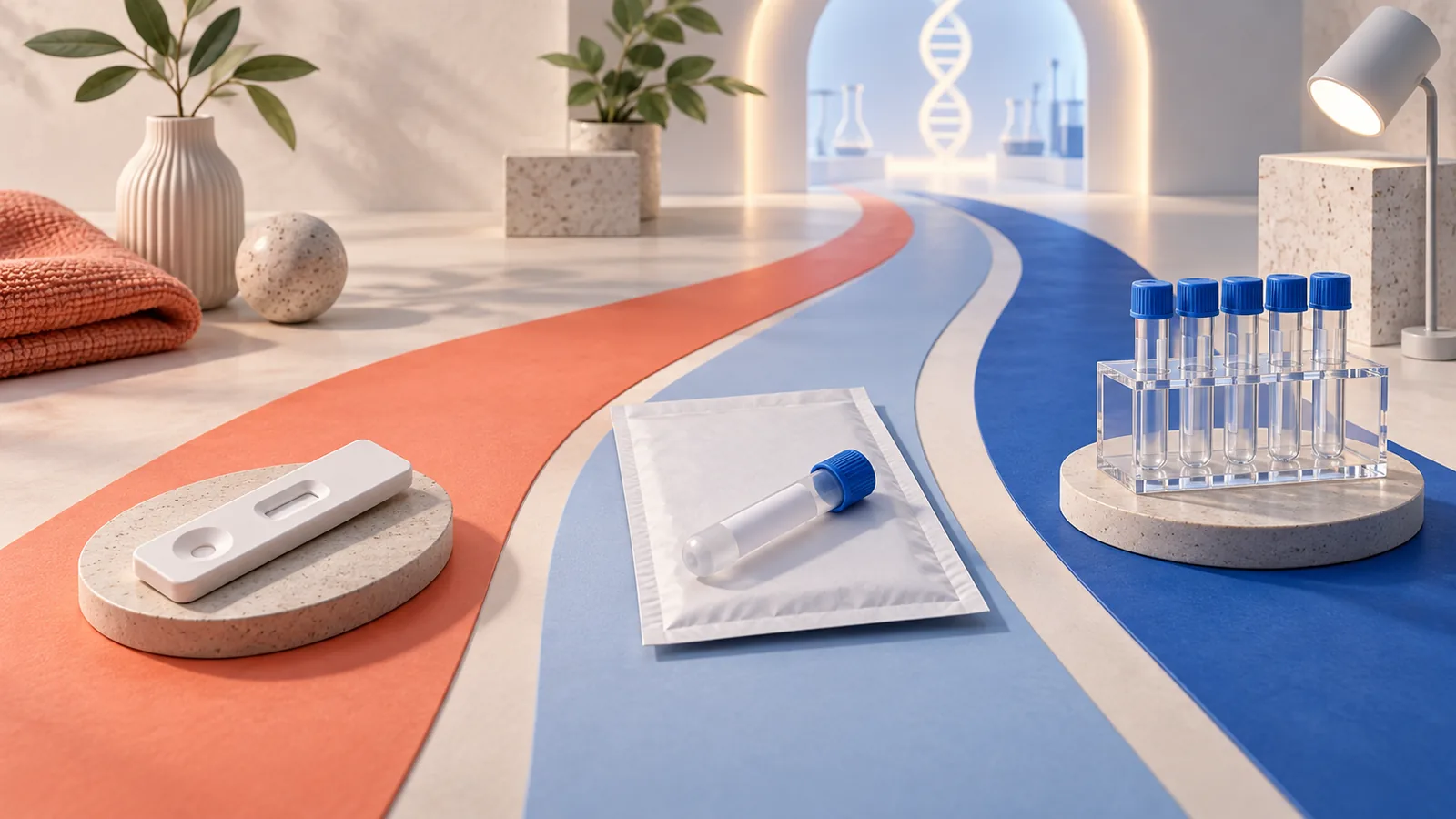
A fully at-home STI test, a self-collection kit mailed to a laboratory, and a clinic test are different pathways. FDA’s first authorized fully at-home OTC test in this category detects chlamydia, gonorrhea and trichomoniasis from a specified self-collected specimen and produces a home result; it does not test every infection, every anatomic site or every exposure window. A defensible choice names the exact analytes, specimen, site, timing, authorization, result method and clinical handoff.12
“Tests for STIs” is too broad to compare. One package may test three infections from one genital specimen; another may send urine or swabs to a CLIA laboratory; a clinic may collect throat, rectal, genital, urine or blood specimens after assessing the history and symptoms.
Start with the route from body to answer
| Pathway | Where analysis happens | Verification priority |
|---|---|---|
| Fully at-home test | The consumer collects, runs and reads the test at home | Exact authorized model, analytes, specimen, age, instructions, controls and result window |
| Home collection plus laboratory | The consumer collects; a laboratory receives and analyzes | Collection device, acceptable specimen/sites, shipping stability, laboratory and method |
| Clinic collection | A clinician or trained collector obtains specimens for point-of-care or laboratory testing | Sites sampled, examination need, method, laboratory, result return and treatment/partner workflow |
The access route does not determine quality by itself. A well-validated home test can answer its narrow claim. A poorly collected or delayed mail-in specimen can fail. A clinic visit can still use the wrong site or omit an infection if the underlying question is not documented.
Analyte and anatomic site are separate fields
A product that detects chlamydia, gonorrhea and trichomoniasis does not test for HIV, syphilis, hepatitis, herpes or every other cause of symptoms. A genital or urine specimen also does not automatically answer a throat or rectal exposure question.
Create a matrix before buying:
- infection or analyte named on the order or label;
- specimen type and who collects it;
- anatomic site represented;
- timing from a possible exposure and whether repeat testing is contemplated;
- symptoms, pregnancy or another context that changes the care pathway; and
- what happens after a positive, negative, invalid or indeterminate result.
CDC screening recommendations are population- and infection-specific.3 They are not a claim that the same panel, specimen or interval fits every person. A seller should not convert a broad CDC recommendation into proof that its exact product answers the complete question.
Authorization belongs to the exact product
FDA authorization applies to a named device, intended user, specimen, analytes, procedure and performance record. “FDA registered lab,” “CLIA certified,” “uses NAAT technology” and “doctor reviewed” each describe a different layer. None substitutes for identifying the finished test or the laboratory method.
The 2026 FDA warning letter to a home-testing seller is useful because the agency said the cited HIV dried-blood-spot self-collection kit lacked marketing authorization; physician involvement did not supply that missing device authorization.4 A warning letter is an agency allegation and compliance action, not a final court judgment about every product sold online. Use it as a reason to verify the current exact offer, not as a reason to distrust all home collection.
For a mail-in kit, record the laboratory’s legal name and CLIA number, specimen acceptability rules, transport temperature and time, rejection criteria, analytical method and confirmation policy. A CLIA certificate addresses laboratory quality obligations; it does not make every consumer-facing claim FDA authorized or clinically useful.
Result speed is only one part of usefulness
A fast home result can reduce friction, but speed loses value if the tested infection or site does not match the exposure. A laboratory method can be highly sensitive yet still produce a misleading answer when collected too early, from the wrong site or after a handling failure.
Ask how an invalid result is recognized and whether a replacement or recollection is included. Preserve the box, lot, expiration, control result, collection time, photograph when allowed, laboratory report and any follow-up communication. If the product is recalled or a result is questioned, those records identify what actually happened.
Build the positive and negative pathways before testing
A negative result answers only the product’s tested fields at that time. It should not be marketed as a universal clearance, proof that symptoms are unrelated to infection, or permission to ignore a later exposure. A positive result likewise needs a product- and infection-specific confirmation and care pathway; some authorized tests may direct professional follow-up rather than serving as the final word.
A seven-field comparison
- 1. Name the infection question List exact analytes rather than buying an undefined full panel.
- 2. Match every anatomic site Identify which body site each specimen represents and which relevant sites remain untested.
- 3. Identify the finished test Record manufacturer, model, authorization, lot, expiration, instructions and result-reading method.
- 4. Verify the laboratory lane For mail-in or clinic analysis, confirm the lab, CLIA record, method, transport and rejection rules.
- 5. Put timing on the record Capture exposure date, collection date and the source for any repeat-testing window without inventing a universal interval.
- 6. Plan every result Write the positive, negative, invalid and discordant-result handoffs before collecting.
- 7. Preserve continuity Keep the report and make sure treatment, partner care and later clinicians can see the actual test and specimen.
Convenience is a meaningful benefit when the product matches the question. The best route is the one that makes the specimen, scope, limitations and next action visible from collection through care.
Sources
- U.S. Food and Drug Administration. FDA grants marketing authorization to first home test for chlamydia, gonorrhea and trichomoniasis. Exact OTC authorization, analytes, intended users, specimen, performance context and follow-up limits. Accessed .
- U.S. Food and Drug Administration. Home use tests. Federal distinctions among home testing, home collection, instructions, limitations and product-specific authorization. Accessed .
- Centers for Disease Control and Prevention. STI screening recommendations. Current screening populations, infections and frequency context; used without creating individualized screening advice. Accessed .
- U.S. Food and Drug Administration. 4U Health warning letter. 2026 enforcement example showing that a home-collection offer and its claims need product-specific authorization. Accessed .