Beard and mustache transplant: donor match, design, direction, and graft records
A beard or mustache transplant moves follicles; it does not create a separate facial-hair type. The plan should protect the donor supply and match caliber, curl, color, growth behavior, border softness, direction, density priorities, grooming, scarring, and future hair-loss needs.
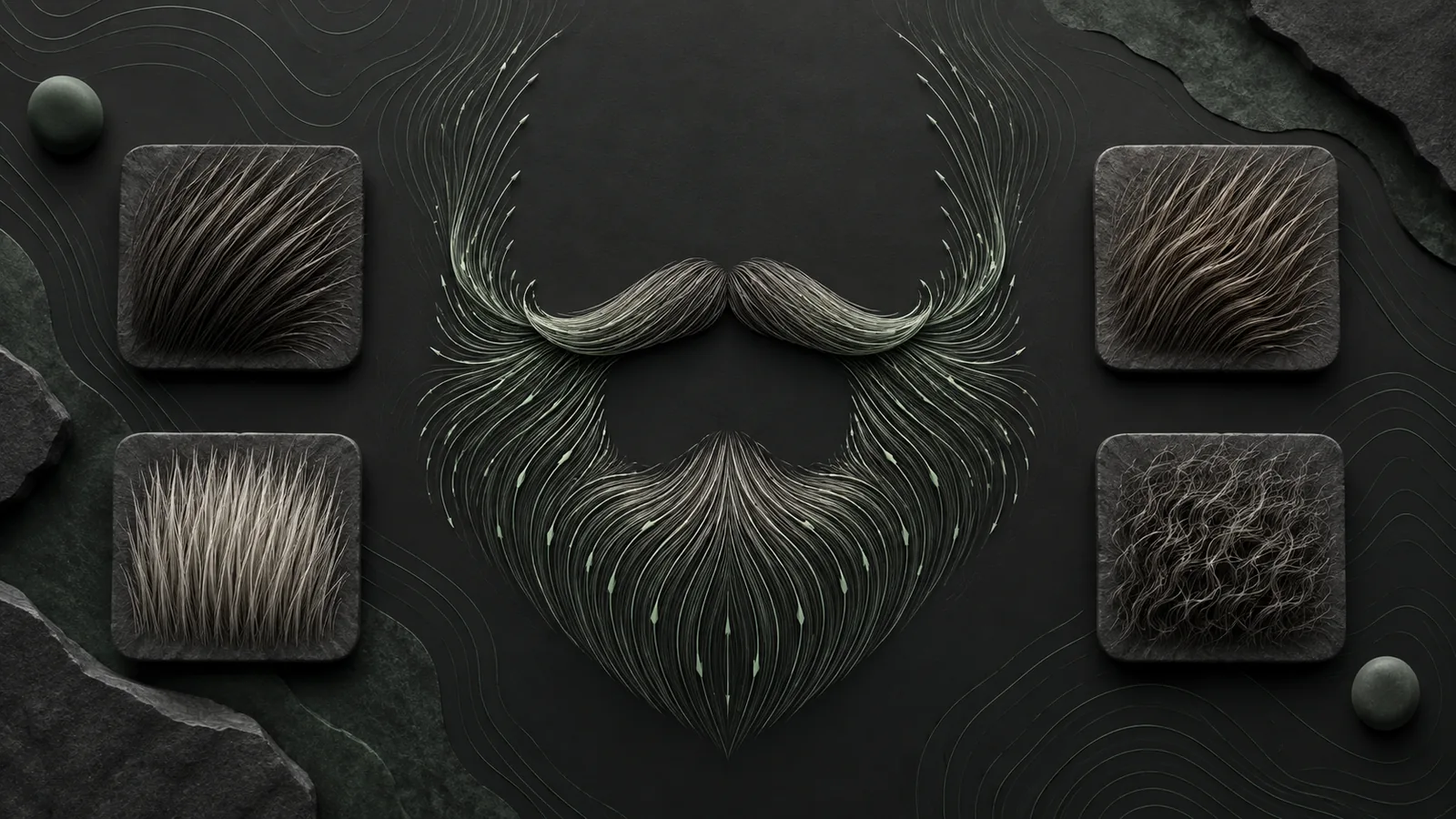
A beard or mustache transplant relocates existing follicles, usually from the scalp or another assessed donor area; it does not manufacture facial-hair follicles or guarantee that scalp hair will behave like native beard hair. A defensible plan starts with the cause and stability of the gap, then maps donor caliber, curl, color and growth cycle against facial zones, direction, border softness, density priorities, grooming, scars, and the donor hair that must remain available for future needs.123
The 2025 ISHRS survey confirms that facial recipient sites are part of contemporary practice, but its percentages describe responding physicians’ case mix—not the prevalence of beard loss or proof that the procedure fits a particular person.1
First decide whether the gap is a design problem
Longstanding sparse density, congenital absence, a stable scar, prior surgery, traction, patchy autoimmune loss, infection, inflammation, and sudden unexplained shedding do not enter the same pathway. A cosmetic graft map should not replace evaluation of active or scarring disease.
Record onset, change over time, symptoms, skin findings, medicines, prior treatment, shaving pattern, personal and family hair-loss history, and whether the target is a complete beard, mustache, goatee, sideburn, scar, or small asymmetric area. The diagnosis gate protects both the recipient skin and the donor supply.
Donor match comes before a graft number
| Donor variable | Why it matters on the face | Record to request |
|---|---|---|
| Caliber and grouping | Coarse multi-hair grafts can create an abrupt border; finer single-hair units may better soften exposed edges | Distribution of single- and multi-hair units by facial zone |
| Curl and cross-section | A mismatch changes shadow, ingrowth pattern, styling, and apparent density | Close comparison of donor and native facial hair at useful length |
| Color and contrast | High skin-hair contrast can reveal spacing or angle errors | Standardized photographs in direct and oblique light |
| Growth cycle and length | Scalp-origin hair may require different trimming and can keep scalp-like behavior | Written grooming expectations and donor-origin map |
| Donor reserve | Harvest for the face can reduce options for future scalp loss or repair | Density, miniaturization, scars, prior harvest, and long-range reserve |
Technique literature often describes the mid-occipital scalp as a useful donor source, but that is not a universal match.2 Beard hair can itself be a donor in some hair-restoration plans, yet it is not automatically the correct source for every facial zone. Compare the actual hair, not the anatomical label alone.
FUE is not scarless. Small extraction scars, patchy contrast, temporary shedding, altered sensation, folliculitis, and visible donor thinning belong in the discussion. Hair length, skin tone, hair color, curl, and punch distribution affect how a donor area reads after healing.
Facial design is a field of directions, not an outline
A drawn perimeter cannot show emergence angle, direction, whorl, transition, or how the design changes with movement. Beard and mustache zones differ: the cheek border, sideburn transition, jaw, chin, submental area, philtral columns, and upper-lip edge need zone-specific planning. Technique reviews emphasize shallow placement and careful directional control, but published angles and densities are not universal prescriptions.23
Ask for a close-up map that shows which units are single hairs, how direction changes across zones, where density is intentionally lower, and how transplanted hair blends with any native pattern. View the design clean-shaven, at intended grooming length, from the front, profile, and below the jaw.
An intentionally soft border can be more valuable than the highest possible count. A quote built only around maximum grafts may ignore whether the donor can support them or the face needs them.
Clarify who performs every surgical step
Hair transplantation includes diagnosis, design, anesthesia, donor incisions or extraction, recipient-site creation, graft preparation and placement, and postoperative care. Get the licensed professional’s name and role for each step, not only the clinic brand. ISHRS’s position emphasizes physician responsibility for surgical judgment and scalp-surgery steps.4 The same verification discipline matters when the recipient site is the face.
Document the facility, emergency process, sterile workflow, follicle handling, graft counts by grouping and donor source, medications, aftercare, contact pathway, and the person who evaluates poor growth, infection, scarring, cysts, direction concerns, or donor depletion.
Compare quote, endpoint, and future burden together
The quote should separate evaluation, laboratory or diagnostic work when relevant, harvest, graft preparation, recipient work, medicines, supplies, travel, follow-up, touch-up policy, and treatment of complications. “Per graft” is meaningful only when graft definition, hair count, donor source, and team roles are clear.
A transferable planning sequence
- 1. Establish the indication Separate stable cosmetic density or scar camouflage from active, sudden, inflammatory, or scarring loss.
- 2. Map the native pattern Record existing density, border, direction, hair characteristics, skin findings, and grooming goals.
- 3. Audit donor fit and reserve Compare caliber, curl, color, grouping, length behavior, scars, miniaturization, and future scalp needs.
- 4. Review zone-by-zone design Inspect transitions, single-hair allocation, emergence direction, density priorities, symmetry, and views beyond the front.
- 5. Preserve the operative record Keep donor source, graft counts by grouping, team roles, photographs, medicines, follow-up, and any adverse-event record.
The strongest proposal is not the largest graft count. It is a stable indication, convincing donor match, direction-aware design, protected donor reserve, named surgical responsibility, and a record that still makes sense after the beard grows long enough to groom.
Sources
- International Society of Hair Restoration Surgery. 2025 ISHRS practice census results. Current respondent-practice context for facial recipient sites and donor sources. Accessed .
- Journal of Cutaneous and Aesthetic Surgery. Beard and mustache reconstruction. Anatomic design, donor selection, direction, angulation, graft grouping, and individualized planning. Accessed .
- Facial Plastic Surgery Clinics of North America. Beard transplantation. Technique review and limits relevant to facial-hair restoration. Accessed .
- International Society of Hair Restoration Surgery. Position statement on qualifications for scalp surgery. Professional position used to frame physician responsibility for hair-restoration surgery. Accessed .